- Tank-only retail prices for a 2,500L poly tank range from R1,800 (budget) to R10,449 (horizontal Eco Tanks), per verified retailer pricing.
- A realistic DIY total, including slab, pump and fittings, runs R10,000 to R15,000. A fully installed, compliant system regularly lands between R20,000 and R40,000.
- Hidden costs, including backflow prevention, a Plumbing Certificate of Compliance, and water quality testing, can add R3,000 to R6,000 that most supplier quotes omit.
- Payback on a rainwater harvesting system saving 10 kL per month is 3 to 7 years, according to servicelinksa.co.za, and some Cape Town owners report recovering costs within a single year.
- The tank is the cheapest part of the system. Labour, pipework, a pump, and compliance fittings routinely cost more than the vessel itself.
South Africans searching for a 2,500-litre water tank quickly discover a dizzying spread of prices. A quick online search returns anything from R1,800 to R14,000 for what looks like the same product. The reason for that gap is not dishonest marketing. It is that the listed price almost never reflects what you will actually spend by the time water flows from a tap inside your home. This guide traces every cost, from the first rand you hand over for the tank to the annual maintenance bill five years later, so you can budget accurately before committing.
What a 2,500L Tank Alone Will Cost You
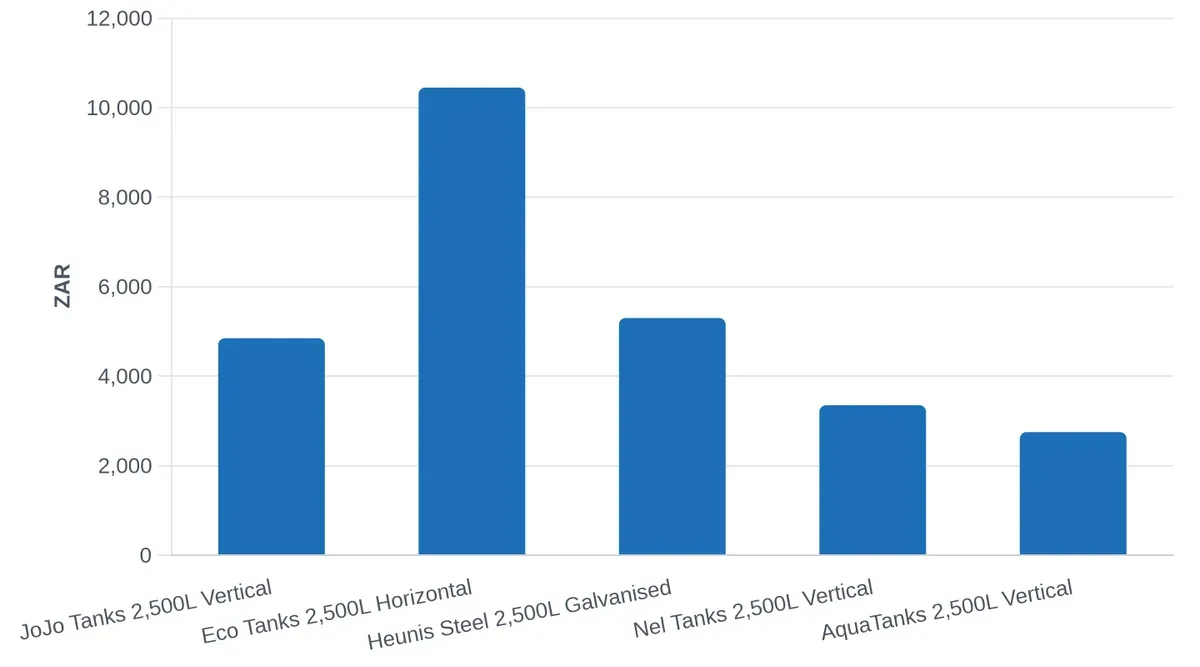
The table below captures current retail prices from verified South African sources. These are tank-only prices and do not include delivery, fittings, a base, or installation.
| Brand and Model | Material | Tank-Only Price | Source |
|---|---|---|---|
| Africa Tanks 2,500L Green | 3-layer HDPE blow-moulded | R1,800 | aceconstructionsgroup.co.za |
| AquaTanks Vertical 2,500L | Poly | R2,750 | aqua-tanks.co.za |
| Nel Tanks 2,500L Vertical | Poly with black lining | R3,350 | Nel Tanks |
| JoJo Tanks 2,500L/2,700L Vertical | Poly | R4,199 to R4,848 | plumblink.co.za |
| Heunis Steel 2,500L Round | Galvanised steel | R5,300 | heunis.co.za |
| Eco Tanks 2,500L Horizontal Cape Green | Poly horizontal | R10,449 | buco.co.za |
| Precast Concrete 2,500L (approx.) | Precast concrete | R40,000 (at R16/L) | enviroleg.co.za |
Prices verified from listed sources and current as of publication. Delivery, fittings, and installation are excluded from all figures above.
The R1,800 Africa Tanks price and the R10,449 Eco Tanks horizontal price are both real, but they are not comparable products. The Africa Tanks unit is a budget-tier vertical poly tank. The Eco Tanks horizontal is a slimline unit engineered for low-profile installation under decks or in tight spaces. The Heunis Steel galvanised tank at R5,300 suits agricultural and rural applications where UV exposure and physical knocks are a concern. Precast concrete at R16 per litre (per enviroleg.co.za) is only worth considering for permanent, buried, or heritage-farm installations given the logistics involved.
“Nel Tanks, best of the lot that I have dealt with. Has the black lining. Proper lid. Nice and sturdy. LOVE these tanks… GOOD to see the buying public doing their homework and shunning the poor quality items.”
4×4 Community Forum veteran on brand comparisons
The internal black lining mentioned above matters: it blocks light penetration and suppresses algae growth. Budget tanks without it create a real maintenance headache over time.
“Haven’t cleaned my JoJo tank for a while. Found black algae where I had the hose pipe…”
MyBroadband forum user on algae from light intrusion via fittings
The Costs That Appear After You Buy the Tank
Here is where most buyers get caught out. The tank is just a container. Everything needed to make it useful, safe, and legal adds significantly to the final bill.
Concrete Slab
JoJo Tanks specifies that a vertical tank must rest on a level concrete slab at least 85mm thick, built at least 100mm wider than the tank diameter, with the compacted ground and slab curing for at least 7 days before the tank is placed. Ignoring this is expensive. One installer described the consequence directly:
“If the slab, tower or base under the water tank is weak or uneven the water tank will suffer structural tension when filled and will tear or crack.”
Installer Green Overall, warning about base-induced tank failure
Expect to pay R2,000 to R3,500 for a properly mixed and poured slab at a suburban property. One homeowner who used premix reported paying R2,500 for their slab alone.
Pump and Pressure Equipment
A gravity-fed tank works if the tank is elevated well above the point of use. Most residential installations need a booster pump to deliver adequate pressure. Here is what real buyers have paid:
“I have a DAB pump as well with a pressure tank that cost me just over R3k about 6 months ago. 2,500L water tank was R2,600. Pressure switch was R350. It’s supplying my entire house without any pressure/flow issues.”
User Ancalagon, MyBroadband forum
“2KL JoJo from Builders, a few bags of cement to create a solid base, a booster pump and the associated plumbing… pump was about R4k, plumbing supplies about R2k. Labour was my time.”
Homeowner on a DIY hookup, January 2025
Budget R3,000 to R6,000 for a quality pump, pressure tank, and pressure switch for a whole-house setup. The RotoTank 2,500L combo, which bundles a 0.75kW pump, UV light, and water filters with the tank, retails at R13,960 (rototank.co.za), giving a useful sense of what that equipment stack costs when packaged together.
Plumbing Labour and Call-Out Fees
A PIRB-registered plumber charges R450 to R650 per hour excluding VAT, with call-out fees in the same R450 to R650 range during business hours (kandua.com and plumber-pretoria.co.za). A straightforward top-up connection to an existing municipal feed typically takes 4 to 8 hours of plumber time. A full switchover installation with multiple connection points runs longer. Budget R3,000 to R8,000 for labour alone on a residential plumbing job, before materials.
Backflow Prevention and Compliance Fittings
Any tank permanently connected to internal plumbing must include an approved backflow prevention device. A Double Check Valve or a Reduced Pressure Zone (RPZ) valve satisfies this requirement under South African law (plumber-pretoria.co.za). The installation must comply with SANS 10252 (water installations) and SANS 10400 (building regulations), per id.org.za. A Plumbing Certificate of Compliance issued by a PIRB-registered plumber is the formal sign-off required to prove compliance (amanzirms.co.za).
Some homeowners shrug off these requirements:
“You either have to install this special NRV [non-return valve] or have a break water tank. Meaning the house can only be fed by the tank and the pump [so it] can’t syphon back into the municipal line. That applies everywhere in South Africa but I doubt anyone does it. A NRV is unreliable but there are no water police enforcing it.”
Forum discussion on regulatory compliance and backflow prevention
That view carries real financial risk. Property inspectors have issued spot fines of R1,500 to R5,000 for water by-law violations in Cape Town (capetown.gov.za). More importantly, if a non-compliant installation contaminates municipal supply and causes damage, the liability falls on the property owner. An RPZ valve costs R800 to R1,500 in fittings. A COC costs R500 to R1,200 depending on the plumber. These are not optional extras if you intend to sell the property or if your insurer asks questions after a claim.
Water Quality Testing
If you intend to drink from a rainwater or borehole-fed tank, a SANS 241 potability analysis is essential. A complete chemical and microbiological analysis costs R1,450 to R1,900 (waterquotes.co.za), and individual chemical or microbiological tests run R1,750 each (sanswater.co.za). One borehole owner learned this the hard way:
“The downside is the water is hard on my elements (kettle, dishwasher, washing machine and geyser)… I bought the house with a borehole, connected to the 5,250L JoJo tank… albeit high in minerals.”
Homeowner on mineral-heavy borehole water and appliance wear
Untested hard borehole water quietly destroys appliances. One MyBroadband user described a whole-house filtration response: three 20-inch Big Blue filter housings, a 5-micron pre-filter, a carbon block, a 1-micron post-filter, and a siliphos stage for scale protection. That filtration stack adds R4,000 to R8,000 to the system cost depending on components chosen.
Total-Cost-of-Ownership: Three Realistic Scenarios
| Cost Component | DIY Budget Build | Mid-Range Installed | Full Compliance System |
|---|---|---|---|
| Tank (2,500L poly) | R2,600 | R4,848 | R4,848 |
| Concrete slab | R2,500 | R3,000 | R3,500 |
| Pump and pressure fittings | R3,350 | R5,000 | R6,500 |
| Plumbing labour | R0 (DIY) | R6,000 | R9,000 |
| Pipe, fittings, float valve | R2,300 | R2,500 | R3,000 |
| Backflow prevention device | R300 (NRV) | R800 | R1,500 (RPZ) |
| Plumbing COC | R0 (skipped) | R700 | R1,200 |
| SANS 241 water test | R0 (skipped) | R0 (municipal feed) | R1,750 |
| Basic filtration | R0 | R0 | R4,500 |
| Day-1 total | R11,050 | R22,848 | R35,798 |
| Annual maintenance (filter replacements, pump service) | R500 | R800 | R2,000 |
| 5-year total cost of ownership | R13,550 | R26,848 | R45,798 |
Labour costs assume suburban Gauteng or Western Cape rates. Costs vary by site conditions, municipality, and whether the tank feeds backup supply only or full household supply.
These figures align with real-world owner reports. One homeowner in Johannesburg described receiving quotes of R30,000 to R39,000 fully installed:
“I’m getting quotes of R30K to R39K fully installed, with a slab thrown. That seems a bit much to me, I was thinking under R30K. I don’t want to do it myself. There are a ton of companies out there doing installations in Jhb…”
Homeowner discussing quote shock for a fully installed backup water system, March 2024
Those quotes sit at the high end of the mid-range installed scenario in the table above, reflecting Johannesburg market rates and likely a more complex plumbing connection. Another owner described the lesson learned from buying a tank before getting a full system quote:
“I bought a R6,000 JoJo tank online thinking that was the hard part. Turns out connecting it to the house cost more than the tank itself… Labour and materials: R48,000. The total system cost R54,800, and it works brilliantly. But the homeowner wished they had asked for a full quote before buying the tank. The lesson: the tank is just a container.”
Andy Plumbers, Randburg installer account, 2026
The R54,800 figure reflects a high-complexity installation, likely with multiple feed points, an elevated header tank, or a full switchover setup. It illustrates the ceiling of what residential installations can reach.
Pre-Packaged and Installed Options
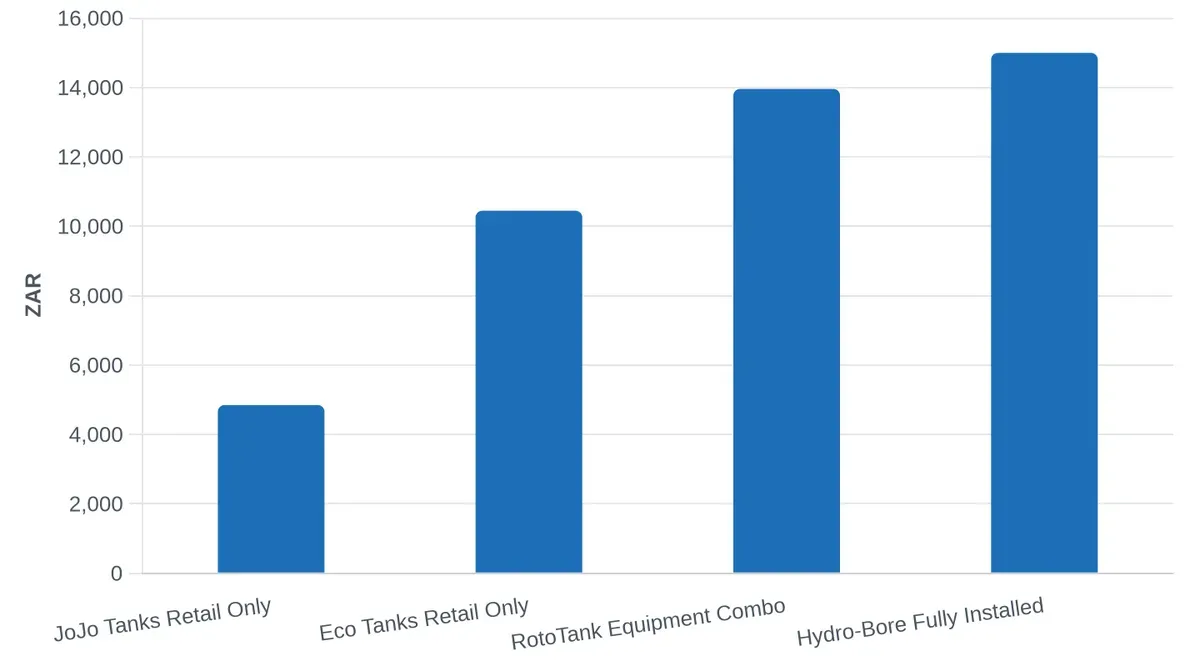
For buyers who want a single price with no surprises, two packaged options stand out from verified sources. Hydro-Bore offers a standard fully installed 2,400L to 2,500L package at R14,999 (hydrobore.co.za). That price appears to include the tank, installation, and the slab, though buyers should confirm exactly what is included in writing before signing. RotoTank’s 2,500L equipment-only combo, bundling a tank, 0.75kW pump, UV light, and water filters, retails at R13,960 (rototank.co.za), but this is equipment supply only and does not include installation labour, slab work, or compliance fittings.
Before choosing RotoTank, note the following forum experience shared by a buyer:
“Rototank: PATHETIC VERBY. Paid for a 5000 litre tank and some other goodies on Monday… after I phoned and emailed them numerous times I have not received the invoice nor the tank and other goods that I paid for.”
4×4 Community Forum, complaint about RotoTank delivery and communication
This is a single data point, not a verdict on the brand, but it underlines the value of purchasing from a supplier with a local physical presence and a track record of delivery.
Payback Period and Return on Investment
A household investing R20,000 in a rainwater harvesting system and saving 10 kL of municipal water per month can expect a payback period of 3 to 7 years, according to servicelinksa.co.za. That range is wide because payback depends almost entirely on your local water tariff. Cape Town’s stepped tariff structure makes savings accumulate faster than in lower-tariff municipalities:
“With Cape Town’s water tariffs I recovered my costs within a year.”
MyBroadband user on the ROI of a tank setup
One owner who installed a wellpoint and pump system at around R15,000 total reported his father’s water bill dropping by more than 50 percent. These outcomes are achievable but are not guaranteed. The actual saving depends on your current consumption, the municipal tariff tier you fall into, and whether your tank is fed by harvested rainwater, borehole water, or municipal top-up.
Practical Mistakes That Cost Money
Beyond the headline costs, several recurring owner errors quietly inflate the final bill.
Skipping the slab cure time. JoJo Tanks specifies a minimum 7-day cure before placing a filled tank. Filling a tank on a green slab can crack the base and stress the tank walls, causing leaks that are expensive to repair.
Placing the tank in full sun without adequate UV-rated material. Poly tanks are UV-stabilised but not UV-proof. One owner noted that tank expansion from direct sun heat affected level sensor readings. Another forum contributor advised: “Different suppliers of tanks have different UV protection ratings. As I understand it is still better to place the tank where it would not get too much direct sunlight, under a tree or near a wall, to limit direct sunlight.” A shaded position also slows algae growth.
Poor lid fitting. A poorly fitted lid invites wildlife intrusion. One forum user put it bluntly: “nothing beats dead lizard flavoured water first thing in the morning because of a poorly fitted lid.” Ensure the lid gasket seats correctly and is checked at each tank inspection.
Ignoring municipal pressure interactions. One owner described burning out a pump controller because municipal pressure occasionally dipped below the pump’s rated pressure threshold. A pressure-reducing valve and a low-pressure cutoff protect the pump and prevent reverse-flow problems.
Tap fittings and brittle plastic. A commonly overlooked maintenance cost: the tank outlet tap. One owner noted, “Had to repair the JoJo tank tap, my own fault, but it broke due to brittle plastic.” Budget R150 to R400 for a replacement brass or reinforced fitting if you use the outlet tap frequently.
How to Get an Accurate Quote
To compare installer quotes fairly, ask every supplier to quote against the same scope in writing. At minimum, the quote should specify: the tank brand, volume, and colour; whether a concrete slab is included; the pump make, model, and rated pressure; all fittings including backflow prevention; whether a Plumbing COC is included; and the delivery address and any regional surcharge. Without a line-item quote, you cannot compare R22,000 from one contractor against R30,000 from another. The cheaper quote may exclude the slab and COC. The more expensive one may include a superior pump and five-year warranty.
One DIY-capable owner summarised the self-install versus professional split honestly: “I think you are looking closer to R15k for installation and supply… I did mine myself and it cost me probably about R11k. Concrete slab R2,500, 2,500L Africa tank R2,000, DAB pump R2,000 (usually R4,500, got it on clearance), JoJo tank float R300.” If you are confident with basic plumbing and can lay a concrete slab, the DIY saving is real. If you are not, the risk of a non-compliant or leaking installation outweighs the saving.
Ready to find out whether your address qualifies for a rainwater or backup water system and get a sizing estimate before you commit to any purchase? Check my address and see what options are available at your property.
Get started
Get an accurate quote for your 2,500L tank install
Vetted local installers · honest advice first
Photo: Doğan Alpaslan Demir / Pexels