A borehole — only if the odds are good.
Your own water for life. But drilling is the one fix that can take R70,000 and give you nothing. So before you spend a cent, we show you whether you'll actually hit water — from the real boreholes already drilled around your home.
Never pay for a dry hole.
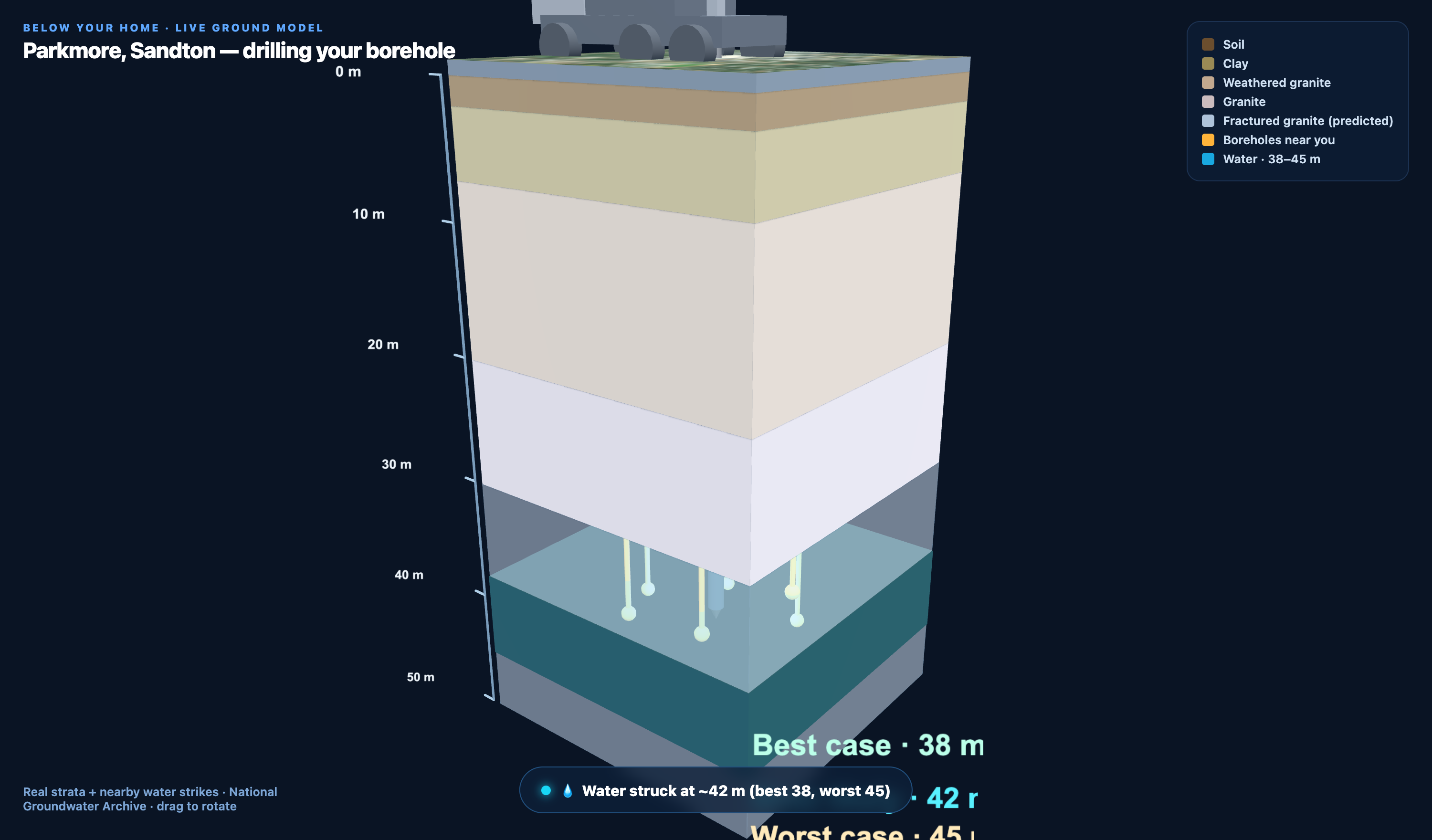
South Africa's #1 borehole rip-off is paying R50–70k for a hole that hits no water — with no refund. The fury in every complaint is the same: “they should have surveyed first.” So we do. We show you the real boreholes around your home — how deep they went, what they yielded, and whether they struck water — so you know your odds before you risk the money.
See my water oddsWe don't guess and we don't dowse. We read the National Groundwater Archive — the real boreholes already drilled near you — and show you the honest odds.
Plotted on your map — how many struck water, and how many came back dry.
The actual strike depths nearby, so you know what you're paying to reach — best case to worst case.
The yield from neighbouring holes — enough for the house, or just the garden.
What a borehole really costs
No surprises, no “it depends.” Honest Gauteng ranges for a typical ~90 m hole — you'll see your own figure when you enter your address.
Most homes never need to spend this. If a tank or wellpoint solves your problem for a fraction, we'll tell you — and tell you to take it.
Do it in the right order
The most expensive mistake is buying a pump before you know there's water. Here's the sequence that protects your money.
Check the odds
The real boreholes near you say whether — and how deep — you'll hit water. Free, first.
Drill & test
Drill, then test the actual water and yield. Only now do you know what you've got.
Size the pump
Match the pump to the real yield — not the one the driller wants to upsell you.
Filter if needed
Test against SANS 241. Add the right filter only if the water needs it — no gold-plating.
Is it even allowed here?
Domestic boreholes usually need a simple municipal notification — not a full water licence. But drilling is banned on dolomite (e.g. Valhalla, Erasmia, Laudium). We check your erf and the geology first, and registering even helps your resale value.
No fly-by-nights
There is no public registry of trusted drillers — which is exactly how the deposit-and-vanish scams thrive. So we vet them for you:
- Real premises, traceable, real track record
- Itemised quotes — no inflated yields
- Reviewed in public on Hellopeter & Google
Homeowners who checked first
Real South Africans — from the 2,389 voices we studied.
“4 of the boreholes near me came back dry. I'd have lost R60k. Went with a tank instead.”— Thabo M · Centurion
“Knew exactly how deep the water was before I drilled. The driller was shocked I had the data.”— Pieter V · Pretoria East
“Vetted installer, fair price, water in two days. No deposit-and-vanish like last time.”— Naledi K · Midrand
See your borehole odds — free.
Before you spend a cent. On your side, never the driller's.
Check my address →Boreholes — common questions
- How much does a borehole cost in South Africa?
- A typical ~90 m borehole runs about R50,000–75,000 all-in: drilling (~R500–1,500/m), the pump and installation (R3,000–30,000), and a water test plus connection (R2,000–5,000). Running costs are roughly R1,000–2,500 a year.
- Will I actually hit water if I drill?
- It's never guaranteed — paying R50–70k for a dry hole is South Africa's #1 borehole rip-off. We read the National Groundwater Archive to show the real boreholes near you, how deep they struck water and what they yielded, so you know your odds before you spend a cent.
- Do I need a licence or permit to drill a borehole?
- Domestic boreholes usually need only a simple municipal notification, not a full water licence. Drilling is banned on dolomite (e.g. Valhalla, Erasmia, Laudium), so we check your erf and the geology first.
- How deep is the water and how long does drilling take?
- Depth depends on your area's water table — we show the actual strike depths from neighbouring holes. Most domestic boreholes are around 90 m and are drilled in a day or two.
- Is a borehole worth it, or is a tank or wellpoint cheaper?
- Most homes never need a borehole. If a tank (from R7,000) or a wellpoint (R5,000–7,000) solves your problem, we'll tell you to take it instead — we never sell more than you need.