Key points
- A JoJo 5,250L tank costs R6,499 but a fully connected home backup system regularly runs R14,000 to R55,000 once plumbing, a pump, a stand and switchover valve are included.
- JoJo announced a 31% price increase in April 2026 due to disrupted global petrochemical supply chains, making competitor pricing comparisons more important than ever.
- All four major residential water tank brands in South Africa, JoJo, RotoTank, Eco Tanks, and Nel Tanks, carry 10-year warranties or guarantees, so warranty length alone should not drive your decision.
- Vectus does not manufacture residential water storage tanks in South Africa; its local footprint is strictly industrial and utility-grade GRP pipes.
South Africa’s water security situation has not improved in 2026. The Department of Water and Sanitation reports that 107 water services authorities are in poor or critical condition, and municipal outages, droughts, and infrastructure failures continue to push homeowners toward private backup storage. The tank market has responded with more brands, more configurations, and more confusing claims than ever.
This guide does one thing: tells you what each brand actually costs, what the specs actually mean, what real owners actually experience, and what your total system will realistically set you back. No filler, no inflated promises.
The brands you will actually encounter in South Africa
Before comparing specs, it is worth clearing up one persistent search query. Many buyers search “Vectus tanks South Africa” after seeing the brand mentioned in regional content. Vectus’s South African footprint is strictly industrial and utility-grade GRP pipes, not residential water storage tanks. If you are a homeowner or small business owner looking for a backup tank, Vectus is not a product line you will find at a hardware store or agricultural supplier. The comparison that actually matters for residential buyers is JoJo, RotoTank, Eco Tanks (Africa Tanks), and Nel Tanks.
Brand-by-brand overview
JoJo Tanks
JoJo is the dominant brand by name recognition in South Africa. Its potable water tanks are manufactured from 100% virgin food-grade Linear Low-Density Polyethylene (LLDPE), according to jojo.co.za. The tanks are UV-stabilised and carry a 10-year material and workmanship warranty. JoJo offers the widest range of sizes and configurations available domestically, including vertical, horizontal, slimline, underground, and chemical tanks.
The April 2026 price increase of 31%, triggered by force majeure and disrupted global petrochemical supply chains, has made JoJo noticeably more expensive relative to competitors at almost every size point. This matters more at the 5,000L to 10,000L range than at smaller sizes, where the rand-per-litre gap widens.
JoJo also sells its own IoT Tank Level Monitor, retailing at R5,199 at Builders Warehouse, which connects via the Sigfox network and requires an annual subscription after the first 12 months. A budget-friendly alternative is the Tuya WiFi Ultrasonic Liquid Tank Detector (TLC2502), available at R895 to R1,499 from GeeWiz and Takealot.
“I got 2 jojo slimline tanks last year… Was somewhat happy until my Brother in law got 2 Eco tanks 2 months later. His tanks came with far more accessories already with the tank that I had to buy separately… I even had to go buy a 40mm plug for the one hole where the eco tanks appeared to come with everything you need.”
This is a recurring theme in owner feedback. JoJo’s tank body quality is not disputed, but the accessories experience is inconsistent. Budget for fittings separately if you go the JoJo route.
RotoTank (Roto)
RotoTank manufactures its tanks through rotational moulding in a single, seamless heavy-duty piece. This production method eliminates weld seams, which are the most common failure points in lower-quality tanks. RotoTank is particularly well-regarded among installers and informed buyers for the security of its lid design.
“Roto tanks close more securely if for drinking water. some lids just lie on top, some screw down, some are vermin safe like the Roto… you contact them Rototanks, they send you a pro forma invoice, you pay them, they deliver, easypeasy… nothing beats dead lizard flavoured water first thing in the morning because of a poorly fitted lid.”
RotoTank sells directly to consumers and through selected distributors. Direct purchasing is straightforward: request a pro forma invoice, pay, and they deliver. For buyers storing potable water, the vermin-proof lid is a genuinely practical advantage, not a marketing point.
Eco Tanks (Africa Tanks)
Africa Tanks manufactures Eco Tanks using HDPE (High-Density Polyethylene) with a 3-layer Extrusion Blow Moulding process. The 3-layer construction typically includes an inner food-grade layer, a UV-blocking middle layer, and an outer structural layer. Eco Tanks carries a 10-Year Full Replacement Guarantee.
At the 5,000L size point, Africa Tanks is priced at R5,199 at Favrit Home Centre, which is meaningfully cheaper than the JoJo equivalent, particularly post the April 2026 JoJo price increase. The accessories-included approach noted above adds further practical value. Builders Warehouse reports that domestic backup water storage is becoming a standard property investment, and the value difference between brands at similar capacities is increasingly scrutinised by buyers.
“I install these tanks n can assure you there is no noticeable difference between the two brands. Pple have differences in OPINION and not the quality.”
Professional installers who work across both brands consistently report that the performance difference in day-to-day use is negligible. The choice often comes down to price, accessories, and what your local supplier stocks.
Nel Tanks
Nel Tanks positions itself at the premium end of the residential and light commercial market. Its 10,000L vertical tank is priced at R18,550, compared to R17,118.60 for the JoJo 10,000L via NWK. Nel Tanks carries a 10-year guarantee that explicitly mandates professional installation as a condition. This is worth noting: if you self-install a Nel Tank and something goes wrong, your guarantee claim may be rejected.
A note on the February 2026 collapse incident
In February 2026, a municipal JoJo tank collapsed in Ritchie, critically injuring a local resident. This incident involved a large municipal installation, not a standard residential setup. It does, however, reinforce two important points that apply across all brands: large tanks require properly engineered stands and bases, and municipal procurement and maintenance standards are not the same as private installation standards. The incident is not a reason to avoid JoJo tanks for home use, but it is a reason to take structural installation seriously regardless of brand.
Pricing comparison: tank body only
| Brand | Size | Tank price | Material | Warranty | Source |
|---|---|---|---|---|---|
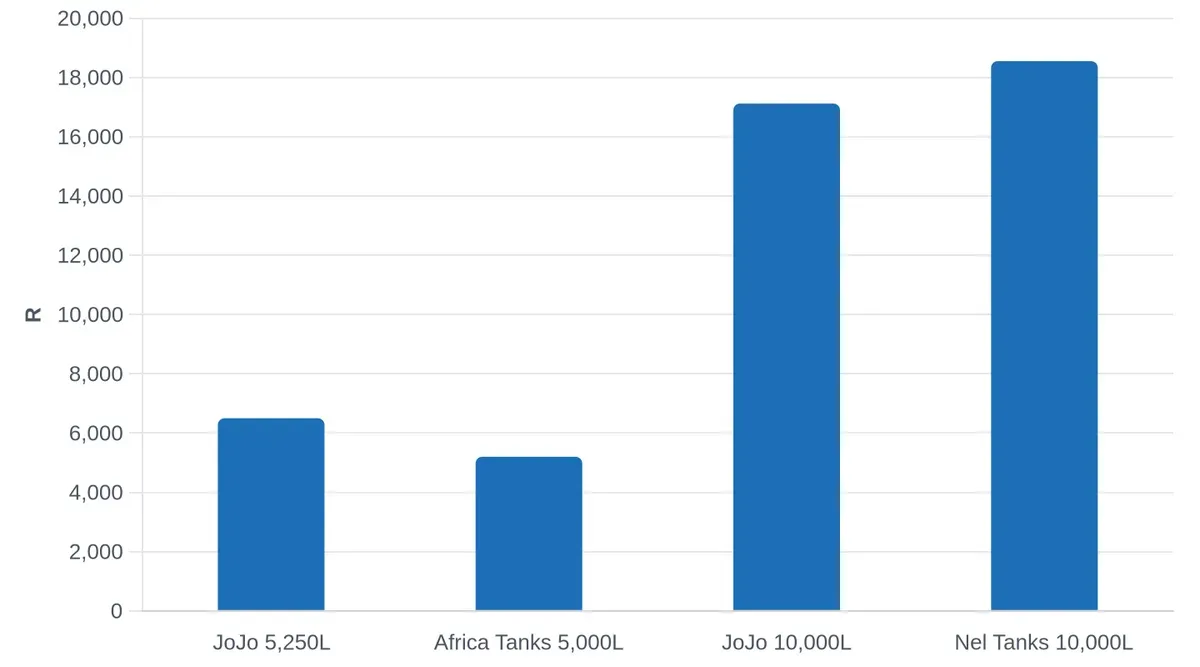
| JoJo | 5,250L vertical | R6,499 | Virgin LLDPE | 10 years | waterpointsa.co.za |
| Africa Tanks (Eco) | 5,000L | R5,199 | HDPE 3-layer | 10 years (full replacement) | Favrit Home Centre |
| JoJo | 10,000L vertical | R17,118.60 | Virgin LLDPE | 10 years | NWK |
| Nel Tanks | 10,000L vertical | R18,550 | LLDPE | 10 years (pro install required) | waterpointsa.co.za |
At the 5,000L size, prices cluster between R5,199 and R6,499 across the main brands at standard hardware and agricultural retailers. JoJo’s post-increase pricing sits at the top of this range. The gap is meaningful at scale: two tanks means a meaningful extra spend for JoJo branding alone.
Cape suppliers report countrywide demand for alternative storage has surged, meaning stock availability and delivery lead times are increasingly relevant alongside headline price when choosing a brand.
The real cost of a backup water system: tank plus everything else
This is where most buyers get surprised. The tank is the most visible cost, but rarely the largest one once you factor in a proper installation.
“I bought a R6,000 JoJo tank online thinking that was the hard part. Turns out connecting it to the house cost more than the tank itself. A Fairland homeowner bought a 5,000-litre JoJo tank from a hardware store. Delivery was R800. Total spend: R6,800. Then they called us to connect it. The connection needed a stand… 30 metres of pipe… a booster pump, a pressure vessel, an automatic switchover valve… Labour and materials: R48,000. The total system cost R54,800, and it works brilliantly. The lesson: the tank is just a container. The plumbing makes it a water backup system.”
That R54,800 figure reflects a comprehensive, long-run installation with a full booster pump and pressure vessel setup. Not every installation needs that scope, but the point stands: plumbing integration is where costs accumulate. PIRB-registered plumber labour for expert integration runs R4,500 to R5,500. Add materials, a pump, a stand, and filtration, and your total system cost is almost always two to four times the tank price alone.
A more common mid-range installation was described by a Reddit user:
“Just finished 2x 2050l tanks, with 1kW pump. Labour, the pump, tanks, concrete pour, and other odds and ends cost me just over R14,000… not taking any chances.”
Two tanks totalling 4,100L plus a pump and concrete base for R14,000 all-in is a reasonable benchmark for a straightforward installation without long pipe runs or complex switchover plumbing.
Ready to find out what a backup water system will cost at your specific address? Check my address for location-specific pricing and installer availability near you.
Full system cost-of-ownership comparison
| Cost component | Low-end estimate | Mid-range estimate | High-end estimate | Source |
|---|---|---|---|---|
| 5,000L tank (Africa Tanks) | R5,199 | R5,199 | R5,199 | Favrit Home Centre |
| 5,250L tank (JoJo) | R6,499 | R6,499 | R6,499 | waterpointsa.co.za |
| PIRB plumber labour (integration) | R4,500 | R5,000 | R5,500 | kandua.com |
| Stand, pipe, fittings, valve (materials) | R2,500 | R5,000 | R15,000+ | Installer estimates |
| Whole-house sediment and carbon filter (installed) | R7,745 | R7,745 | R7,745 | skoonwater.co.za |
| Booster pump (standard) | Included in labour | R3,000 to R6,000 | R8,000 to R15,000 (VSD) | Owner reports |
| IoT tank level monitor (optional) | R895 (Tuya, GeeWiz) | R1,499 (Tuya, Takealot) | R5,199 (JoJo IoT, Builders Warehouse) | GeeWiz, Takealot, Builders Warehouse |
| Realistic total (Africa Tanks, basic integration) | R14,000 | R22,000 | R38,000+ | Combined sources |
| Realistic total (JoJo, full VSD pump integration) | R30,000 | R35,000 | R55,000+ | Owner reports, Andy Plumbers |
One owner summarised the pump decision clearly:
“I figured that I may as well go for a VSD [Variable Speed Drive] pump for convenience. With the solar… I want reliable auto system with minimal manual switching and noise. The 2 obvious choices are the Jojo 0.75kw VSD or the DAB EsyBox Mini… I’m getting quotes of R30K-R39K fully installed, with a slab thrown”
The R30,000 to R39,000 range for a VSD-pump integrated system with a solar tie-in aligns with what multiple installer quotes reflect in 2026. If you want a fully automatic, noise-managed, solar-compatible backup system, that is the realistic budget range.
Pump selection: the decision that outlasts the tank
Owners consistently report that pump quality and selection matters more to long-term satisfaction than brand differences between tank bodies. Two specific failure patterns come up repeatedly.
First, JoJo-branded pumps supplied as part of bundled installations have drawn criticism:
“A JoJo branded pump was supplied as part of the installation. This is almost certainly badge engineered… it’s noisy, with an annoying high speed whine (it is noisier than the heat pump just a couple of meters away). The 750W pump can draw up to 840W (per my Kill-A-Watt).”
Second, pressure tank sizing affects whether a standard or VSD pump is appropriate:
“If you’re going to get a 60-litre or larger pressure-tank, a standard pump is perfect. If you don’t want a pressure-tank, your only option is a DAB/VSD pump.”
The practical guidance: if budget is a constraint, a standard pump with a 60L or larger pressure vessel is a workable combination. If you want a quieter, fully automated system without a large pressure vessel footprint, budget for a DAB EsyBox or equivalent VSD pump from the outset.
Water quality and stagnation: the risk nobody mentions at the hardware store
A backup tank that sits unused for weeks is not a neutral object. Still water in a closed polyethylene tank, even a food-grade one, will develop microbial activity and potentially algae growth, especially in South African summer temperatures. One owner flagged this plainly:
“Water left in the tank too long stagnates and gathers lots of issues including algae, rather connect your tank in line as opposed to a seperate ‘incase’ type storage”
The practical implication: an in-line (flow-through) plumbing configuration, where municipal supply fills and draws from the tank continuously, is meaningfully better than a static emergency reserve setup. A dual-stage 20-inch whole-house sediment and activated carbon filter system, installed, costs R7,745, and is a reasonable addition if potable water quality is a priority.
For households relying on rainwater harvesting to feed their backup tanks, the limitations are even sharper. One Nelson Mandela Bay resident described the practical ceiling of a tank-and-rainwater system during a drought period: “We drink water stored in JoJo tanks that’s then filtered… However, this system is still dependent on rain, and they sometimes have to buy bottled water to drink.” No tank brand solves a supply problem. The tank only stores what comes in.
Owner verdict: which brand do people actually recommend?
After reviewing dozens of owner discussions, the honest answer is that brand loyalty in the tank body market is soft. The most common owner verdict is a variation on: “they are all the same.” One homeowner with six JoJo tanks put it plainly:
“I would say Jojo (have 6) but the lid on the Eco is better… in the end I think they all the same”
The differences that do matter in practice: lid security (RotoTank and Eco Tanks are consistently praised; some JoJo lids are reported as loose-fitting), accessories included in the box (Eco Tanks wins this), direct purchasing experience (RotoTank’s direct-to-consumer model is praised as simple), and current pricing (Africa Tanks and Agrimark-stocked brands are cheaper per litre post the JoJo April 2026 increase).
Decision framework: choosing the right brand for your situation
- Largest range and ecosystem (pumps, fittings, monitors): JoJo, at a price premium post-April 2026.
- Best value per litre at 5,000L: Africa Tanks (Eco Tanks) at R5,199, with accessories included.
- Best lid security for potable water: RotoTank, consistently preferred by installers for vermin-proof fit.
- Largest residential size with a premium guarantee: Nel Tanks 10,000L at R18,550, with mandatory professional installation for warranty validity.
- Residential buyer searching for “Vectus”: Vectus does not make residential storage tanks in South Africa. Look at the brands above instead.
Ready to size and install your backup tank system?
Smart monitoring: knowing what is in your tank
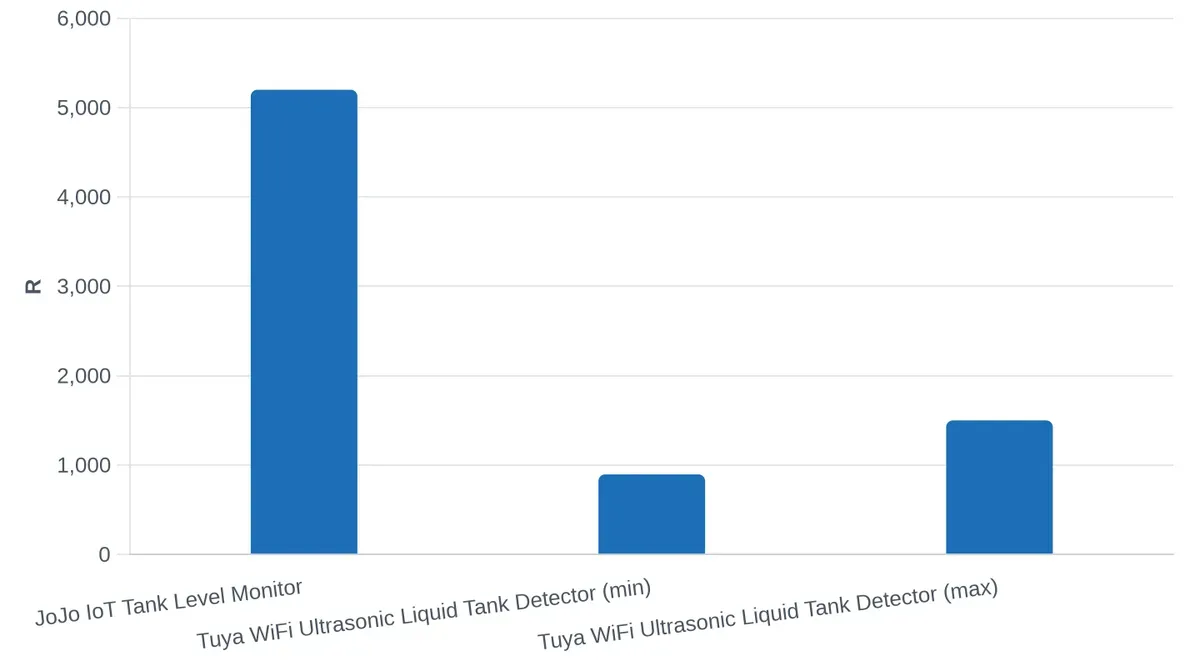
Level monitoring is increasingly practical at accessible price points. The Tuya WiFi Ultrasonic Liquid Tank Detector (TLC2502) is available at R895 to R1,499 from GeeWiz and Takealot, works with standard WiFi (no subscription required), and is compatible with most tank brands. The JoJo IoT Tank Level Monitor at R5,199 (Builders Warehouse) uses the Sigfox network, which offers wider range but requires an annual subscription after the first year. For most homeowners, the Tuya unit is the cost-effective starting point. One owner added a useful automation layer: “I have sonoff devices fitted in the house and when the electrician fits power for the pump I’ll get him to install a smart outdoor plug so I can schedule the pump to switch off at night.” (MyBroadband, May 2022). Scheduling pump operation via a smart plug is a low-cost way to reduce noise and unnecessary power draw overnight.
Summary: what you should budget
A realistic backup water system in 2026 costs between R14,000 and R55,000 fully installed, depending on tank size, pump type, pipe run length, and whether you add filtration. The tank itself is typically 15% to 35% of that total. Choosing between JoJo and Eco Tanks at the 5,000L mark saves approximately R1,300 on the tank body today, but that saving is largely irrelevant if the installation scope differs. Focus your comparison energy on the full system quote, the plumber’s credentials (PIRB registration), and whether your installation will be in-line or passive storage.
Ready to find out what a backup water system will cost at your specific address? Check my address for location-specific pricing and installer availability near you.
Get started
Ready to size and install your backup tank system?
Vetted local installers · honest advice first
Photo: Doğan Alpaslan Demir / Pexels