Key points
- A R7,000 budget buys a 4,750L to 5,250L tank only. Factor in R13,000 to R28,000 more for a fully installed, pump-integrated system.
- JoJo and Eco Tanks dominate the market. A JoJo 5,250L vertical costs R6,499 at Builders Warehouse; an Eco Tanks 4,750L vertical costs R5,399.95 at Cashbuild.
- Total installed cost for a standard 5,000L integrated setup runs R20,000 to R35,000. An advanced 10,000L estate setup runs R30,000 to R70,000-plus.
- Plumbers charge R450 to R900 per hour. A reinforced concrete slab costs R1,500 to R3,000. Variable Speed Drive pumps cost R5,000 to R12,000.
- Municipal bylaws in Cape Town, Johannesburg and eThekwini carry real legal obligations, including mandatory signage, backflow prevention, and lilac pipework for greywater.
- Polyethylene tanks last 10 to 20 years; concrete tanks last 30 to 50-plus years. Tank type dictates long-run cost of ownership more than purchase price.
What the R7,000 figure actually means
South African water security conversations almost always end up at the same number: around R7,000. It appears in builder quotes, forum threads and hardware store circulars as a rough benchmark for a mid-sized residential tank. What it rarely includes is everything else required to make that tank useful.
Municipal supply is under growing pressure. A joint ministerial coalition was formed in September 2026 to tackle frequent power trips at Rand Water pumping stations that cause unpredictable water shutdowns across Gauteng. Meanwhile, eThekwini loses up to 65% of its treated water to leaks and infrastructure collapse, and Johannesburg Water is rolling out smart flow controllers that intentionally reduce overnight pressure to build reservoir capacity. In this environment, a home backup tank is not a luxury, it is a sensible buffer.
According to the Research Brief, a R7,000 budget will buy a vertical above-ground polyethylene tank in the 4,750L to 5,250L range. Specifically, the JoJo 5,250L vertical sits at R6,499 at Builders Warehouse, and the Eco Tanks 4,750L vertical is R5,399.95 at Cashbuild. Both are tank-only prices. No pump. No base. No plumbing. No labour.
Once you add a reinforced concrete slab (R1,500 to R3,000), a pressure pump (R1,450 to R12,000 depending on type), plumber labour at R450 to R900 per hour, pipework, isolation valves, a float valve and basic filtration, the total installed cost for a standard 5,000L integrated setup lands between R20,000 and R35,000, per general research findings. That gap between the tank sticker price and the all-in number is where most buyers get an unpleasant surprise.
“I did mine myself and it cost me probably about R11k. Concrete slab – R2500… 2500L africa tank – R2000, DAB Pump – R2000 (usually R4500, got it on clearance), Jojo tank float – R300.”
MyBroadband forum, DIY cost breakdown
That owner got lucky on pump clearance pricing. Budget for full retail and a 2,500L DIY setup with a quality pump is closer to R14,000 to R17,000 once wiring, pipe runs and fittings are included. A professionally installed 1,000L system starts at R14,880 according to enviroleg.co.za, which illustrates how heavily labour and integration costs stack up even on smaller setups.
The main tank types: polyethylene, fibreglass and concrete
The overwhelming majority of South African residential buyers choose UV-protected polyethylene tanks. They are the cheapest entry point, widely available, and straightforward to install. JoJo Tanks uses SABS-approved food-grade polyethylene with a trademark black inner lining that blocks light penetration and suppresses algae growth, per JoJo’s own product documentation. That inner lining is a meaningful differentiator: tanks without it require more frequent chemical treatment to control biological growth.
Fibreglass (GRP) tanks handle temperatures up to 90 to 100 degrees Celsius according to dtfiberglass.com, making them the correct choice for solar thermal applications or industrial environments where a polyethylene tank’s 40-degree Celsius maximum (per jojo.co.za) would be exceeded. They cost considerably more and are less common in purely residential backup applications.
Concrete tanks last 30 to 50-plus years per watertankcalculator.com, compared to 10 to 20 years for polyethylene. The lifespan difference is the central argument for underground concrete tanks in permanent installations.
“While I’m digging I may as well just keep digging, get a 10 000l underground tank and bury it… problem solved!… Worst part of this is moving these [above ground] tanks. Even if you drain them there’s like 4 or 5cm of water left, which is like 150 litres + the weight of the tank.”
MyBroadband user SAguy, on switching to underground concrete
SAguy’s point about residual water weight is practical and often overlooked. A nominally empty 5,000L tank can still hold 150L-plus of undrainable water, adding significant mass to any relocation attempt. If your installation is permanent, a concrete underground tank avoids that problem entirely, at the cost of higher upfront excavation and installation expense.
Brand comparison: JoJo, Eco Tanks, Africa Tanks and RotoTank
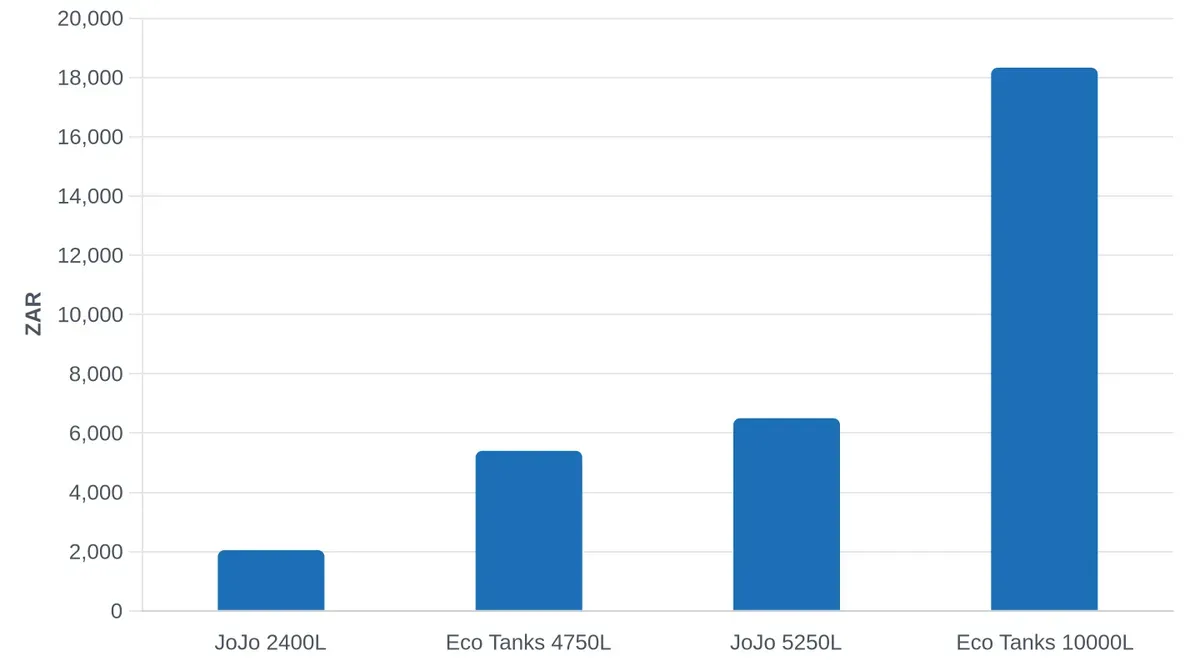
| Tank | Capacity | Retail Price | Source |
|---|---|---|---|
| JoJo Vertical | 2,400L | R2,049 | builders.co.za |
| Eco Tanks Vertical | 4,750L | R5,399.95 | cashbuild.co.za |
| JoJo Vertical | 5,250L | R6,499 | builders.co.za |
| Eco Tanks Vertical | 10,000L | R18,329.85 | plumblink.co.za |
JoJo is the market leader by recognition and retail availability. Its SABS-approved polyethylene construction and trademark black liner set a clear product standard. Africa Tanks addresses a specific spatial problem: their 1,450L slimline tank has a 700mm diameter according to MyBroadband, making it practical for narrow side passages where a standard round tank simply will not fit. Eco Tanks competes directly on price and backs that with an industry-standard 10-year full replacement guarantee per ecotanks.co.za, which is a strong warranty position. RotoTank wins consistent praise specifically for lid security.
“Roto tanks close more securely if for drinking water. some lids just lie on top, some screw down, some are vermin safe like the Roto… nothing beats dead lizard flavoured water first thing in the morning because of a poorly fitted lid.”
MyBroadband user soulie, on lid security
Lid design is a genuine hygiene consideration in South Africa’s climate, not a cosmetic one. If a tank stores water for drinking or cooking, a vermin-secure lid is non-negotiable.
Pumps: the component that determines whether the system actually works
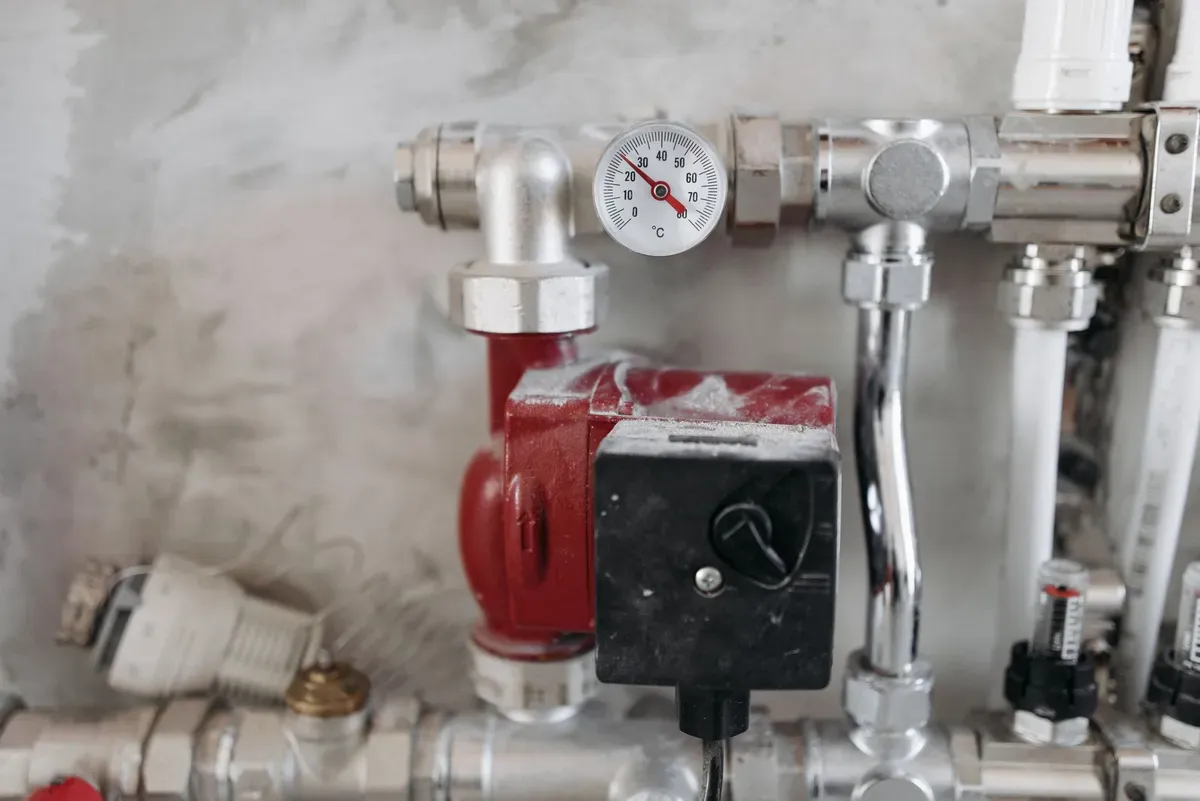
A tank without a pump is a glorified emergency bucket. For a backup system to supply a house at liveable pressure, you need a pump that can detect low municipal pressure and activate automatically. The good news is that this does not require sophisticated automation equipment.
“You don’t need any fancy devices to get it to change to your water tank automatically. It all depends on how you have it plumbed in. A summary is that you can have both your municipal water feed and tank on at the same time. Your pump will detect that there is sufficient pressure and never turn on. If the municipal line goes down then the pump will kick in to provide pressure to your property.”
Fcon_Vpro, MyBroadband forum, on automatic switchover
Entry-level peripheral booster pumps (0.37kW) cost R1,450 to R1,500 per waterpumps.co.za and are the most common choice for 2,500L to 5,000L residential setups. Variable Speed Drive pumps, which modulate output to match demand and consume less electricity, cost R5,000 to R12,000 per general research findings. The DAB e.sybox costs around R10,000 for the Mini and R15,000 for the standard version per MyBroadband and represents the premium end of the residential pump market.
“cant really recommend any pump, mine is 5 years old permanently connected, was the cheapest 0,37 kw unit i could find, has never skipped a beat…”
MyBroadband forum user, on budget pump longevity
That said, pump durability is not guaranteed, and outdoor exposure is a known failure vector. One owner reported a different experience with premium equipment:
“DAB, not sure what went wrong all 3 literally disintergrated… Outside under the same plastic pump covers, connected in the same way. Between 2-3 years of use, 1 pump after the other broke into pieces. Replace with metabos, which I have now owned longer than I owned the DABs, no issues so far.”
MyBroadband user soulie, on pump weathering failure
The lesson is that premium brand does not automatically mean outdoor durability. Shade, enclosures and weather protection matter regardless of pump tier. A pressure vessel (at least 8L capacity) is also worth budgeting for separately: it prevents the pump cycling on and off for small draws like a dripping tap, which extends motor life materially.
On plumbing materials, one widely shared forum warning deserves attention:
“Your installation is wrong. You never use copper from pump to house, you will cause vibrations to go through the house piping. If someone at night opens a tap it will wake everyone up. You should use HDPE from pump to house, doing away with vibrations.”
Homeowner, South African plumbing forum
Use HDPE pipe from pump to house. It is also worth noting Water 4 Africa’s pipe sizing rule: the larger the distance between the pump and the house, the larger the pipe diameter must be to maintain adequate pressure. Budget for 22mm or 25mm HDPE on runs over 10 metres.
Installation costs: the honest breakdown
| Cost Item | Typical Range | Notes |
|---|---|---|
| 5,250L JoJo tank (tank only) | R6,499 | builders.co.za retail |
| Reinforced concrete slab | R1,500 to R3,000 | Non-negotiable for tanks over 2,500L |
| 0.37kW booster pump | R1,450 to R1,500 | waterpumps.co.za; entry-level reliable |
| VSD pump (premium) | R5,000 to R12,000 | Better efficiency; quieter |
| Plumber labour | R450 to R900/hour | Budget 8 to 12 hours for standard setup |
| Float valve, connectors, pipe, fittings | R2,100 to R4,000 | Per Mzezman DIY itemisation |
| Electrical wiring and conduit | R2,000-plus | For 50m cable run; varies with distance |
| 3-stage filter set (replacement) | R485 | pricecheck.co.za; annual ongoing cost |
| SANS 241 water quality test | R1,450 to R1,885 | enviroleg.co.za; recommended on commissioning |
| Professional tank clean (1,000L to 2,500L) | R1,500 to R2,500 | waterquotes.co.za; annual or biannual |
| Total: standard 5,000L integrated setup | R20,000 to R35,000 | General research findings |
| Total: advanced 10,000L estate setup | R30,000 to R70,000-plus | General research findings |
Mzezman’s granular DIY itemisation gives a useful real-world cross-check:
“Jojo tank float – R300, Tank to pump connector kits – R300, Piping and connectors – R1500… Electrical wiring and conduit – R2000 (50m of cable and conduit).”
Mzezman, MyBroadband forum, DIY auxiliary cost itemisation
Those figures align closely with the general research ranges and confirm that even competent DIY installations accumulate material costs that buyers routinely underestimate at the planning stage. The waterquotes.co.za benchmark for a professionally installed 2,500L to 5,000L residential setup with pressure pump is R20,000 to R40,000, which brackets the general research finding neatly.
Check my address to see whether a tank alone solves your suburb’s outage frequency, or whether you need a larger system.
Get a vetted installer quote for your backup tank setup
Cost of ownership: polyethylene vs. concrete over 20 years
Purchase price comparisons between tank types are misleading without factoring in lifespan and maintenance costs. Here is a simplified 20-year comparison for a 5,000L residential installation.
Polyethylene above-ground (5,250L JoJo): Tank at R6,499. Expected lifespan of 10 to 20 years (jojo.co.za). If replacement is needed at year 15, add another R7,500 (allowing for price increases). Two professional cleans at R2,000 each equals R4,000. Annual filter replacement at R485 equals R9,700 over 20 years. Pump replacement once at R3,000. Twenty-year total excluding installation labour: approximately R30,700 for tank and consumables alone.
Underground concrete (10,000L): Higher upfront excavation and installation, typically R40,000 to R60,000 installed. Lifespan of 30 to 50-plus years means no replacement within the 20-year window. Cleaning costs similar. Twenty-year total: installation cost plus consumables, but no mid-life tank replacement. For permanent homeowners, the concrete option often has a lower total cost of ownership despite the higher entry price.
The subscription model offers a third path. Zero Water offers comprehensive backup packages at R599 to R1,199 per month (zero-water.co.za). Over 20 years at the entry rate, that is R143,760 total: considerably more than a purchased system, but with zero capital outlay, maintenance included, and equipment upgrades managed by the provider. For renters or those with irregular cash flow, the economics can make sense.
Water quality and hygiene: what owners get wrong
A tank is not a passive container. Stored water degrades, and South Africa’s climate accelerates the process. JoJo’s black inner liner blocks the light that algae needs to grow, but it is not a substitute for regular cleaning and proper plumbing configuration.
“Refilled it using my JoJo tank. Haven’t cleaned my JoJo tank for a while. Found black algae where I had the hose pipe…”
MyBroadband user, on tank contamination
“Water left in the tank too long stagnates and gathers lots of issues including algae, rather connect your tank in line as opposed to a seperate ‘incase’ type storage.”
MyBroadband forum discussion on stagnation
This is important plumbing advice. An inline configuration keeps water cycling through the tank rather than sitting static. Stagnant backup water that is only used during outages is more prone to biological growth than water that turns over regularly. The contrast with a properly sealed, infrequently used tank is equally instructive:
“As the tanks are closed with a lid no dirt is detected on the bottom yet and the water is still clear, without any algae after more than a year of non-use.”
MyBroadband user Steamy Tom, on properly sealed poly tank storage
The difference between these two outcomes is lid quality, sealant integrity, and whether the inlet hose was left in contact with stored water. Budget for professional cleaning at R1,500 to R2,500 per clean (waterquotes.co.za) at least annually, and commission a SANS 241 SABS/SANAS-accredited laboratory test at R1,450 to R1,885 (enviroleg.co.za) when the system is first commissioned and after any contamination event.
Foundation: the overlooked structural requirement
A full 5,000L tank weighs just over 5,000kg. Standard residential garden soil cannot support that load without settlement. Uneven settlement cracks tanks and shears off outlet fittings.
“A settling or cracked base can damage the tank and its connections, and no warranty covers a foundation the installer didn’t build.”
Plumbing contractor warning, South African installation forum
A professionally poured reinforced concrete slab costs R1,500 to R3,000. It is not optional for any tank over 2,500L. No manufacturer warranty covers damage caused by an inadequate base, and no amount of tank quality compensates for a foundation that fails.
Legal compliance: what your municipality actually requires
Backup water tanks in South Africa carry real legal obligations that most hardware store conversations do not mention.
Cape Town requires official signage for any alternative water system plumbed into a home’s reticulation, per WaterPointSA. As one compliance voice put it:
“If you plumb a rainwater tank into your home’s reticulation and do not put up the prescribed sign, you are non-compliant. The sign alerts emergency services and visitors.”
WaterPointSA, on Cape Town signage requirement
Greywater recycling return pipes must be painted lilac (Pantone 522) per IOPSA, to prevent cross-connections with potable supply lines. In eThekwini, building bylaws grant boundary relaxation exemptions for tanks up to 5,000L, per eThekwini municipality bylaws. Above that threshold, a formal exemption application is required. In Johannesburg, the metropolitan water bylaws require backflow prevention on any alternative water system connected to the municipal network. The liability position is direct:
“In terms of the City of Johannesburg Metropolitan Municipality Water By-laws… if you don’t have [a backflow preventer], and contamination traces back to you, you are liable.”
Borehole Sure Pumps, on Johannesburg contamination liability
Do not rely on a cheap non-return valve as your sole backflow prevention device. As one experienced installer noted, non-return valves can fail and should be backed by physical stop cocks. JVC Insurance policies cover water tanks and boreholes only if they supply water solely for domestic use, per JVC Insurance, so any commercial application requires a separate policy review.
DIY vs. professional installation: where it goes wrong
DIY installation is viable for competent homeowners with basic plumbing experience, particularly on smaller setups. The risks are concentrated in two areas: electrical integration and pump wiring.
“Problem is that when it is on, everything’s fine…but the moment a tap is opened, my earth leakage trips instantly… Turnout that my plumber had messed things up during the installation… Lesson: Plumbers are not necessarily the best people to do this!”
User trevorfarayi, on premium pump installation failure
An earth leakage trip on tap-open is a wiring fault, not a pump fault. Premium pumps with sophisticated electronics (particularly variable-speed units) require installers who understand the pump’s specific earthing and pressure-sensing requirements. A general plumber who is unfamiliar with electronic pump controllers can create a dangerous and non-functional installation. When using a VSD or smart pump, confirm that your installer has specific experience with that product line.
For those on tighter budgets, the micro-budget approach is also valid as a transitional solution:
“What i ended up doing is just getting a 750L jojo. This is used to flush toilets. A bucket at a time. Not a big deal. Drinking water. Well just get 10x 5L bottles.”
MyBroadband forum user, on minimum-viable water security
A 750L tank for toilet flushing and bottled water for drinking is a legitimate starting point. The JoJo 2,400L vertical at R2,049 (builders.co.za) can serve a similar purpose at gravity-fed pressure for garden and toilet use, deferring pump costs entirely until budget allows.
The human reality: what owners actually feel
Beyond specifications and pricing, backup water tanks have a measurable effect on daily stress levels in a country where municipal supply reliability varies significantly by suburb and municipality.
“I had 2 slimline 1kl tanks installed with all the fixtures and labour… It’s made such a difference to my family with the water issues we’ve had over the last year. Significantly lower stress and anxiety compared to my neighbours.”
Johannesburg community board comment on quality of life return
“My neighbour put two 5000s against our wall. I popped champers. 10kls of water saved…”
Cape Town resident, on neighbour’s installation benefiting shared peace of mind
These are not marketing quotes. They reflect the practical reality that in areas with unreliable supply, a well-installed backup system shifts a household from reactive crisis management to calm continuity. The financial return is difficult to quantify exactly, but the quality-of-life return is consistently reported as immediate and substantial relative to the capital cost.
Summary: what to budget for each scenario
Minimum viable (toilet flushing, gravity-fed, no pump): JoJo 2,400L at R2,049 plus basic fittings at R500 to R1,000. Total: approximately R3,000. No installer required for a standalone fill-and-use setup.
Entry integrated (2,500L to 5,000L, booster pump, DIY-capable): Tank R2,049 to R6,499, slab R2,000, pump R1,500, fittings and pipe R2,100, wiring R2,000. Total DIY: R10,000 to R14,000. Professionally installed: R20,000 to R35,000.
Standard residential (5,000L, professional install, filtration): R20,000 to R35,000 all-in, per general research findings.
Advanced estate (10,000L-plus, VSD pump, filtration, monitoring): R30,000 to R70,000-plus, per general research findings.
Subscription (no capital outlay): R599 to R1,199 per month from providers such as Zero Water (zero-water.co.za). Practical for renters or those avoiding upfront capital commitment.
Before committing to any of these, check whether your specific address is in a municipality that has additional requirements, rebates, or restrictions that affect your choice of tank size, connection type, and signage. Supply reliability in your street determines how large a tank you actually need, and that varies more than most buyers realise.
Use the tool below to check what applies at your address before you buy: Check my address.
Get started
Get a vetted installer quote for your backup tank setup
Vetted local installers · honest advice first
Photo: Doğan Alpaslan Demir / Pexels