- Entry-level 1.5 kW booster pumps start at R3,220 (incl. VAT). Premium VSD units like the DAB E.sybox 1.1 kW list well over R10,000, but their energy behaviour is fundamentally different.
- Import duty on water pumps (HS Code 8413) is 0% MFN under the South African Customs Tariff Book, so landed cost is essentially retail cost plus courier or distribution margin.
- Load-shedding, voltage surges, and hard borehole water are the primary causes of pump failure in South Africa, according to AfriPumps. Controller and pressure-switch burnouts are the most common failure mode, not the pump body itself.
- Bearing failure accounts for 80% of all centrifugal pump failures globally (Samotics), and wear ring clearance growth of 0.010 to 0.015 inches causes a 3% to 5% drop in efficiency (Mislier) before most homeowners notice anything is wrong.
- Standard pumps paired with a 60-litre or larger pressure tank deliver good value. Without a pressure tank, a VSD (variable-speed drive) pump is the only practical option that avoids short-cycling and pressure spikes.
- Warranty terms vary considerably. JoJo’s 12-month warranty explicitly does not cover removal, installation, or transport costs. DAB’s standard controller warranty is also 12 months, though an extended EsyCare service tier launched in 2026.
Why this comparison matters in 2026
South African municipal water pressure is specified at 200 to 600 kPa (2 to 6 bar) under normal operating conditions, according to MyBroadband. In practice, it regularly falls well below that. One MyBroadband user described the problem plainly:
“Normal pressure ranges from 200-600kPa, but… this morning it was as low as 90kPa [0.9 bar], which was not sufficient to push water above the 4th floor.”
That gap between specification and reality is what drives the booster pump market. Homeowners who have installed borehole-to-tank systems, rainwater harvesting setups, or municipal backup tanks all face the same downstream problem: gravity-fed or low-pressure supply is not enough for a modern home. A booster pump solves that, but the wrong choice costs more over three years than the upfront price difference suggests. This article works through the numbers so you can make a fully informed shortlist before you spend anything.
The South African pump landscape: who actually sells what
The local market splits into four rough categories: global premium brands with local distribution (DAB, Grundfos, Wilo, Ebara), mid-range European or Italian-designed brands assembled or distributed locally (Pedrollo, Speroni, Leo), locally branded products that may source components from Asia (JoJo, Plumline, ICM), and pure budget imports sold through hardware chains and online marketplaces (Taifu, Pascali, unbranded Takealot listings).
Import duty at 0% MFN means none of these brands carry a tariff penalty at the border. Price differences are therefore driven by component quality, motor efficiency class, warranty infrastructure, and distribution margin, not customs protection.
Verified retail prices: 1.5 kW class side by side
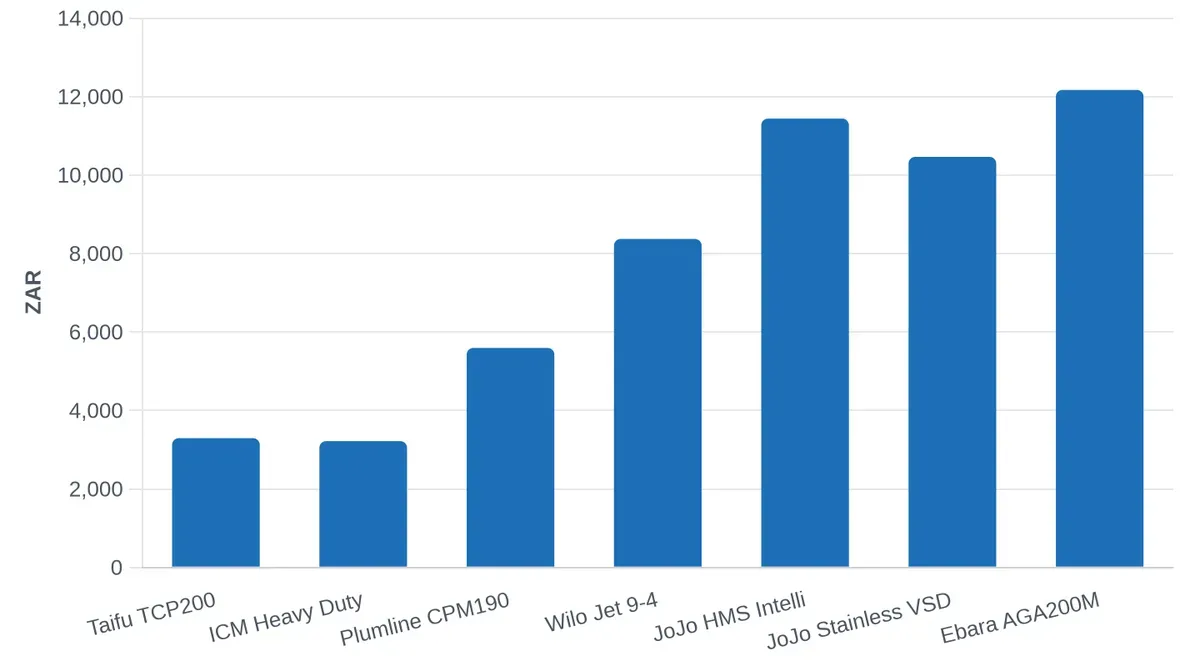
The table below uses the 1.5 kW power bracket as a common reference point. Where a brand’s most popular SA booster model sits slightly outside that bracket (the DAB E.sybox at 1.1 kW is the clearest example), the actual rated power is noted. All prices are the latest verified retail figures in ZAR.
| Brand and Model | Power | Retail Price (ZAR) | Drive Type | Source |
|---|---|---|---|---|
| ICM Heavy Duty Booster | 1.5 kW | R3,220 incl. VAT | Fixed speed | ICM Industries |
| Taifu TCP200 | 1.5 kW | R3,295 | Fixed speed | Adendorff Machinery Mart |
| Pascali Self-Priming Jet | 0.75 kW | R2,900 to R3,275 | Fixed speed | diyshop.co.za |
| Speroni CAM100/25 | 0.75 kW | R4,789.90 | Fixed speed (25 L tank) | Hinterland |
| Plumline CPM190 | 1.5 kW | R5,595 | Fixed speed | Plumblink |
| Wilo Jet 9-4 | 1.5 kW | R8,373 | Fixed speed | SuperPump Shop |
| JoJo Tanks SS VSD Booster | 1.5 kW | R10,465 | Variable speed | JoJo Tanks |
| JoJo HMS Intelli Booster | 1.5 kW | R11,440 | Variable speed | Water Pumps Online |
| Ebara AGA200M (cast iron, self-priming) | 1.5 kW | R12,171 | Fixed speed | AfriPumps |
| DAB E.sybox | 1.1 kW | Well over R10,000 | Variable speed (VSD) | MyBroadband |
Note: Hardware for piping, bypass manifold, valves, brackets, and a level indicator adds R500 to R1,000 to any installation, per MyBroadband community data. Labour is additional and varies by region.
Fixed-speed pumps: what the budget tier actually delivers
The ICM, Taifu, and Pascali bracket is where most first-time buyers land. alanB on MyBroadband Forum captured the entry-level logic well:
“R3,500 should get you a decent jet pump with pressure switch, non return valve and fittings that will be able to run showers… Get the correct booster pump based on your specific maximum requirements of pressure and flow rate… Ideally get one with variable VSD if you can afford (DAB e.sybox, Grundfos Scala etc).”
Fixed-speed pumps run at full power from the moment a tap opens until the pressure switch cuts them off. A standard 230V 850-watt pump pulls roughly 3.8 amps running current, but the startup surge is 3 to 5 times higher, between 11.4 and 19 amps, according to poolpumprepairs.co.za. That surge matters for two reasons: it stresses the motor bearings and capacitor on every start, and on a solar-backed system it can trip the inverter.
Short-cycling, where the pump starts and stops repeatedly because of micro-leaks or a waterlogged pressure tank, is the leading cause of premature motor burnout. One AfriPumps mechanic is blunt about the outcome:
“This will destroy your motor.”
One experienced DIYer on MyBroadband identified the installation fix that prevents most of these failures:
“Lesson learned the hard way: use the blue pipes and PVC glue everything, no leaks, which means your pressure switch does not switch on all the time, only when you open a tap.”
Pascali deserves a specific mention because its longevity record in SA households is unusually strong relative to its price. One MyBroadband user, I.am.Sam, gave a frank field report:
“I have a Pascali, so does my dad and so does a few of my friends. My one friend has about 3 and has no issues for years. Same with my dad and me, its been years and they work fine. The DAB is a little more pricey I see.”
That kind of multi-household anecdote is not a controlled test, but it is consistent with what a R2,900 to R3,275 all-mechanical pump (diyshop.co.za) with no electronic controller to burn out looks like in real SA conditions. The Leo range gets a similar endorsement from a farm user:
“I’ve used / installed quite a few pumps on our farm for a combination of large irrigation, household use and garden irrigation; the most reliable I’ve found so far are the Leo range.”
VSD pumps: the DAB E.sybox as the benchmark
The DAB E.sybox at 1.1 kW (120 L/min, 65-metre maximum head, per SANS Water) has become the reference product for premium residential boosting in South Africa. It modulates motor speed to hold a user-set pressure, so it draws only what the demand requires. One SA owner described the real-world behaviour precisely:
“My DAB E.sybox booster pump will pull 200W to 600W the majority of the time but can ramp up to 1.1kW if I have irrigation and shower and a tap going.”
That 200 W to 600 W operating range, against a nameplate of 1.1 kW, is the core energy argument for VSD. At Cape Town residential electricity rates of R3.22 to R4.69 per kWh (capetown.gov.za), a fixed-speed 1.5 kW pump running 2 hours a day costs R9.66 to R14.07 per day in electricity. The same duty cycle on a VSD unit averaging 400 W costs R2.58 to R3.75 per day, a difference of roughly R7 to R10 per day, or R2,555 to R3,650 per year. Over three years, that is R7,665 to R10,950 in electricity savings, before any maintenance differential.
The user experience of the VSD is also qualitatively different:
“I have a DAB E.sybox pump. Super quiet, super efficient (it’s an inverter pump so it only runs as fast as it needs to to maintain set point pressure. 3.1 bar in my case).”
And one satisfied installer:
“Get a DAB E.sybox 0.75kW, you won’t be unhappy… Dead quiet and has a WiFi connection… Expensive but well worth it IMO.”
The JoJo 1.5 kW Stainless Steel VSD (R10,465, JoJo Tanks) and the JoJo HMS Intelli Booster (R11,440, Water Pumps Online) occupy a comparable price point with VSD technology and the advantage of a local brand’s service network. One buyer who switched to the JoJo Smart Series from a noisy fixed-speed unit reported a dramatic difference in both noise and consumption:
“Had an existing booster pump connected to my Jojo tank but every time we turned on the tap, the pump when running was noisy… After purchasing the JOJO 0.55KW SMART SERIES PUMP, we don’t hear any noise… and only uses average of 300W.”
The pressure-spike problem: basic controllers versus VSD
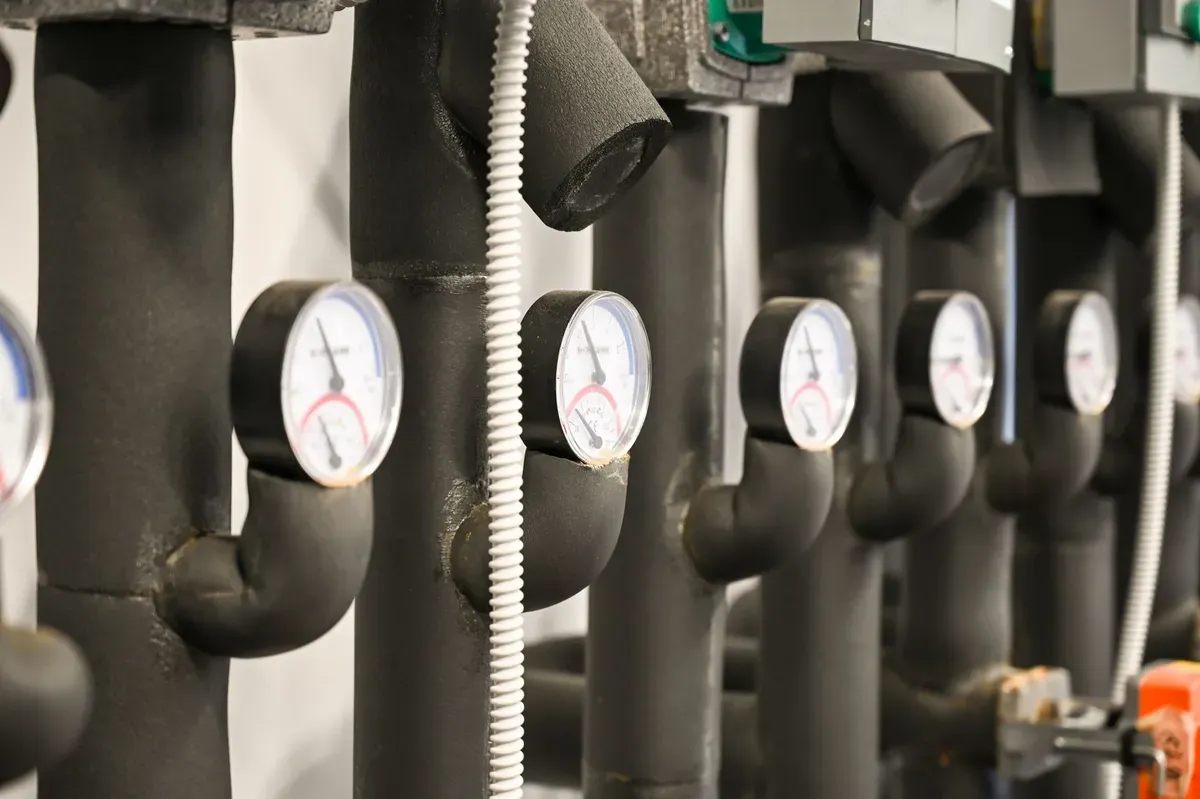
Fixed-speed pumps with mechanical pressure switches have a known behaviour that one MyBroadband user, tetrasect, documented clearly:
“BUT with these units there is a ~10 second delay before the pump actually turns off. This delay is what causes the pressure to rise even further up to the pump’s maximum pressure.”
In an older suburb where ageing distribution pipes are already stressed, that pressure hammer matters. As one MyBroadband user described the consequence of repeated over-pressure events: “Entire pipes need to be replaced, they’re way beyond the end of their service life. Plug a leak and the pipe just pops again a few metres away when the pressure comes back.” A VSD pump that ramps down gradually before stopping does not create that spike.
The VSD retrofit question
A logical middle path is buying a cheap fixed-speed pump and adding an aftermarket VSD controller. The forum consensus is sceptical. LCBXX on MyBroadband summarised the economics:
“If you’re going to get a 60-litre or larger pressure-tank, a standard pump is perfect. If you don’t want a pressure-tank, your only option is a DAB/VSD pump. You can also retrofit a standard pump with a VSD controller but the cost eventually adds up to just buying one which already has the controller.”
nadeem_k on MyBroadband added one exception: importing a VSD controller directly from China keeps the retrofit cost below the premium-brand threshold, but that path carries its own warranty and compatibility risks.
Warranty terms decoded: what SA homeowners actually get
Exact brand-by-brand warranty claim rates are not publicly disclosed by any manufacturer in South Africa, per general industry consensus. What is public is the fine print, and it has real financial consequences.
JoJo’s 12-month warranty covers parts and replacement but expressly does not obligate the company to bear any cost of removal, installation, transportation, or other charges arising from a warranty claim, per jojo.co.za. That means a motor that fails at month 11 may be replaced for free in terms of parts, but the plumber’s call-out, the removal, and the reinstallation are your costs. If the callout is R1,500 and the installation is R800, the “free” warranty repair still costs you R2,300.
DAB carries a standard 12-month warranty on controllers, with a new EsyCare extended service tier launched in 2026 for priority parts access, per dabpumps.co.za. The practical experience of one homeowner who had a brand-new DAB E.sybox 1.1 kW trip the earth leakage on installation illustrates how even premium brands can have teething issues: “I had a water pump replaced yesterday with the DAB E.sybox 1.1kW… the moment a tap is opened, my earth leakage trips instantly. I had none of these issues with the replaced pump.” (SA forum user.) Resolving that required a qualified electrician and an earth bonding check, neither of which the warranty covers.
The worst warranty experience is one where the terms forbid third-party intervention. One frustrated SA homeowner described what that looks like in practice:
“He [the plumber] says it’s a 10 minute job for the supplier (he can’t open it because that would void the warranty). Supplier says it will be a week before they can get a guy here. Plumber is taking the pump away, says it will be quicker. In the meantime reservoirs in the area are running low… I bought this system so I would not be affected by an outage.”
By contrast, JoJo’s local brand presence has also produced the opposite experience. One MyBroadband community member reported: “Pump from JoJo worked nicely for me. JoJo support is what made the difference. Something fried inside and was outside guarantee. Jojo rep fixed for free.” That kind of goodwill repair, outside the written warranty terms, reflects the advantage of buying from a brand with physical SA representation and a reputational stake in its local market.
What SA conditions do to any pump: the failure drivers
Load-shedding, voltage surges, and hard borehole water are the primary causes of pump failure in SA, per afripumps.co.za. The most common failure modes are controller and pressure-switch burnouts, motor burnouts, and seal leakages. That hierarchy matters for brand selection:
- Electronic controller burnouts hit VSD pumps harder than mechanical-switch pumps. A standard 850-watt pump with a simple pressure switch has almost nothing electronic to destroy. A DAB E.sybox has a sophisticated inverter board that is expensive to replace outside warranty.
- Motor burnouts in fixed-speed pumps are usually caused by dry running, short-cycling, or voltage drop during load-shedding restores. A surge protector and a dry-run protection float are cheap insurance regardless of brand.
- Seal leakages are accelerated by hard borehole water. The Ebara AGA200M’s cast-iron body (R12,171, AfriPumps) is specified for harder, dirtier water than the stainless or plastic-bodied budget units.
Even premium brands are not immune to environmental degradation. One user reported a troubling pattern with DAB units installed outdoors:
“DAB, not sure what went wrong all 3 literally disintegrated… Outside under the same plastic pump covers… Between 2-3 years of use, 1 pump after the other broke into pieces.”
That pattern points to UV-induced plastic degradation on units not installed inside a dedicated pump housing or shade structure. Any pump installed outdoors in South Africa should be treated as requiring a UV-resistant enclosure. That adds cost to the base price that most online comparisons omit.
Borehole-specific sizing: the drawdown reality
For homeowners pumping from a borehole rather than a holding tank, the yield number is not fixed. Randburg-based Andy Plumbers explained the seasonal pattern:
“Yields often drop during the dry winter months as the water table falls, and recover after the summer rains… A yield test during the dry season gives you the most conservative, and most useful, data for pump sizing.”
MyBroadband user Magnum reinforced the hydraulic reality: “A pump only pumps the difference of height between the tank top and the water level. As it drops you pump less at a higher back pressure. You need to drain the hole and do a pressure and volume test to see how much water you can pull and spec the pump and motor according to that.” Oversizing the pump for a low-yield borehole produces dry-running failures within months.
Total cost of ownership: a three-year comparison
The table below models three representative scenarios over 36 months. Assumptions: 2 hours of daily operation, Cape Town mid-tier electricity at R3.80 per kWh (midpoint of R3.22 to R4.69, capetown.gov.za), one plumber call-out for routine maintenance at R1,500, and one controller or pressure-switch replacement for fixed-speed units at R800 (a conservative estimate based on forum reports of common failures). VSD units are assumed to have no controller replacement in the period, though this is optimistic in load-shedding-heavy areas. Hardware installation (R750 average, MyBroadband) is included for all three.
| Cost Element | Budget Fixed-Speed (Pascali 0.75 kW, R3,100) | Mid-Range Fixed-Speed (Wilo Jet 9-4 1.5 kW, R8,373) | Premium VSD (DAB E.sybox 1.1 kW, ~R10,500) |
|---|---|---|---|
| Purchase price | R3,100 | R8,373 | R10,500 |
| Installation hardware | R750 | R750 | R750 |
| 36-month electricity (at rated power, 2 hrs/day) | 0.75 kW x 2 h x 365 x 3 x R3.80 = R6,232 | 1.5 kW x 2 h x 365 x 3 x R3.80 = R12,483 | ~0.4 kW avg x 2 h x 365 x 3 x R3.80 = R3,329 |
| Maintenance call-out | R1,500 | R1,500 | R1,500 |
| Controller / switch replacement (est.) | R800 | R800 | R0 (assumed in-warranty period) |
| 3-year total cost of ownership | R12,382 | R23,906 | R16,079 |
These are illustrative modelled costs based on verified input figures. Actual electricity consumption varies with real demand, pipe length, head height, and duty cycle. The DAB E.sybox average draw of 0.4 kW is based on the owner-reported range of 200 W to 600 W (PowerForum) rather than nameplate power. Labour costs vary by region and are not included beyond the stated call-out.
The numbers reframe the premium-versus-budget choice. A Pascali at R3,100 looks cheap until you add 36 months of full-rated electricity draw from a fixed-speed motor. The DAB E.sybox’s higher purchase price is substantially offset by its variable draw. The Wilo Jet at R8,373 sits in an uncomfortable middle ground: mid-range purchase price, full-rated electricity draw, and no VSD benefit.
Donato du Plessis on MyBroadband Forum articulated the purchase psychology accurately:
“The E.sybox cost at least one kidney. Yes, I am exaggerating, but it is expensive. The cheaper alternative is matching the pump pressure with the required pressure.”
And one anonymous MyBroadband user distilled the upgrade loop into a single sentence: “You either buy the DAB or you buy the Mac [cheap alternative] and then the DAB.” That is not inevitable for every buyer, but it is a pattern worth taking seriously before the first purchase.
Installation: the hidden variable that determines real performance
The best pump, badly installed, performs like a mediocre pump. Hazy_Living@79 on MyBroadband Forum described a correct bypass manifold setup:
“I split the incoming municipal feed in a manifold, one end to the house, the other to the tank… When the municipal water pressure drops off we just turn on the pump and through a couple one-way valves plumbed into the manifold the water feeds the house…”
That approach works for a manually managed system. An automated system with a DAB E.sybox running in constant-pressure mode is described by another MyBroadband user, W@P: “So far it works exactly as it did on muni supply. No lag (despite having to travel through about 30m of piping to get to the house), and pressure is also as it used to be… As soon as it drops, the pump kicks in.” That seamless switchover is the design goal. Getting there requires correctly sized pipework, non-return valves in the right positions, and a dry-run protection device.
Full installed costs for complete backup tank and pump systems vary widely. One MyBroadband user shopping for quotes in 2024 found: “I’m getting quotes of R30,000 to R39,000 fully installed, with a slab thrown in.” That is a whole-system cost (tank, pump, civils, plumbing, and electrics), not just the pump. It contextualises the pump purchase price as typically 10% to 35% of the total system cost.
Size and install your booster pump correctly—the first time
Shortlist guidance by buyer profile
- Tight budget, existing pressure tank, stable power: A Pascali or ICM at R3,100 to R3,220 with a correctly sized 60-litre pressure vessel is a defensible choice. Plan for a controller and capacitor check at the 18-month mark.
- Mid-range, no pressure tank preferred: The JoJo 1.5 kW Stainless Steel VSD at R10,465 or the HMS Intelli at R11,440 gives VSD performance with local brand support and a track record in borehole-to-tank applications.
- Premium, solar-backed system, noise-sensitive: The DAB E.sybox 1.1 kW is the benchmark. Its modulating draw of 200 W to 600 W is well-matched to typical solar inverter capacity, and its noise profile is genuinely different from fixed-speed alternatives. Budget for an enclosed, UV-protected housing and an earth bonding check on installation.
- Hard borehole water or agricultural-adjacent use: The Ebara AGA200M’s cast-iron body at R12,171 (AfriPumps) is specified for abrasive and mineral-heavy water that degrades standard impellers quickly.
- Farm or multi-point irrigation: The Leo range has a consistent reliability endorsement from multi-unit farm users, though formal SA specifications and pricing should be confirmed with a local distributor before committing.
Five things to do before you buy
- Measure your borehole or tank yield in the dry season, not the wet season, per Andy Plumbers. Size the pump to the conservative yield, not the peak.
- Check your existing household pipe material. Old galvanised or compression-fitted pipe cannot safely absorb the pressure spikes from a fixed-speed pump without a correctly sized pressure tank.
- Confirm your inverter or solar system’s surge capacity. A standard 850-watt pump surges to 11.4 to 19 amps on startup (poolpumprepairs.co.za). Many 3 kVA inverters will trip on that surge.
- Read the warranty exclusions, not just the headline period. Confirm whether removal, transport, and reinstallation costs are covered before you buy, not after a failure.
- Budget R500 to R1,000 for hardware fittings (MyBroadband) and get a quote that separates the pump, the fittings, and the labour so you can compare like for like.
When you are ready to move from shortlist to decision, checking which products and installers are available in your specific area is the logical next step. Check my address to see what solutions and vetted suppliers serve your location.
Get started
Size and install your booster pump correctly—the first time
Vetted local installers · honest advice first
Photo: Pavel Danilyuk / Pexels