Key points
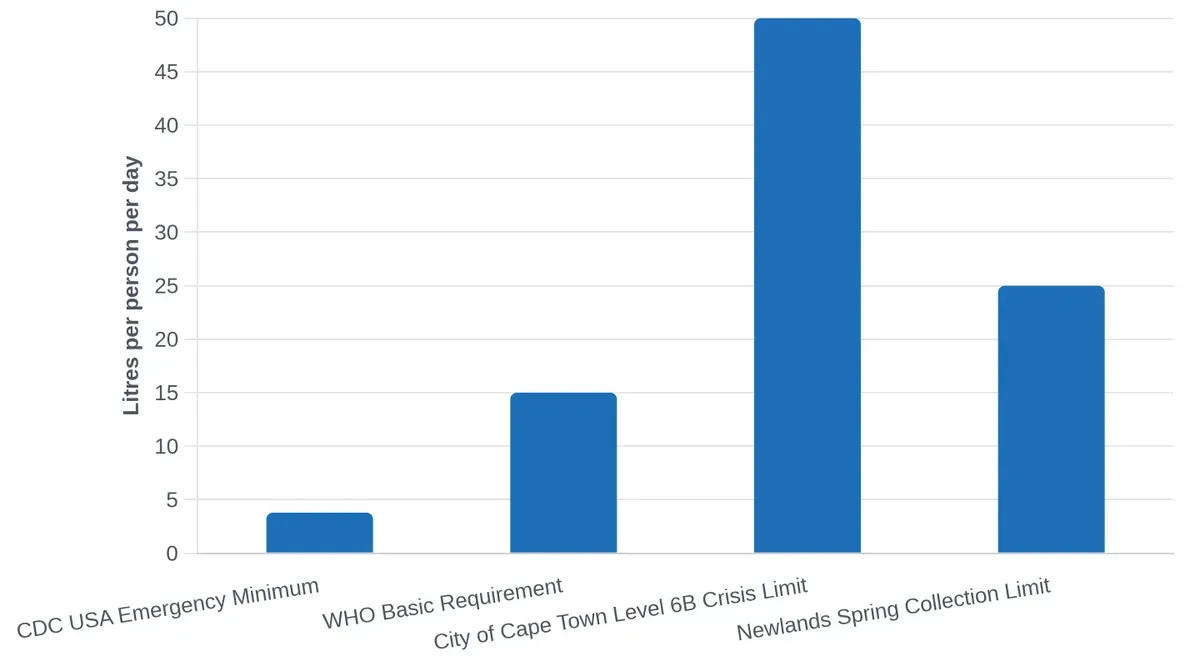
- The WHO minimum for drinking, cooking and hygiene is 15 litres per person per day. The CDC advises at least 3.8 litres for drinking alone. Know your household’s floor before a crisis hits.
- A 5L bottle of still water costs R28.99 at Pick n Pay. Bottled water is an expensive short-term bridge, not a strategy.
- Newlands Spring limits collection to 25 litres per person per turn. In a city-wide event, queues form within hours.
- A 5,000L municipal buffer tank installed and fully compliant costs R15,600 to R22,500. That is less than many Cape Town households spend on bottled water over five years.
- Municipal backup tanks connected to your household plumbing require a Reduced Pressure Zone (RPZ) valve or double check valve with air gap under SANS 10252-1 and the CoCT Water By-law. Skipping this risks a spot fine of R3,000 to R6,700 and a failed Water CoC inspection when you sell.
- Greywater stored untreated turns toxic within 24 hours. It is a toilet-flush supplement, not a drinking source.
- A fully installed borehole in Cape Town ranges from R50,000 to R140,000 depending on depth, geology and filtration needs.
Why outages keep happening and why your response time matters
Cape Town’s water network serves a growing city through infrastructure that was largely built decades ago. Burst mains, pump station failures, reservoir maintenance and load-shedding-related pump outages all cause unplanned supply interruptions. When pressure drops suddenly, sediment disturbs, air enters pipes, and the municipal meter can register that air as consumption.
“Your main problem is you need to let the air out. The design of water meters currently makes them susceptible to registering air… Getting the air out requires a bypass valve.”
A MyBroadband forum member explaining how air in pipes inflates municipal water bills after pressure is restored.
The practical lesson: a supply interruption does not end the moment pressure returns. Budget for a possible inflated bill on that cycle and dispute it with your meter reading on hand.
Municipal responsiveness during emergencies is also inconsistent. One Capetonian documented multiple failed attempts to get help during a burst pipe event:
“I called the CoCT call centre emergency water number… 4 calls from myself and 2 [from others]… they blame shift the incompetence of their call centres on the tax payers.”
A MyBroadband forum resident describing the experience of reporting a burst main emergency.
This is not an argument against calling the municipality. You should. It is an argument for not relying on a fast response as your only plan.
Your 6-hour survival checklist
The first six hours after supply drops are the most important. Work through this in order.
Hour 1: Confirm the outage and assess your current stock
- Check the CoCT Water and Sanitation outage map and the @CityofCT Twitter account before assuming the worst. Planned maintenance outages are notified in advance. Unplanned ones appear on the map within an hour or two of being reported.
- Count every container of potable water in the house: filled bottles, jugs, the kettle. Using the WHO figure of 15 litres per person per day as your minimum, divide your stock by your household size to know how many days you have.
- If you have a geyser, you have a reservoir. A standard 150L geyser holds enough for a family of four for roughly two and a half days at the 15-litre minimum. The draw-off tap at the base of the geyser is your access point. Let it cool before drinking.
Hours 2 to 3: Secure immediate supply
- Fill every clean container you own from the geyser before pressure drops further.
- Fill your bathtubs. Bathtub water is not for drinking without treatment but is immediately useful for flushing and hygiene.
- If you have a pool, treat it mentally as a hygiene and toilet-flush reserve, not a drinking supply.
- Send someone to the nearest Pick n Pay or Checkers for drinking water. A 5L bottle costs R28.99 at Pick n Pay. For a family of four at the WHO minimum of 15 litres per person, you need 60 litres per day for drinking and cooking alone. That is 12 x 5L bottles, which costs R347.88 per day at that price. This is why bottled water is a bridge, not a backup strategy.
“Ordering a delivery of 500 cases of bottled water (4x5L per case) for emergency use should day zero happen.”
A MyBroadband user describing their bulk pre-purchase strategy during the Day Zero threat.
Bulk pre-purchasing is a legitimate short-term hedge. But 500 cases at 4 x 5L each is 10,000 litres. That is exactly the same volume as a 10,000L permanently installed tank costing R28,000 to R35,000 fully installed (local Cape Town installers), which refills itself every time municipal supply is restored. The maths favours the tank over any multi-year horizon.
Hours 3 to 5: Ration and prioritise
- Drinking and cooking come first. The CDC advises a minimum of 3.8 litres per person per day for drinking. The WHO figure of 15 litres adds basic hygiene and cooking. Use 15 litres as your planning floor per person.
- During the Day Zero crisis, the City of Cape Town restricted residents to 50 litres per person per day at Level 6B. Use that as a reference point for what a functional household can operate on with discipline.
- Switch toilets to bucket-flush using bathtub or pool water. A single flush uses 6 to 9 litres. At 15 litres per person per day total, every flush matters.
- Wet wipes and hand sanitiser are not luxuries in this context. They preserve your drinking water allocation.
Hour 6: Greywater, its strict limit
Greywater (from sinks, showers and washing machines) can be redirected to toilet cisterns during an outage. There is one hard rule you cannot ignore: South African standards prohibit storing greywater untreated for more than 24 hours, and MyBroadband confirms it turns into toxic, odour-producing sludge at that point.
“I know the common setup is to run it into a container and then pump it out but then you sit with the ungodly smell after a while.”
A MyBroadband community member on the practical failure of basic bucket-and-pump greywater systems.
Use greywater within the same day for toilet flushing only. One MyBroadband user described a practical phased approach:
“Phase 1 small municipal water back up system… Phase 2 will be adding grey water system aimed at flushing toilets only. Filter just to avoid blockages smells etc.”
A MyBroadband user describing their home backup phasing plan.
This is the right mental model: greywater is a toilet-flush supplement in a controlled, same-day loop with basic filtration. It is not storage and it is not drinking water.
Newlands Spring: what to know before you queue
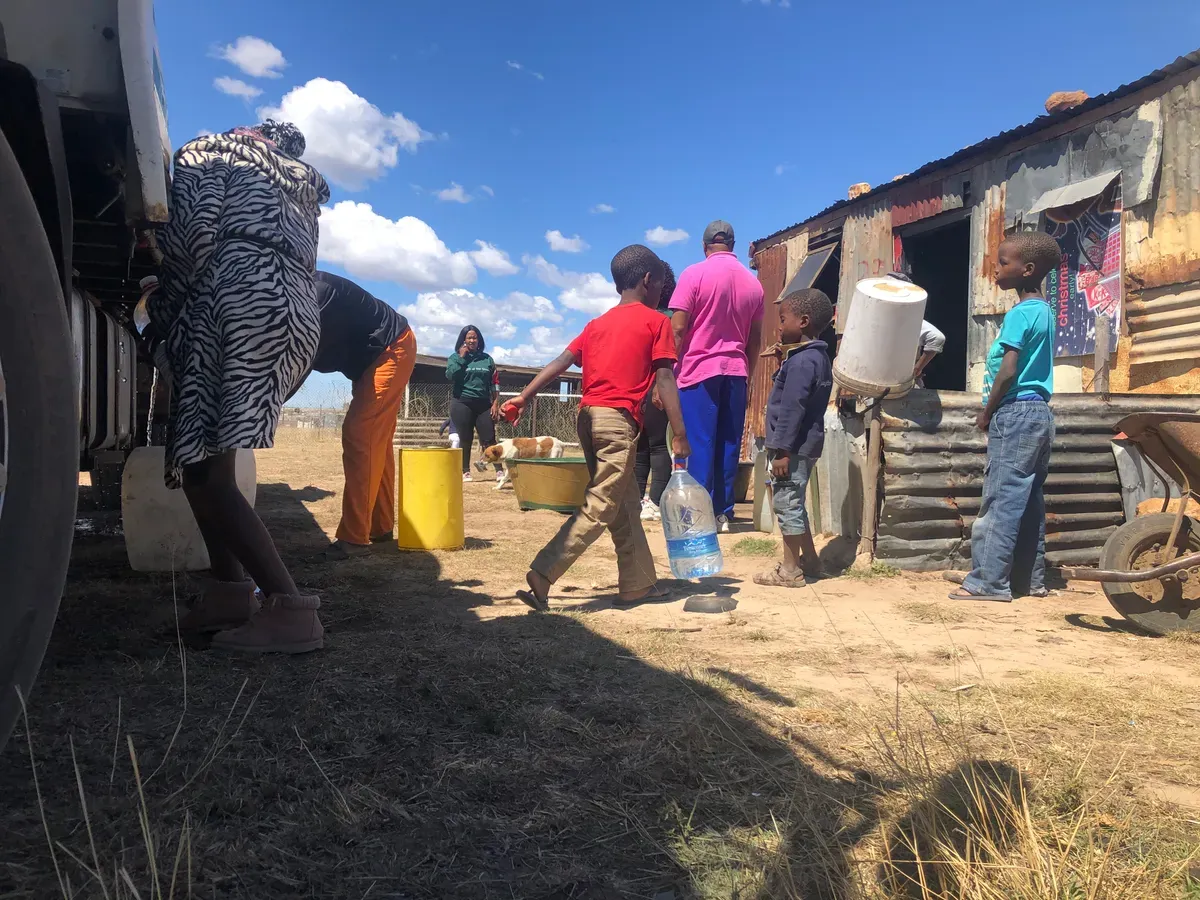
In an extended city-wide outage, Newlands Spring becomes a social focal point. The City limits collection to 25 litres per person per turn (IOL). For a family of four at the WHO 15-litre minimum, one trip yields just over one day of supply. You will need to return daily, and queues during a genuine crisis stretch to hours.
“I have been coming here for a year now and I need this water. They really can’t do that [limit access].”
A regular Newlands Spring collector speaking to the press about the 25-litre collection limit.
Newlands Spring is genuinely useful for a household with no other options. It is not a substitute for household-level storage. Build the spring trip into your checklist as a supplement, not a solution.
Permanent backup options: what each costs and what each actually delivers
The six-hour checklist handles a crisis. What prevents the next one from being a crisis is installed infrastructure. Here is a clear comparison of the main options for Cape Town homeowners, with verified costs.
| Option | Typical installed cost (ZAR) | Volume / capacity | Best use case | Key compliance requirement |
|---|---|---|---|---|
| Municipal buffer tank (5,000L) | R15,600 to R22,500 | 5,000L | Short outages, pressure backup, urban properties | RPZ valve or double check valve plus air gap (SANS 10252-1) |
| Municipal buffer tank (10,000L) | R28,000 to R35,000 | 10,000L | Longer outages, larger households | Same as above |
| Rainwater harvesting (fully integrated, 5,000L+) | R17,000 to R26,000 | Depends on roof area and rainfall | Supplement municipal supply, irrigation, toilet flushing | First-flush diverter, SANS 241 lab test at R1,000 |
| Borehole plus 5,000L surface tank | R95,000 to R105,000 | Dependent on aquifer yield | True independence from municipal supply | CoCT registration, annual maintenance, water testing |
Municipal buffer tanks: the most practical starting point
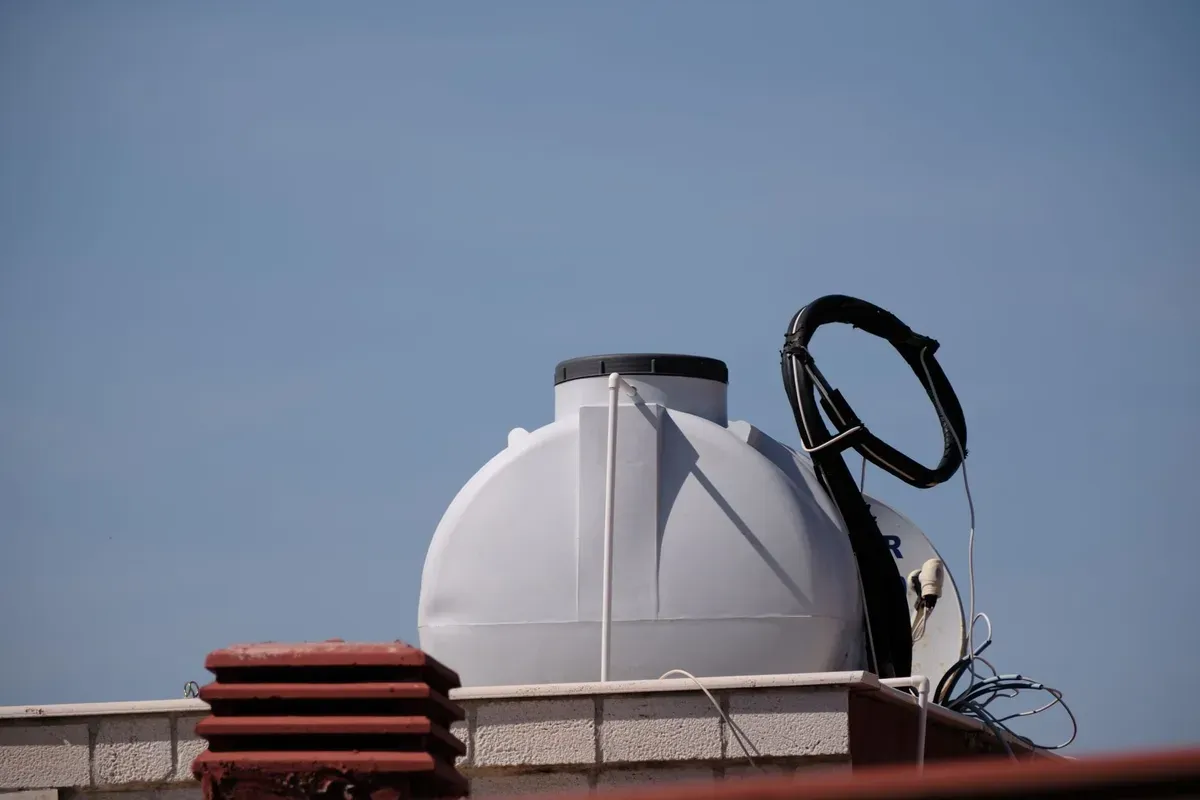
A 5,000L buffer tank installed by a compliant Cape Town installer costs R15,600 to R22,500 (Power Water Solutions and local Cape Town installers). A 10,000L system runs R28,000 to R35,000. These tanks fill during normal supply and feed your household plumbing when municipal pressure drops. The compliance requirement is not optional and is not just bureaucratic friction.
“In Cape Town it is explicitly forbidden according to the by-laws to have a buffer tank… if you are going to connect your water storage system to the pipes in your house you will have to pay for a very expensive non-return valve that prevents your house’s water supply from backwashing into the municipal supply.”
MyBroadband user ‘PaulNOTsaul’ on City of Cape Town compliance for connected municipal buffer tanks.
The required Reduced Pressure Zone (RPZ) valve or double check valve with physical air gap (SANS 10252-1 and CoCT Water By-law) is a real cost in the installation budget. It is also required for your Water Certificate of Compliance when you sell the property. CoCT can issue spot fines of R3,000 to R6,700 for illegal water usage or unregistered bypasses. A routine Water CoC inspection costs R500 to R750 (property attorneys STBB and Brightwave). Skipping compliance to save money on the valve is a false economy by any calculation.
Another MyBroadband member confirmed this point plainly:
“Have you checked with your municipality that you’re allowed to store municipal water? A lot of municipalities, like the City of Cape Town, expressly forbid this sort of backup system if it’s fed by municipal water and you can get into trouble if caught. Also if you’re connecting the backup system to the mains in your house you’ll need a non return valve to prevent any of your backup water from contaminating the municipal supply.”
A MyBroadband forum member on municipal permissions and backflow prevention for connected backup tanks.
Rainwater harvesting: the independent supplement
A fully integrated rainwater harvesting system in the Western Cape averages R17,000 to R26,000 installed. One Cape Town homeowner shared a real-world cost breakdown on Reddit:
“Just finished 2x 2050l tanks, with 1kW pump. Labour, the pump, tanks, concrete pour, and other odds and ends cost me just over R14,000… not taking any chances.”
Reddit user ‘Futurebackwards_ZA’ on the installed cost of a rainwater harvesting system.
This is a useful data point for a DIY-adjacent installation. A professional fully integrated system with municipal crossover, first-flush diverter (R500 to R1,500 per MyBroadband) and filtration sits higher. One critical issue that most installers do not lead with: harvested rainwater in Cape Town has a measured pH of 5.5 to 7.0 (MyBroadband). That acidity corrodes copper pipes over time.
“Rainwater can indeed be quite acidic. I measured the pH a few times and it varied from 5.5 to 7.0. So if your copper pipes are long, or difficult to access, you are probably exposing yourself to some annoying leaks after a few years.”
A MyBroadband community member warning about rainwater acidity and long-term plumbing corrosion.
Budget for a SANS 241 lab water test at R1,000 and, if the pH is low, pH correction treatment before the water enters household plumbing. A MyBroadband user quoted the cost of pH correction at roughly R6,500 DIY for a 1,000L settling tank with lime rocks. Factor this in when comparing the headline installation cost to the real total.
Boreholes: genuine independence, genuine complexity
A complete domestic borehole installation in Cape Town ranges from R50,000 to R140,000 according to boreholehub.co.za, with a 60-metre base installation averaging R81,680 (Cape Town base drilling costs). Adding a 5,000L surface tank brings the total to R95,000 to R105,000. One forum member reported a fully compliant installation including CoCT fees at R115,000:
“My total costs with install, COCT [City of Cape Town] etc around R115 000. So your costs does seem slightly more expensive.”
A MyBroadband forum member discussing a fully compliant borehole and backup water installation.
The honest caveats for boreholes are important. One community member raised the two that matter most:
“You might need to mention annual maintenance on the borehole. Also some places don’t allow it due to dolomite.”
A MyBroadband community member on borehole maintenance and geological restrictions.
Dolomitic geology in parts of the Cape Peninsula and surrounding areas can make drilling impossible or dangerous. Annual maintenance, yield testing and pump servicing add ongoing cost. Cape Town borehole water frequently carries suspended rock dust that requires filtration before use in household plumbing. One owner described the issue:
“I had a borehole done awhile ago, however, the problem is, the water has a lot of fine ‘dust’ in it… the water coming out has a ‘silver/grey’ appearance, you can smell the ‘dust-smell’.”
A MyBroadband user describing the filtration challenge of suspended rock dust in Cape Town borehole water.
Budget for a multi-stage filtration system and annual water testing as part of the cost of ownership, not as optional extras.
The real cost of doing nothing: a 5-year comparison
Cape Town’s 2025/2026 Step 1 municipal water tariff is R24.32 per kilolitre (capetown.gov.za). But the cost of unpreparedness is not measured in tariff rates. It is measured in the price of bottled water during an extended outage and the disruption cost of lost productivity, missed work and crisis logistics.
| Scenario | Year 1 cost | Year 2 to 5 (annual) | 5-year total | Notes |
|---|---|---|---|---|
| Bottled water as primary backup (family of 4, one 3-day outage per year) | R4,185 | R4,185 | R20,925 | 12 x R28.99 x 3 days per year at 60L per day. Price increases excluded. |
| 5,000L municipal buffer tank, compliant install | R18,000 (install) | R0 to R500 (maintenance) | R19,000 to R20,000 | Covered after Year 1. Refills from municipal supply at R24.32/kl. |
| Rainwater harvesting (5,000L+) | R21,500 (install midpoint) | R600 to R1,000 (filters, maintenance) | R24,000 to R25,500 | Filter cost reference from Reddit user; ongoing cost low after install. |
| Borehole plus surface tank | R100,000 (install midpoint) | R2,000 to R5,000 (maintenance, testing) | R108,000 to R120,000 | Highest capital cost but full municipal independence. |
A compliant 5,000L buffer tank breaks even against recurring bottled water spend within five years for a family that experiences just three days of outage per year. A family that experiences more frequent or longer disruptions breaks even sooner. The buffer tank is not a luxury item in Cape Town. It is the most cost-effective defensive infrastructure a residential property can carry.
One respected MyBroadband voice made the clearest case for why cheap improvisations fail:
“CoCT spend billions in the Day Zero fiasco… People bought Jojo tanks which at the end is not suitable for potable water use without expensive filters and pumps and whatnot. Most of those tanks were for capturing rain water from polluted roofs… And most of those tanks would have run dry within a week or two in any case…”
A MyBroadband forum member on the failure of underprepared Day Zero tank installations.
A tank alone is not a solution. A tank with a compliant connection, a quality pump, a first-flush diverter where applicable, correct backflow prevention and a tested water supply is a solution. The difference between the two is the difference between an asset on your property and a white plastic liability that adds nothing when you actually need it.
Is your Cape Town address at risk in the next outage?
A note on neighbours and shared infrastructure
Cape Town residents have a practical history of informal cooperation during water crises. One Reddit user summarised the borehole-sharing model that emerged during earlier droughts:
“During the most recent drought some neighbours on that side of the street clubbed together to get a borehole.”
A local resident on Reddit discussing neighbourhood borehole-sharing agreements during crises.
Shared infrastructure arrangements can reduce per-household capital cost significantly. They require a written agreement on cost-sharing, maintenance responsibility and access rights to hold up over time. If you are considering this route, speak to a plumber and an attorney before committing.
What to check before buying anything
Not every solution works on every property. Before calling an installer, you need to know:
- Whether your erf has the footprint for above-ground tanks and what your HOA or body corporate permits.
- Whether your area has dolomitic geology that would prevent borehole drilling.
- Whether your roof catchment area is sufficient for meaningful rainwater harvesting in the Western Cape’s seasonal rainfall pattern.
- Whether your property already has a valid Water CoC or will need one remediated before a backup system can be legally connected.
The fastest way to get property-specific answers is to use a tool that cross-references your address against these factors before you spend anything.
Check what backup water options are available and compliant at your specific Cape Town address: Check my address.
Get started
Is your Cape Town address at risk in the next outage?
Vetted local installers · honest advice first
Photo: Rajesh S Balouria / Pexels