Key Points
- A 5,000L entry-level system costs R22,500 to R35,000 fully installed (Specialised Maintenance Solutions). A fully pressurised premium 5,000L setup runs R40,000 to R70,000+ (Andy Plumbers).
- A 10,000L medium-commercial system ranges from R40,000 to R80,000+ (WaterQuotes). Bare 50,000L poly tanks cost R15,000 to R55,000 in materials alone (Enviroleg), before any civil works, pumping, or compliance.
- Johannesburg Water’s audited non-revenue water losses sit at 44.8% (Johannesburg Water audited figures), meaning roughly half of bulk supply never reaches paying customers reliably.
- Every system tied to the municipal line must comply with SANS 10252. Polyethylene tanks must meet SANS 1731:2017. A PIRB-issued Certificate of Compliance costs R850 to R2,500 and is not optional if you want insurance cover.
- Annual consumable costs include filter cartridge sets at R550 to R1,050 (h2owarehouse.co.za), a UV-C bulb at R600 (watertechs.co.za), and water quality testing at R2,685 to R3,714 per cycle.
- Pump energy use averages 2.1 kWh per kilolitre pumped. On a 50,000L commercial system filling once a week, that adds up quickly on Eskom tariffs.
Why Gauteng Businesses Can No Longer Treat Municipal Water as a Given
Gauteng’s treated water demand exceeds 1,700 megalitres per day, and the system supplying that volume is under chronic stress. Johannesburg Water’s own audited figures confirm that 44.8% of bulk supply is lost to leaks and illegal connections before it reaches any meter. A Centre for Development and Enterprise report warns that Joburg Water faces a R26.6 billion infrastructure backlog, while a separate analysis found a critical 28% drop in Joburg Water’s distribution system storage capacity, shrinking average reserve margins to just 28 hours.
For a factory manager or a commercial property owner, water-shedding is not an abstraction. It means scheduled and unscheduled supply cuts, pressure fluctuations that damage plumbing and equipment, and the kind of production downtime that does not appear on any vendor’s installation brochure. One business owner in Emmarentia put the ground-level reality plainly in a community account of the ongoing Johannesburg water crisis:
“If we run out of water, then we have to close down. You can’t afford to really do it, especially coming out of January into February. It affects staff, it affects the business, it affects the area.”
At the commercial scale, improvising around outages is not a strategy. A properly sized, properly installed, and properly maintained backup system is. This guide gives you the numbers to plan one.
Check my address to get a feasibility report and priced recommendation for your site before committing to any hardware.
System Size: Choosing Between 5,000L and 50,000L
The right tank size for a commercial premises is determined by three variables: daily consumption, acceptable downtime, and available footprint. A 5,000L tank stores roughly two to four days of water for a small office or retail unit. A 50,000L tank can sustain a medium manufacturing operation through a week-long municipal outage, provided consumption is managed. The gap between those two scenarios is not just a matter of tank size. It drives every subsequent cost decision: pump sizing, civil foundations, filtration capacity, and compliance category.
As a rule of thumb, start with your daily consumption figure, multiply by your target days of autonomy, then add 15% for dead volume and thermal buffer. Get a licensed plumber to verify that figure before you order anything.
What Systems Actually Cost: Verified Price Ranges
The table below consolidates verified pricing from named South African sources. Note the difference between supply-only and fully installed costs. That gap is where most budget surprises live.
| System | Supply Only | Fully Installed Range | Source |
|---|---|---|---|
| 5,000L entry-level | From approx. R6,000 (tank only) | R22,500 to R35,000 | Specialised Maintenance Solutions |
| 5,000L fully pressurised / premium | Varies | R40,000 to R70,000+ | Andy Plumbers |
| 10,000L medium commercial | Varies | R40,000 to R80,000+ | WaterQuotes |
| 10,000L corrugated steel kit | R12,999 | Add civils, pump, filtration, COC | Damtech |
| 50,000L poly/plastic industrial tank | R15,000 to R55,000 | Add civils, pump, filtration, COC | Enviroleg |
| Plumbing COC (PIRB-registered plumber) | N/A | R850 to R2,500 | PIRB |
The single most important lesson from these numbers is the ratio of tank cost to installation cost. A bare 50,000L poly tank at R55,000 is the cheapest line item on a project that will also include a concrete or engineered base slab, structural engineering fees run approximately 2% of total construction cost, inlet and outlet pipework, a commercial booster pump set, a pressure management valve rated below the 600 kPa threshold that industry installers identify as a major cause of secondary failures, filtration, and SANS 10252-compliant connection to the municipal line. Rand Water’s 40-day maintenance shutdown in mid-2026 demonstrated exactly why that civil and plumbing investment is not optional: businesses without deep storage faced extended outages with no short-term remedy.
The Compliance Layer You Cannot Skip
Connecting any backup system to Gauteng’s municipal supply is a regulated activity. SANS 10252 governs plumbing installations tied to the reticulation network. Polyethylene tanks must carry SANS 1731:2017 certification. And when the work is done, a PIRB-registered plumber must issue a Certificate of Compliance.
Why does the COC matter beyond the regulatory box-tick? Because without it, your insurer can and will reject claims. One installer in Pretoria put the consequence plainly:
“The work must be carried out by a PIRB-registered plumber who can issue a Plumbing Compliance Certificate (COC) on completion. Without a COC… your insurer may reject any claim for water damage arising from a system failure.”
For commercial properties, the stakes are higher still. If a warehouse or shopping centre suffers a fire and the backup water storage is non-compliant or absent, insurers will ask why. Relying solely on the municipal line is a risk many businesses cannot afford, particularly given national government warnings about municipal infrastructure failures and the introduction of personal criminal liability for municipal managers over service delivery failures.
For installations inside sectional title commercial schemes or industrial parks governed by a body corporate, there is an additional step: obtain written trustee approval before any civil works begin. Getting written approval before installation protects you if there is ever a dispute.
The cost of getting compliance wrong at the start is severe. Retrofitting a tank to compliance standards costs a multiple of what installing the correct system from day one would have cost. That ratio applies equally to commercial backup systems where substandard pipe classes are used or the COC is skipped.
Real Owner Pain Points: What Goes Wrong After Installation
Vendor brochures describe completed, functioning systems. Owners describe what happens over the following months and years. Several recurring failure patterns emerge from verified owner accounts.
Undersized pumps in commercial settings
At commercial scale, a pump sized for residential peak flow will be perpetually inadequate. Pump sizing must be based on simultaneous demand across all draw points, not average daily consumption. Variable speed drives reduce energy cost and extend pump life by avoiding the constant start-stop cycling that damages fixed-speed units on fluctuating commercial demand.
Pressure fluctuations burning out controllers
Municipal pressure in Gauteng is not stable. Pressure management valves, set below the 600 kPa ceiling, and properly rated non-return valves are not optional extras. They are the difference between a one-off installation cost and an ongoing repair bill.
Wrong pipe class causing catastrophic failure
SANS 10252 specifies pipe pressure ratings for a reason. One owner faced a repair bill of approximately R20,000 after an installer used the wrong class pipe, which subsequently burst. Verify the pipe class on your installer’s bill of materials before work starts.
Sensor corrosion and electronics degradation
Electronic float sensors and level controllers in wet environments degrade faster than most owners anticipate. Budget for sensor replacement as a recurring maintenance item, not a warranty anomaly.
No manual bypass
Systems without a manual bypass leave the business entirely without water if the pump or controller fails. For a commercial building, a manual bypass is a basic resilience requirement, not an upgrade.
Water Quality: Testing, Filtration, and the SANS 241 Standard
For systems that draw on borehole water as a supplementary or primary source, water quality testing is mandatory before commissioning and should be repeated annually. Johannesburg borehole water must be tested against the SANS 241 (2024 edition) drinking-water standard. Skipping this test and relying on visual clarity is not a risk management approach. It is a liability exposure.
Filtration running costs are predictable and should be built into annual budgets from day one. A 20-inch CTO Carbon Block Cartridge costs R437 (watertechs.co.za). A replacement set of standard 3-Stage 20-inch Big Blue filter cartridges costs R550 to R1,050 (h2owarehouse.co.za). A 55-watt 4-pin UV-C replacement bulb costs R600 (watertechs.co.za) and should be replaced annually regardless of apparent output, because UV-C intensity degrades before the bulb visibly fails. A Basic Potability Test with Microbiological analysis costs R2,685 (sanswater.co.za). A full SANS 241 Core Essentials Analysis costs R3,714.08 (thechemistrysolutionscompany.com).
The Cost-of-Ownership Comparison: Five-Year View
Capital cost is only the entry point. The table below models total cost of ownership across a five-year period for three commercial system sizes. Annual operating costs are based on verified consumable prices, pump energy at 2.1 kWh per kilolitre at a representative commercial Eskom tariff, and one annual water quality test. Maintenance figures are conservative estimates based on owner-reported repair costs and exclude major failure events, which the pump and pipe failure accounts above demonstrate can add R20,000 or more in a single incident.
| Scenario | Installed Capital Cost | Annual Consumables and Testing | Annual Energy (est.) | Annual Maintenance (est.) | 5-Year Total Cost of Ownership |
|---|---|---|---|---|---|
| 5,000L entry-level | R28,000 (midpoint) | R4,300 | R1,800 | R2,500 | R69,500 |
| 10,000L medium commercial | R60,000 (midpoint) | R5,500 | R3,600 | R4,000 | R126,500 |
| 50,000L industrial (poly tank, fully installed estimate) | R140,000 (estimated, tank plus civils plus pump plus filtration plus COC) | R7,500 | R14,400 | R8,000 | R289,900 |
Planning ahead and installing a correctly specified system costs a fraction of emergency procurement, water tanker delivery, and production downtime combined. The Gauteng Provincial Government has urged businesses to cut water consumption as rising temperatures drop reservoir levels, businesses without backup storage have no buffer when that warning becomes a cut.
Tank Material and Configuration: Poly, Corrugated Steel, and Underground
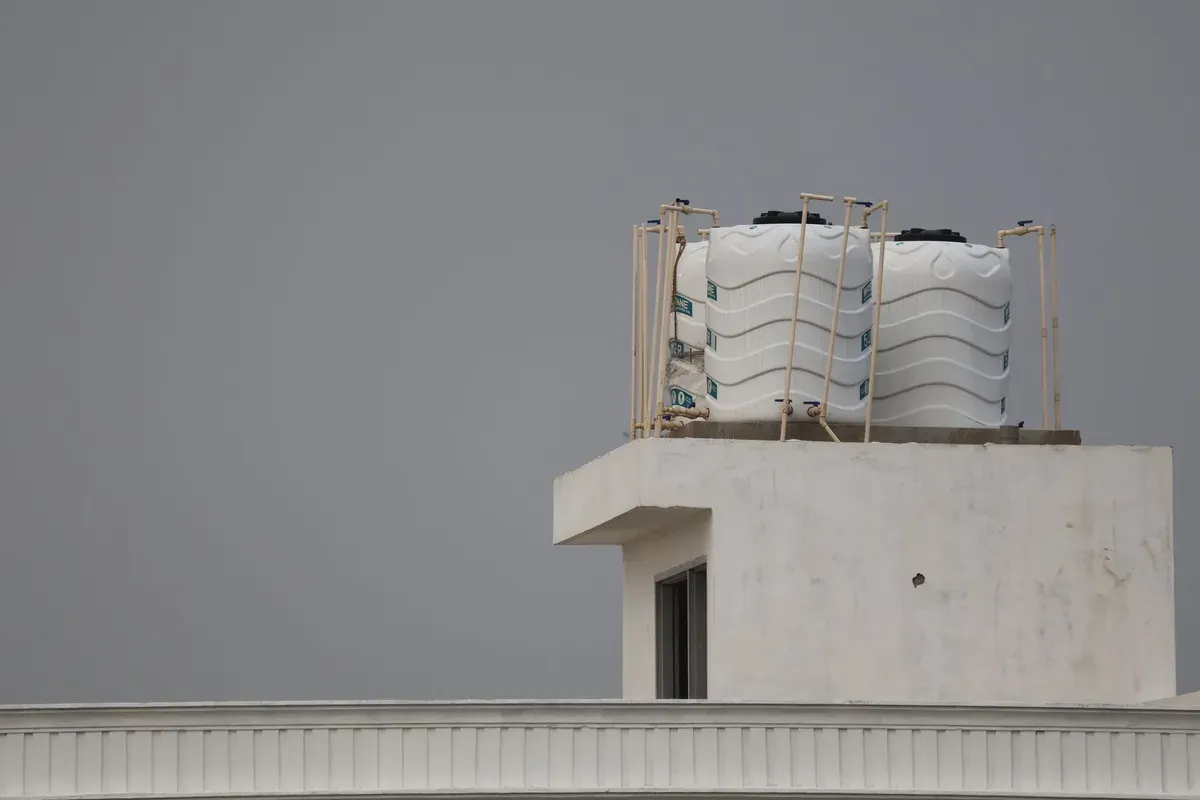
Polyethylene (poly) tanks compliant with SANS 1731:2017 are the default choice for above-ground commercial installations. They are UV-stabilised, do not corrode, and are available from 1,000L to 50,000L. At the commercial procurement scale, the brand matters less than the SANS 1731 certification mark and the supplier’s ability to guarantee replacement parts.
Corrugated steel tanks, such as the Damtech 10,000L kit at R12,999 supply-only, offer a lower entry price but require a liner, careful base preparation, and ongoing inspection for rust ingress at the liner joins. For commercial installations where structural engineering fees add approximately 2% of total construction cost, base preparation should be scoped properly from the start.
For installations where above-ground footprint is constrained, GRP (fibreglass) underground tanks offer a structural advantage that poly tanks cannot match: they can remain empty underground without collapsing during low-demand periods. The trade-off is higher unit cost and more complex installation.
What Good Installation Looks Like
A compliant commercial installation should include: a SANS 1731:2017 certified tank on a properly engineered base, SANS 10252-compliant pipework with the correct pressure class throughout, a booster pump set sized for peak simultaneous demand (not average daily use), a pressure management valve set below 600 kPa, a non-return valve on the municipal inlet, a manual bypass, filtration appropriate to the water source, a UV-C disinfection unit with a fresh bulb, and a PIRB-issued COC on completion. Any installer who cannot itemise all of these on a written quote is not the installer for a commercial project.
Size and cost your commercial backup tank system correctly
Summary: The Numbers That Matter
Commercial water backup in Gauteng is not a luxury purchase. It is an operational and insurance risk management decision with a defined, plannable cost structure. Entry-level 5,000L systems start at R22,500 fully installed (Specialised Maintenance Solutions). Mid-range 10,000L systems run to R80,000+ (WaterQuotes). Industrial 50,000L configurations, properly civilled, pumped, filtered, and compliant, will exceed R140,000 in total installed cost once all line items are included. Annual running costs of R8,000 to R30,000 depending on system size should be budgeted from year one. A PIRB COC costing R850 to R2,500 is not the last thing you get, it is the thing that makes the system insurable. Get it, keep it, and give a copy to your insurer before the system goes live.
Ready to get accurate quotes from PIRB-registered commercial installers who know Gauteng’s specific compliance requirements? Talk to a vetted installer and get a written, itemised proposal before you commit to any hardware.
Get started
Size and cost your commercial backup tank system correctly
Vetted local installers · honest advice first
Photo: Los Muertos Crew / Pexels