Key points
- Some Knysna wards endured up to 4 weeks with zero tap water after a pump collapse, according to Daily Maverick, and Gift of the Givers’ Southern Cape manager confirmed there was no deadline for restoration.
- Mossel Bay’s 2026/2027 tariff schedule runs from R12.20 per kilolitre at baseline to R104.40/kl at the highest tier (mosselbay.gov.za), making overconsumption brutally expensive.
- A basic 5,000L rainwater system costs R12,000 to R22,000 installed (servicelinksa.co.za); a borehole in the Garden Route runs R300 to R500 per metre drilled (boreholepros.co.za).
- George Municipality classifies rainwater tanks as Minor Building Works and mandates 5,000L capacity (or 2,500L minimum where site constraints apply) for all new builds.
- Illegal cross-connection of a borehole to municipal supply carries a R3,000 to R5,000 fine under George Municipality’s 2023 Water and Sanitation By-Laws.
- ABSA, FNB, Nedbank and Capitec all allow homeowners to finance water systems through a home loan readvance (BoreholeHub).
Why the Garden Route Cannot Rely on Municipal Water Alone in 2026
The Garden Route stretches from Wilderness and George in the west through Knysna and Plettenberg Bay to Mossel Bay in the east. It is one of the wetter parts of South Africa, which creates a dangerous false sense of security. Rainfall does not automatically mean a reliable tap. Infrastructure age, population growth, tourism pressure and climate variability mean that municipal supply in this corridor has failed residents repeatedly, and the failures have not been brief or politely resolved.
“The crisis has been continuing, you can say, for years now in Knysna… They still don’t have a deadline on when it will be up and running again.”
That quote should sit with every Garden Route homeowner. Daily Maverick documented that some Knysna wards endured up to 4 weeks with zero tap water following a pump collapse. Four weeks. That is not a drought statistic. That is an infrastructure failure, and it will happen again without significant capital investment by the municipality, which faces its own financial constraints. BusinessTech reported that rapid semigration into Knysna and the Garden Route pushed main dams to 15% capacity, with population growth outpacing municipal supply upgrades.
In Mossel Bay the financial pressure is visible in the tariff schedule. The 2026/2027 residential metered tariff starts at R12.20/kl for baseline use and escalates to R104.40/kl at the highest consumption tier (mosselbay.gov.za). The tiered structure is designed to punish high usage, but it also punishes households that have no alternative when supply is intermittent and they fill emergency storage at whatever cost they can. A backup system that reduces your billed kilolitres is no longer a lifestyle choice. It is cost protection. The Mossel Bay Advertiser has outlined why residents cannot rely solely on long-term municipal timelines and need immediate household backup solutions.
Even when restrictions ease, the relief is temporary. SABC News reported that George Municipality lifted emergency water tariffs and eased restrictions after heavy rainfall refilled the Garden Route Dam to nearly 89%, illustrating just how rapidly tariffs and restrictions can swing in either direction. Meanwhile, Knysna Municipality lowered restrictions from Level 4 to Level 2 following dam recovery but warned of high vulnerability ahead of the summer El Niño cycle. Knysna has also launched a public digital water tower dashboard so homeowners can track reservoir levels in real time, useful for deciding when to top up backup storage before supply tightens again.
The Real Cost of Doing Nothing: Your Monthly Bill Under Pressure
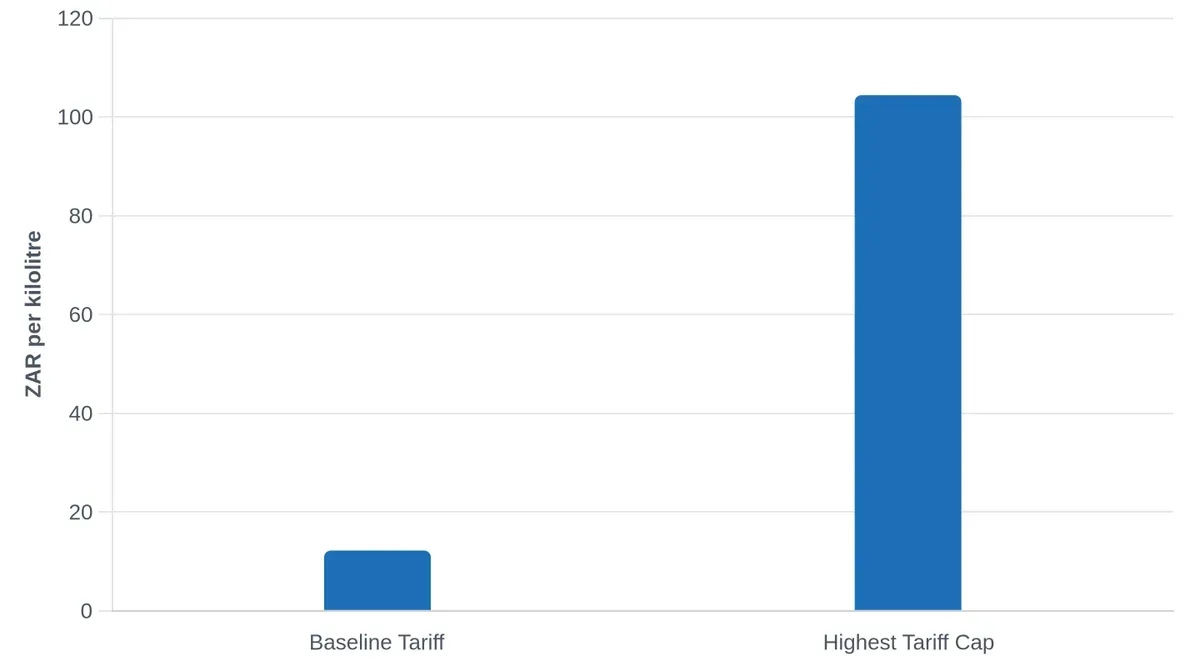
To make this concrete, consider a household consuming 30 kilolitres per month in Mossel Bay. At the baseline tariff of R12.20/kl the monthly water cost would be R366, ignoring fixed charges and VAT. But tiered tariffs do not work that way. Every extra kilolitre over the baseline allowance moves into progressively higher bands. A household that tops up from trucked water or runs extra loads through the municipal meter during a restriction period can find themselves paying rates closer to the upper end of the tariff schedule.
The contrast becomes stark when you look at what a combined rainwater and greywater system actually delivers in practice.
“During drought… Greywater + rainwater covered 80% of toilet and garden needs. Municipal usage dropped to 12 kilolitres/month… Annual water bill R4,200 vs R9,800 pre-upgrade. Savings: R5,600/year. Payback 4 years on rainwater system.”
R5,600 per year in savings against an installed cost of roughly R22,000 at the top of the rainwater system range gives a payback of under 4 years. That calculation was done at lower tariffs than Mossel Bay’s current 2026/2027 schedule. At today’s rates, the payback period shortens further. This is the honest arithmetic that most marketing material buries in vague language. Here it is plainly: a well-designed system pays for itself, and then it becomes pure monthly savings.
System Options, Costs and Cost-Per-Litre: A Comparison Table
Not every Garden Route home needs the same solution. A Wilderness cottage on a small plot with good roof area is a different problem from a Mossel Bay townhouse with an HOA and limited storage space. Below is a breakdown of the main options with verified 2026 ZAR pricing.
| System Type | Capital Cost (ZAR) | Capacity | Approx. Cost Per Litre Stored | Primary Use | Key Risk |
|---|---|---|---|---|---|
| Basic Rainwater (tank + pump) | R12,000 to R22,000 installed | 5,000L (George mandate) | R2.40 to R4.40/L of capacity | Garden, toilet flushing | Seasonal rainfall dependency; not potable without filtration |
| Greywater Recycling (Ecogator 120L) | R9,000 unit + installation | 120L recycled daily from bath/laundry | Ongoing; reuses water already paid for | Irrigation, toilet flushing | Discharge must comply with by-laws; R1,000 to R2,000 fine if not |
| Shallow Borehole (20 to 40m) | R6,000 to R20,000 | Variable; aquifer-dependent | Near zero per litre once drilled | Garden, non-potable use | Brackish risk; aquifer depletion |
| Deep Borehole (60 to 100m+) | R18,000 to R50,000+ (R300 to R500/m) | High yield if aquifer found | Near zero per litre long term | Whole-home supply with treatment | R3,000 to R5,000 fine for illegal municipal cross-connection; mineral contamination |
| Combined Rainwater + Greywater | R21,000 to R31,000+ | 5,000L stored + daily greywater reuse | Best blended cost per litre substituted | 80% of non-potable needs | Requires dual plumbing and correct switch gear |
The cost-per-litre figures above refer to capacity cost, not the ongoing cost of the water itself. Once a rainwater or borehole system is installed and operating, the water it delivers costs you only electricity for pumping (typically very low for domestic volumes) and periodic maintenance. The borehole at R300 to R500 per metre (boreholepros.co.za) sounds expensive until you compare it to R104.40/kl at Mossel Bay’s peak tariff tier. At that rate, 1,000 litres from the municipal main costs R104.40. Pump the same volume from a functioning borehole and your cost is fractions of a cent per litre in electricity.
Borehole Reality Check: What Garden Route Conditions Actually Deliver
The Garden Route sits above a mix of Table Mountain Group sandstone aquifers and fractured rock systems. In theory this is good borehole country. In practice, two boreholes drilled 50 metres apart can yield completely different results, as any honest driller will tell you.
“Ground water like a borehole is extremely risky. The water might not be potable or it can have minerals that are hard/costly to remove via filters. If its a heavily used aquifer you might find the water level dropping over time. One of our neighbours sunk a hole and got extremely good water. The other sunk one and got water thats extremely brackish, can’t even grow grass with it. Both holes are 150+ meters deep ($$$$$$$).”
That observation is not an outlier. The coastal zone from Wilderness to Mossel Bay includes areas where proximity to the ocean or to older industrial activity increases the risk of brackish or contaminated groundwater. Before commissioning any borehole, a reputable hydrogeological survey (expect to pay R3,000 to R8,000 for a proper one) reduces your risk of drilling a dry or brackish hole at R400/metre. Without that survey you are essentially gambling.
When a borehole does work, the numbers can be compelling. One forum user shared a straightforward account of total costs and outcomes:
“Prob a kL per day for me (1 person living alone). Borehole and pump, so zero water bills for me. Cost around R40k to get the borehole drilled (equipment hire and wages) and a few k for tanks and pumps.”
At a single-occupant usage of roughly 1 kilolitre per day, and assuming Mossel Bay’s baseline tariff of R12.20/kl just for simple comparison, the municipal equivalent cost would be around R4,453 per year. The R40,000 borehole investment therefore pays back in under 9 years at baseline tariff. If that household were sitting in a higher consumption tier, payback shortens to 4 to 6 years. For families using 3 to 5 kl per day, the economics are even more compelling, provided the borehole yields good water.
The cautionary tale of deeper drilling also deserves honest attention. One owner drilling in a comparable South African climate context noted:
“Total cost was around R100K but I drilled nearly 100m…”
At boreholepros.co.za’s verified rate of R300 to R500 per metre, 100 metres of drilling alone lands at R30,000 to R50,000 before you have added casing, a pump, pressure tank, pipework, filtration and an electrical connection. Budget creep on boreholes is common and sometimes dramatic. The George Municipality 2023 by-laws also require that any home using groundwater display an “OWN WATER” sign, and that the borehole connection must never be cross-linked to the municipal supply. Violating that cross-connection rule brings a fine of R3,000 to R5,000.
Rainwater Harvesting in the Garden Route: The Regulatory Reality
George Municipality has gone further than most South African municipalities in mandating water resilience. All new residential buildings must include a minimum 5,000L rainwater tank (or 2,500L where genuine site constraints prevent the larger size). The municipality classifies tanks as Minor Building Works, which simplifies approval compared to major structures, but approval is still required.
In practice, that approval requirement generates genuine frustration among homeowners who feel the process is slow and counterproductive.
“They just want to penalise the residents for saving water… How ridiculous! that I need approval from the Municipality to have a rainwater tank on my property.”
“Who is going to apply[?] You are lucky if your application ends up on a desk. If it does it will take a year to proceed and get an answer. No thanks.”
Those sentiments are understandable. They are also dangerous counsel to follow. Installing a tank without the required approval in George exposes you to enforcement action, and more critically, an unapproved installation can void your building insurance. More on insurance below. File the Minor Building Works application. It is a relatively straightforward process compared to full building plan approval, and the paper trail protects you if you ever need to claim or resell.
On the integration of rainwater into the household supply, the electrical compliance requirement is worth noting explicitly. Fixed pressure pumps connected to a household system must have an isolator switch within 1.5 metres of the appliance to pass Certificate of Compliance in Mossel Bay and George (rceservices.co.za). This is not optional, and any installer who suggests wiring the pump without it is setting you up for a failed CoC at transfer or on insurance claim.
“I have 12,500 litre rain water capacity using two Jojo tanks and a pump… Feeding this to the house into the house water supply is easy in my case, but the Municipal regulations require very expensive switch over valves (health and safety reasons?). I have not added filters for providing potable water – that is next phase!”
That experience is typical. The switchover valve (an automatic changeover or manual isolation valve that prevents rainwater from backflowing into the municipal main) is not optional under the George by-laws. It is the same health and safety requirement that makes cross-connection illegal. Budget R2,000 to R6,000 for a compliant automatic changeover setup on top of the basic tank and pump cost.
If you want to know which system George, Knysna, or Mossel Bay regulations allow at your specific address, check my address on the WaterPointSA tool for a location-specific assessment.
Greywater Systems: The Overlooked Quick Win
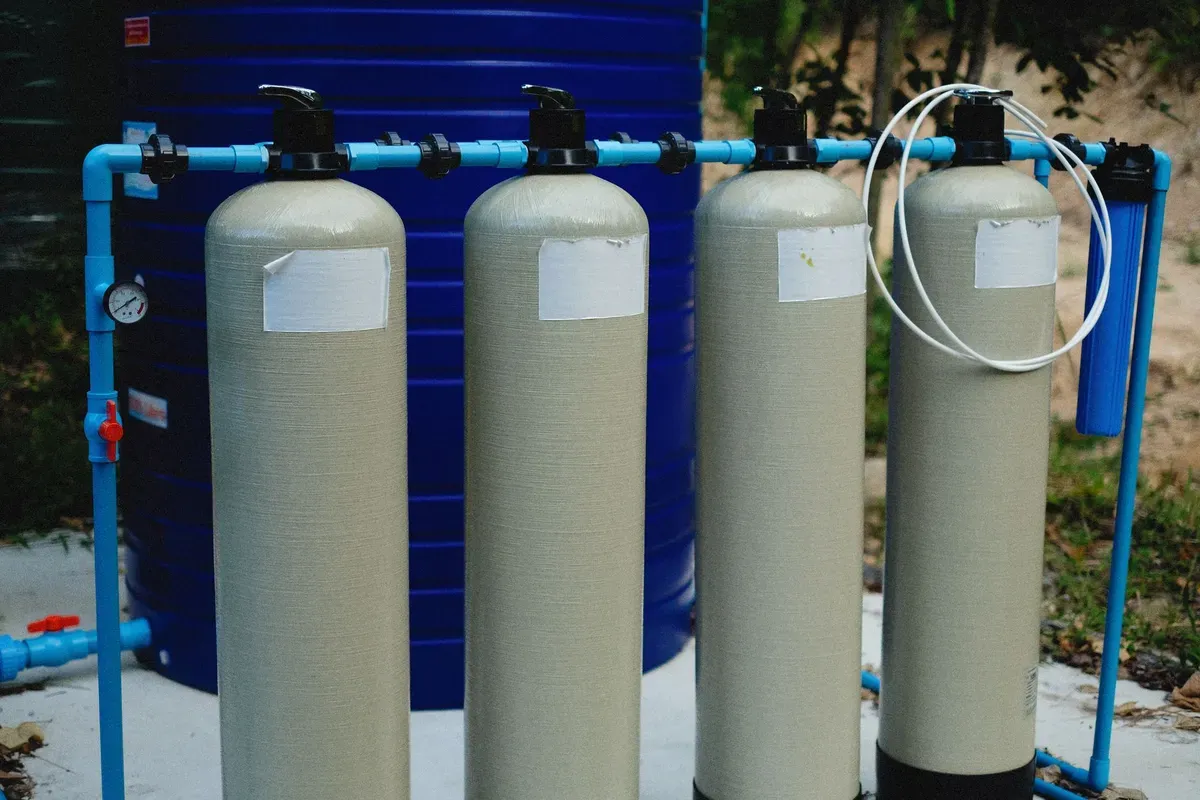
Greywater systems do not generate as much excitement as boreholes but they are often the fastest payback option in the Garden Route. The Ecogator 120L system retails at R9,000 before installation (servicelinksa.co.za). It captures water from bath, shower and laundry outlets, filters it to an acceptable standard for irrigation and toilet flushing, and reduces your billed municipal consumption.
A family of four generating 200L of greywater per day from bathing and laundry, and redirecting that to toilet flushing (roughly 60L/day for two toilets) and garden irrigation, can cut non-potable municipal consumption by 6 to 8 kilolitres per month. At Mossel Bay’s baseline of R12.20/kl, that is R73 to R98/month in direct savings. At a higher tier it is more. The system’s R9,000 cost therefore has a payback of 7 to 10 years at baseline or 3 to 5 years if you are in a higher consumption tier, before installation costs are factored in.
The discharge compliance requirement matters here too. Under George Municipality’s 2023 by-laws, discharging unapproved effluent (including non-compliant greywater) carries a fine of R1,000 to R2,000. A compliant greywater system with proper filtration and a dedicated irrigation or toilet circuit avoids that risk entirely.
The Garden Route Climate Factor: What the Humidity Does to Your System
The Garden Route’s famous lushness comes from high humidity, heavy rainfall in winter months and the temperamental mix of coastal wind and forest microclimate. This is a double-edged situation for backup water system owners. The rainfall makes rainwater harvesting more productive than in drier regions. But the moisture also creates specific maintenance challenges that buyers from the Cape Peninsula or Gauteng do not always anticipate.
“It gets a ton of afternoon sun but also a ton of moisture due to the trees, clay soil and rain we get in the Garden Route… The walls and ceiling are reasonably insulated but the floor has zero insulation [causing damp].”
Tanks installed in low-lying or tree-shaded positions in areas like Wilderness, Sedgefield or the forested suburbs of Knysna are prone to algae growth if not opaque, and to exterior mould if not properly sealed at the base. Pump housings and pressure switches in permanently humid environments corrode faster than the same equipment in George or Mossel Bay’s drier coastal areas. Budget a realistic R800 to R1,500 per year for preventive maintenance including tank cleaning, filter replacement and pump inspection. Skipping this is how a R15,000 system becomes a R25,000 system after an emergency pump replacement in year 3.
Buying a Property with an Existing Backup System: Due Diligence Checklist
The Garden Route property market has seen a wave of homeowners retrofitting tanks, boreholes and greywater systems, partly driven by the Knysna water crises and partly by the national load-shedding era which prompted a broader investment in home resilience. This means that many properties now advertise backup water as a selling feature. Buyers need to verify those claims before transfer.
“If it was not mentioned on the OTP [Offer to Purchase], then it is a derelict or abandoned fixture… sometimes sand or mud pushes up rendering it ineffective… That’s probably why it was not communicated to you… it’s not in working condition.”
That scenario is unfortunately common. Before signing an OTP on a property claiming a borehole, insist on: a recent water quality test result; confirmation the borehole is registered with the Department of Water and Sanitation; evidence of a functioning pump and pressure tank; the Certificate of Compliance for the electrical connection; and the municipal compliance certificate confirming legal non-connection to the municipal main. For rainwater tanks, ask for the Minor Building Works approval documentation from the municipality.
A compliant, documented and functional backup system adds genuine value at resale. An undisclosed, non-compliant or non-functional system is a liability, not an asset. The difference is paperwork and honest installation from the start.
Is your Garden Route property ready for the 2026 tariff surge?
Insurance, Financing and the Admin You Cannot Ignore
Discovery Insure automatically covers borehole and other water pumps used for domestic purposes under building insurance for accidental loss or damage. That is a meaningful benefit. However, MiWay Insurance applies strict exclusions and will not cover damage caused by a borehole that does not meet regulatory standards. This is not a MiWay-specific quirk. Most South African insurers will scrutinise compliance when a claim involves a backup water system.
Santam Insurance notes that water tank, apparatus and pipe claims are consistently among the most common in South Africa. Compliant installation, proper electrical certification and municipal approval documentation are what separate a paid claim from a rejected one.
On financing, the four major banks offering home loan readvances for water system costs are ABSA, FNB, Nedbank and Capitec (BoreholeHub). A readvance is not a new loan: it draws on equity already built in your bond, typically at your existing home loan interest rate. For a R40,000 borehole installation, the monthly bond repayment addition at a 9% interest rate over 20 years is roughly R360/month. If that borehole eliminates R800 to R1,200/month in water costs, the net monthly saving is positive from day one.
One final budget warning that applies specifically to larger projects. A Western Cape homeowner building in conditions similar to the Garden Route gave an honest account of budget management:
“I also have water storage tanks and I am setting up a greywater system to irrigate. The Western Cape is in the midst of the worst drought in recorded history… And despite the fact that I thought I had budgeted down to the last South African Rand, I still fell short by around 20%!”
Add 20% to whatever quote you receive for a borehole or combined system installation. That buffer is not pessimism. It is the standard contingency that experienced installers and project managers apply to water infrastructure work, where soil conditions, rock depth and compliance requirements regularly surprise even careful planners.
The Pump Failure Problem: Why Installation Quality Matters as Much as Equipment
The Knysna municipal crisis was fundamentally a pump failure problem. The same failure mode exists at household scale when backup systems are installed carelessly. This is a documented and preventable risk.
“Pump failure due to incorrect installation (original geyser was fitted horizontally with the 24v pump below the water line but new geyser fitted vertically with old pump on top [causing it to run dry]).”
A pump running dry destroys the motor within minutes. On a borehole this means pulling the pump from depth and replacing it, a job that costs R4,000 to R12,000 depending on depth. On a surface-mounted pressure pump it is cheaper but still avoidable. Always confirm that your installer includes a dry-run protection device (a flow switch or pressure sensor that cuts power before the pump runs dry) in the quote. This component costs R300 to R800 and it is non-negotiable.
Cost-of-Ownership Summary: The Honest 10-Year Comparison
| Scenario | Year 1 Cost | Annual Running Cost (Years 2 to 10) | 10-Year Total | 10-Year Municipal Bill (Baseline, 20kl/month) |
|---|---|---|---|---|
| No backup system (municipal only) | R0 | R2,928+ (at R12.20/kl x 20kl x 12) | R29,280+ (rising with tariff increases) | R29,280+ (excludes fixed charges, VAT, tier escalation) |
| Rainwater system (R17,000 mid-range) + greywater (R12,000 installed) | R29,000 capital | R1,200 maintenance + R1,200 residual municipal (8kl/month) | R50,200 total (capital + running) | Municipal bill drops from R2,928 to approx R1,171/year |
| Productive borehole (R45,000 all-in) + basic tank | R45,000 to R50,000 capital | R1,500 maintenance + minimal electricity | R62,500 to R67,500 total | Municipal non-potable bill near zero; potable reduced 50 to 70% |
The 10-year comparison makes the case plainly. The no-backup scenario looks cheapest in year 1. By year 4 to 5 the combined rainwater and greywater system has erased its own capital cost through savings. By year 10 the backup-equipped homeowner is ahead and holds a documented asset. The homeowner on municipal supply alone has simply paid for water and received nothing durable in return, and that is before factoring in the weeks they spent without any water at all.
To find out which backup water options are viable at your specific address in George, Knysna, Mossel Bay or Wilderness, check my address on the WaterPointSA tool for a location-specific assessment.
Get started
Is your Garden Route property ready for the 2026 tariff surge?
Vetted local installers · honest advice first
Photo: Nicolaas Swart / Unsplash