- The Department of Water and Sanitation (DWS) classifies 78% of Limpopo’s water infrastructure as critically decayed.
- Only 49% of the province has a reliable water supply, according to the South African Human Rights Commission (SAHRC).
- Polokwane loses 38% of treated bulk water to pipe leaks before it reaches taps, and faces a daily deficit of 13 million litres as of March 2026.
- Greater Tzaneen Municipality approved a 101.5% water tariff increase for Tzaneen and Letsitele for 2026/27, after residents were promised 3.7% at public meetings.
- A fully equipped domestic borehole in Polokwane costs R40,000 to R95,000, with a standard 80m setup averaging R82,340 all-in.
- Borehole payback period runs 5 to 9 years when set against rising tariffs and avoided emergency water costs.
- DWS launched a 90-day registration deadline for all water users on 24 April 2026. Legal compliance is not optional.
- Rainwater harvesting is a viable supplement but cannot replace a borehole for year-round water independence in Limpopo.
The scale of the problem: by the numbers
Limpopo’s water crisis is not a prediction or a political talking point. It is a documented, measurable infrastructure collapse. The DWS confirms that 78% of the province’s water systems are in a critical state of decay. The SAHRC finds that only 49% of Limpopo households have a reliable supply. Stats SA records that 25.9% of households in the province experience weekly water interruptions. These are not outlier events in remote areas. They describe the daily reality for residents from Polokwane to Tzaneen to Vhembe.
The consequences for homeowners are direct and financial. Every unplanned outage means buying water from a tanker, losing productive hours, and watching the value case for your property quietly erode. The question is no longer whether the municipal system will fail you. The question is how long it already has, and what you are going to do about it.
“Our communities have endured prolonged water outages, inconsistent supply, collapsing infrastructure, and a complete lack of accountability… Residents of Polokwane do not care about political excuses, intergovernmental disputes, or endless technical reports and the blame game between water authorities; they just want water!”
The worst offenders: municipality by municipality
Polokwane Local Municipality
Polokwane is the provincial capital, but its water infrastructure performs well below that status. According to Polokwane Municipality’s own figures, 38% of all treated bulk water is lost to leaking pipes before it reaches any tap. As of March 2026, the city faces a structural daily water deficit of 13 million litres, according to polokwane.gov.za. For the 2025/2026 financial year, the municipality approved water block tariff hikes of 10.2% to 11.2% (Polokwane Municipal Draft Budget), meaning residents are paying more for a supply that delivers less. Rationing schedules have become routine across multiple suburbs, pushing residents toward self-supply solutions at a rate the drilling industry in the area is visibly struggling to keep up with.
Modimolle-Mookgophong Local Municipality
Academic analysis of this municipality places the deterioration rate of its water network at 80%, the highest figure confirmed for any single Limpopo municipality in the available evidence. That means four in every five components of the local network are degrading without adequate repair or replacement. Residents in the area report the familiar pattern: promises at public meetings, sporadic repairs, and extended periods without supply.
Greater Giyani Local Municipality
Giyani has become a symbol of chronic failure in Limpopo’s water story. Outages here are not measured in days. They are measured in weeks and months.
“Sometimes we can go almost a month with no tap water… They have made many promises, but they have not fixed anything.”
Greater Tzaneen Local Municipality
Tzaneen presents a distinct but equally serious threat: the tariff shock. For the 2026/27 financial year, Greater Tzaneen Municipality approved a 101.5% water tariff increase for Tzaneen and Letsitele, according to citizen.co.za. This came after residents were told to expect a 3.7% increase at public consultation meetings.
“There is no justification for misleading residents. They were deliberately given incorrect information during the public meetings [where they were promised a 3.7% hike]. Tzaneen residents are already affected by poor service delivery, frequent water outages and crumbling infrastructure. Imposing such exorbitant tariff hikes after promising much lower increases is morally wrong and financially unsustainable.”
A household that was budgeting for a modest tariff adjustment now faces a bill that has more than doubled. Against that backdrop, the capital cost of a private backup system recalculates very quickly.
Musina Local Municipality and Vhembe District
In Musina, the failure is so entrenched that even residents who have invested in backup tanks cannot rely on them, because the municipal supply they depend on to fill those tanks rarely materialises.
“I sacrificed to buy this Jojo tank from my old-age grant… [but because of the municipal supply failure] my Jojo tank rarely fills up and is often empty.”
In the Vhembe district, communities are no longer waiting for the state. Community leader Maduwa in Nthabalala describes what self-organised water security looks like in practice:
“We have no choice but to think for ourselves, otherwise we will suffer for a long time anticipating that the municipality will fix the boreholes.”
Your legal position before you drill or harvest
Before spending a rand on any backup system, you need to understand where you stand legally. On 24 April 2026, the DWS launched a strict 90-day nationwide deadline for all water users to register or update their water use information, according to www.gov.za. This deadline has now passed, but the registration obligation is permanent and ongoing.
Under Schedule 1 of the National Water Act, you are exempt from a formal water use licence if you extract less than 10,000 litres per day and irrigate less than 0.5 hectares of land (www.gov.za). Most domestic boreholes fall within this exemption. However, “exempt” does not mean unregistered. You must still register with the DWS. Failing to do so exposes you to administrative penalties and, in a worst case, an order to seal your borehole.
For rainwater harvesting of rooftop water for domestic non-potable use, no licence is generally required. But if you intend to plumb it into your home’s potable supply, get written confirmation from your municipality first, as bylaws vary.
Borehole systems: real costs, hidden costs, and what owners actually paid
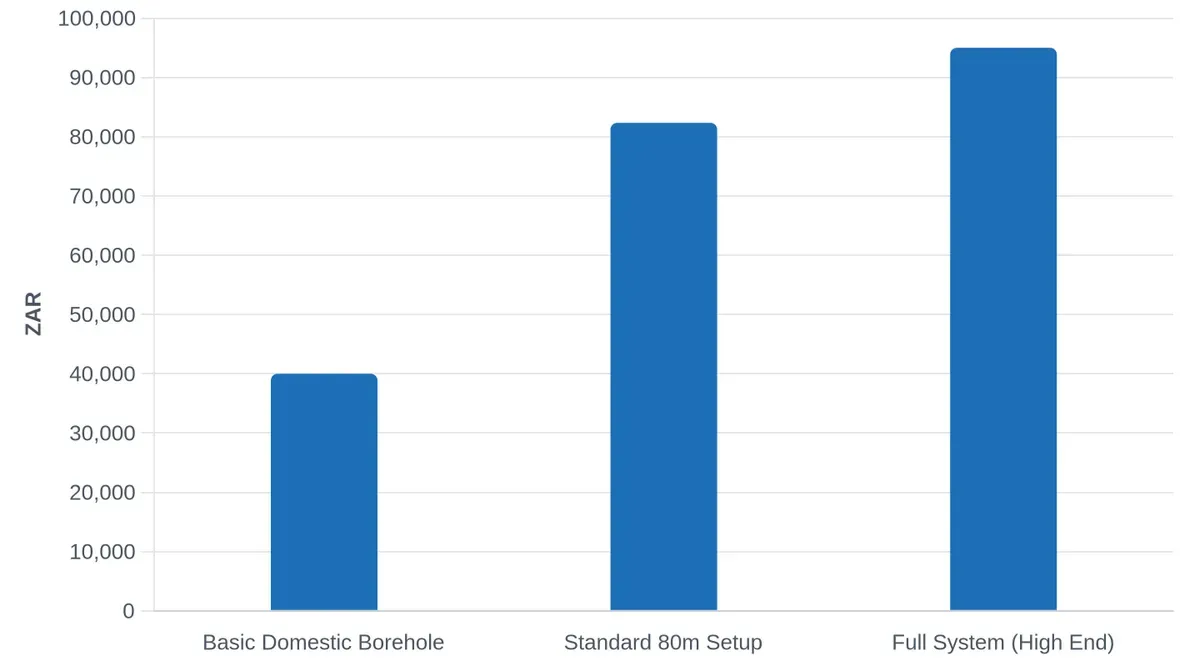
A domestic borehole in Polokwane typically costs between R40,000 and R95,000, with drilling alone averaging R410 per metre, according to boreholerepair.co.za and Industry Pricing Guides. A standard 80m setup works out to an average all-in cost of R82,340 (Industry Pricing Guides). The July 2026 waterpointsa.co.za report places the range for a full residential borehole system nationally at R50,000 to R100,000.
What the headline figure does not tell you is where the money actually goes. One homeowner who documented his full installation itemised it bluntly:
“I went for the company that charged 320 per meter for drilling and 600 per meter for casing and no setup fee… solid rock was reached at 21 meters… Total depth 45 meters… The drilling in total cost R 27000. Here is the hidden costs: All the drill cuttings needs to be removed and cleaned… Pump installation: This is an area where consumers need to be very careful… They will tell you they first need to pump the hole dry to establish the yield… R 2500 for this. Secondly they will tell you, you need a 1.1kw pump and this will cost R18 000… Don’t fall for this crap.”
The hidden cost that catches most owners off guard is water quality. Limpopo groundwater frequently presents with low pH, high sulphur, or elevated iron content. A borehole owner who discovered this learned an expensive lesson:
“Normal ground water from boreholes usually have a Ph of about 6.5 or lower… anything under 7.2 is too corrosive for copper pipes. From experience water with a 6.6 Ph started dissolving our pipes within 10 days… very bad taste, small green lines running where a tap drips… It will eat your geyser quickly… As a best guess – to increase relatively clean borehole water with a Ph of 6.6 to about 7.4 requires at least a 1000l settling tank, about 750kg of lime rocks… This alone will cost about R6500.”
Simple filtration systems cost R2,000 to R10,000 (Industry Pricing Guides). Complex treatment for pH or mineral issues can exceed R20,000 (Industry Pricing Guides). One owner summarised his full spend:
“I paid around 55k for 50m – 60m drilling, with casing. Borehole pump was around 30k. Filtration system around 27k. My water was too sulphuric and irony.”
Finding water before you drill is a cost that surprises many first-timers. A reputable hydrologist can confirm a site with above 90% success probability, but that service costs around R20,000 (forum user ‘McRuder’). Others have used traditional water diviners for as little as R1,000 (forum user ‘Tabac’), with mixed results. One experienced owner who has drilled two domestic boreholes puts it plainly: “R30,000 for a 60m deep borehole seems way too cheap, I would double that cost.”
On pump quality, the evidence consistently points in one direction. One owner spent R100,000 on a nearly 100m deep installation using quality components, including a Franklin motor, and notes he “could have used cheaper components and saved R30K in the short term.” Another owner who chose cheaper parts described what happened next: “Borehole pump pulls water from about 3 minutes. Then the water just stops but I can hear the pump still running… Just had it recently installed but the guy is now ignoring my calls.” In high sand and sediment environments, AfriPumps recommends servicing borehole pumps every 6 months to avoid total failure.
Borehole operating costs
Electricity to run a borehole pump costs R300 to R600 per month (Industry Pricing Guides). Routine annual maintenance runs R1,000 to R2,500 per year (Industry Pricing Guides). Skip that maintenance and you are looking at emergency repair bills of R8,000 to R15,000 (Industry Pricing Guides). One owner captured the lesson succinctly: “Added a run dry protection for my booster pump as this was my weak point in my system when the tank ran dry and damaged my pump twice.”
Rainwater harvesting in Limpopo: what it can and cannot do
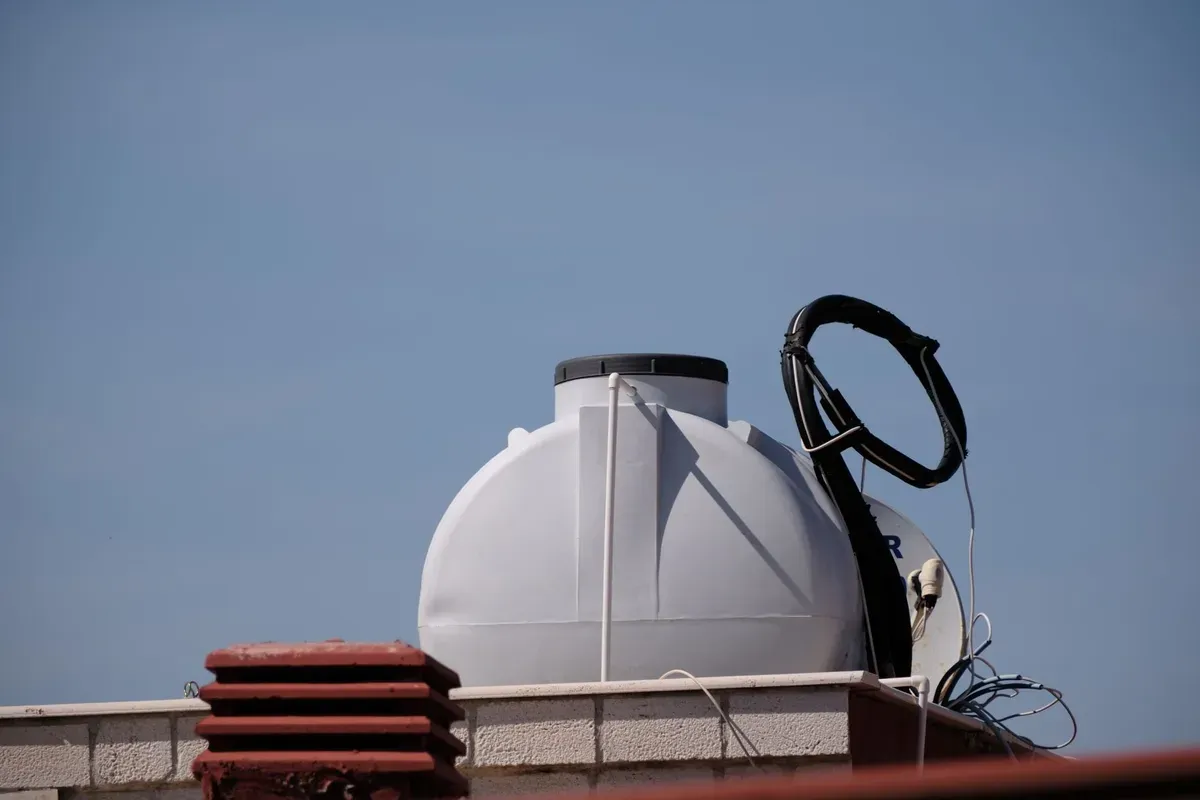
Rainwater harvesting is a legitimate supplement to a borehole or as a first step toward water independence for households that cannot yet afford to drill. A basic garden setup with a barrel or tank costs R1,500 to R3,000 (Industry Pricing Guides). A medium plumbed domestic system with a 2,500L to 5,000L tank costs R8,000 to R25,000 (Industry Pricing Guides). A comprehensive large-home system currently costs between R30,000 and R80,000 or more, according to waterpointsa.co.za.
In Limpopo’s climate, any rainwater harvesting system must include first-flush diverters, mosquito mesh, and filter screens to prevent organic decay, algae, and blockages, according to jojo.co.za. Waterwell Drilling notes that particles of green algae from unmaintained rainwater tanks start blocking water pipes and output points. Grey water, which some homeowners attempt to recycle to extend supply, carries its own hard limit: WATERfirst confirms that grey water becomes as toxic as sewage water within 48 hours of storage if not treated. One owner who discovered biological contamination in their harvested water after installation described the result: “Just need to get a proper UV filter system installed now as the e-coli levels are a bit high, so at the moment I can only use it for irrigation.”
The core limitation of rainwater harvesting in Limpopo is the climate itself. Polokwane averages around 500mm of rainfall per year, concentrated in the summer months. For year-round water independence, rainwater harvesting alone is insufficient. It works best as a supplementary layer alongside a borehole.
Cost and specification comparison table
| Solution | Capital cost | Annual running cost | Supply independence | Key risks |
|---|---|---|---|---|
| Borehole (full domestic, Polokwane) | R40,000 to R95,000 (avg R82,340 at 80m) | R4,600 to R9,700 (electricity plus maintenance) | High: year-round, independent of municipal supply | Dry hole, poor water quality, pump failure, vandalism |
| Borehole (with complex filtration) | R60,000 to R115,000+ | R5,600 to R11,200 | High: potable-quality water possible | High upfront; filter media replacement ongoing |
| Rainwater harvesting (large home system) | R30,000 to R80,000+ | Low (filter replacement, cleaning) | Seasonal: limited in dry months (May to September) | Algae, biological contamination, inadequate rainfall |
| Rainwater harvesting (medium plumbed) | R8,000 to R25,000 | Very low | Partial: supplement only in Limpopo climate | Same biological risks if unmaintained |
| Storage tank (JoJo, municipal top-up) | R1,500 to R5,000 | Minimal | Low: entirely dependent on intermittent municipal supply | Fails entirely when municipal supply fails for extended periods |
Cost-of-ownership comparison: borehole versus rising municipal tariffs
The financial case for a borehole depends on one variable above all others: how fast municipal tariffs are rising. In Tzaneen, the 2026/27 increase of 101.5% (citizen.co.za) means a household paying R800 per month on water will now pay approximately R1,612 per month. Over five years at that base, even before any further annual increases, that is close to R100,000 in municipal water costs alone.
In Polokwane, the approved tariff increase of 10.2% to 11.2% (Polokwane Municipal Draft Budget) is smaller but compounds annually on top of a supply that is already structurally deficient. A standard 80m borehole at an average total cost of R82,340, running at R300 to R600 per month in electricity and R1,000 to R2,500 per year in maintenance, has a modelled payback period of 5 to 9 years (Industry Pricing Guides). Against Tzaneen’s tariff trajectory, that payback period shortens materially.
The hidden cost on the municipal side that most household budgets do not capture is emergency water procurement during outages: water tanker deliveries, bottled water, and lost time. These costs are real and recurring for the 25.9% of Limpopo households experiencing weekly interruptions (Stats SA). They do not appear in the municipal tariff comparison, but they belong in any honest cost-of-ownership calculation.
The storage-tank-only approach, which many residents default to as the cheapest entry point, is demonstrably not a solution in the most affected municipalities. As 100-year-old Musina resident Judas Tlou’s situation illustrates, a tank that cannot be filled by a failing municipal supply provides no water security at all.
Does your Limpopo municipality meet your water needs?
What actually works: strategies residents are using right now
Borehole with quality components and pre-drill testing. The consistent lesson from owners who have done this well is: do not compromise on the pump, test your water chemistry before you choose your filtration, and factor in a hydrologist or at minimum a recognised water diviner before you drill. Madima Borehole Drilling’s published rates of R300 per metre for drilling and R550 per metre for steel casing give you a benchmark to compare quotes against. The per-metre rate is only part of the story. Get a full itemised quote before signing anything.
Run-dry protection on pumps. Fitted from installation, this component prevents the single most common cause of early pump failure in residential systems and costs a fraction of the R8,000 to R15,000 emergency repair it prevents.
Rainwater harvesting as a supplementary layer. For households that have already drilled a borehole, a medium plumbed rainwater system at R8,000 to R25,000 adds meaningful resilience during the rainy season and reduces borehole pump run-time and operating cost. Ensure first-flush diverters and mosquito mesh are included from installation, not retrofitted after a problem appears.
Community pooling in high-failure areas. In the Vhembe district, 240 households pooled money to drill a single community borehole. This approach reduces individual capital cost significantly and is worth exploring through civic structures, stokvel models, or body corporate arrangements in sectional title developments.
DWS registration and documentation. Register your water use with the DWS and keep copies of all drilling logs, pump specifications, and water test results. This protects your investment legally and is required for any future property transaction where the borehole forms part of the sale.
What to avoid
Vandalised infrastructure is a documented risk in Limpopo. One local businessman who privately funded a public borehole for his community reported: “For the first three months I managed to pay my ten workers from my own pocket… The borehole has since been vandalised.” For domestic installations, secure your pump housing and invest in a lockable surface casing cover.
Do not assume a low drilling quote means a low total cost. The drilling rate is one line item. Casing, pump, pressure tank, controller, filtration, run-dry protection, and first yields testing all add up. Madima Borehole Drilling’s competitive rates of R300 per metre for drilling and R550 per metre for steel casing are useful anchors, but the full system cost is what matters.
Finally, do not treat a JoJo tank connected to a deteriorating municipal supply as water security. As the evidence from Musina and Giyani confirms, when the supply fails for weeks at a time, the tank empties and stays empty. Independent supply, not buffered municipal supply, is the only reliable protection in the worst-affected municipalities.
If you are a Limpopo homeowner and you are not yet sure which backup option is viable at your specific address, the most useful first step is to check what is already known about groundwater depth and quality in your area before committing any capital. Check my address to get a location-specific assessment for your property.
Get started
Does your Limpopo municipality meet your water needs?
Vetted local installers · honest advice first
Photo: Alexas Fotos / Pexels