- Rosedale, Lovemore Heights and Upper Tank reservoirs were confirmed at 0% capacity in July 2026, and the municipality admitted no water trucks were available during outages.
- Borehole drilling in Gqeberha costs R310 to R560 per metre in softer ground and R440 to R1,650 per metre in harder formations; a complete residential system runs R100,000 to R200,000 all-in.
- Nearly 40% of boreholes drilled into Uitenhage Group formations yield less than 0.5 L/s, a failure rate that suppliers rarely quote upfront.
- Roughly 65% of private boreholes in the municipal area are concentrated in Summerstrand and Walmer, where Table Mountain Group sandstones produce the best yields.
- A standard 10,000-litre commercial tank system with a basic pump is available in Port Elizabeth for R31,250, making tanks the faster and lower-risk entry point for most households.
- Borehole registration under Clause 31 of the NMBM Water and Sanitation Services By-law is compulsory. Selling domestic borehole water is illegal. Non-compliant plumbing attracts fines of up to R1,000 per violation.
- Energy costs account for more than half of the total lifecycle cost of owning a borehole.
The state of the water supply right now

Nelson Mandela Bay’s infrastructure crisis is not a prediction or a future risk. As of July 2026, key reservoirs including Rosedale, Lovemore Heights and Upper Tank were confirmed standing at 0% capacity, according to Freedom Front Plus monitoring data. When residents called for relief, the response was blunt.
“Notwithstanding the various water outages across the metro currently, there are unfortunately no water trucks available.”
The breakdown in basic service delivery is not new, but the July 2026 reservoir data confirms that it has worsened. Lorna, a resident dealing with an unresolved burst pipe, describes what municipal responsiveness actually looks like on the ground:
“Everytime we call [Nelson Mandela Bay Municipality] we are given reference numbers and a promise that the workers will come and fix it. We received two reference numbers, one for our water meter and another one for the burst pipe. A municipal official came here three times and told us not to worry because this is municipal water that gets wasted, it won’t effect our water account.”
Against this backdrop, more Gqeberha property owners are asking whether a borehole or a tank is the right investment. The answer depends heavily on your suburb, your soil, your budget, and how carefully you read the compliance rules.
Gqeberha’s geology: why your suburb matters more than your budget
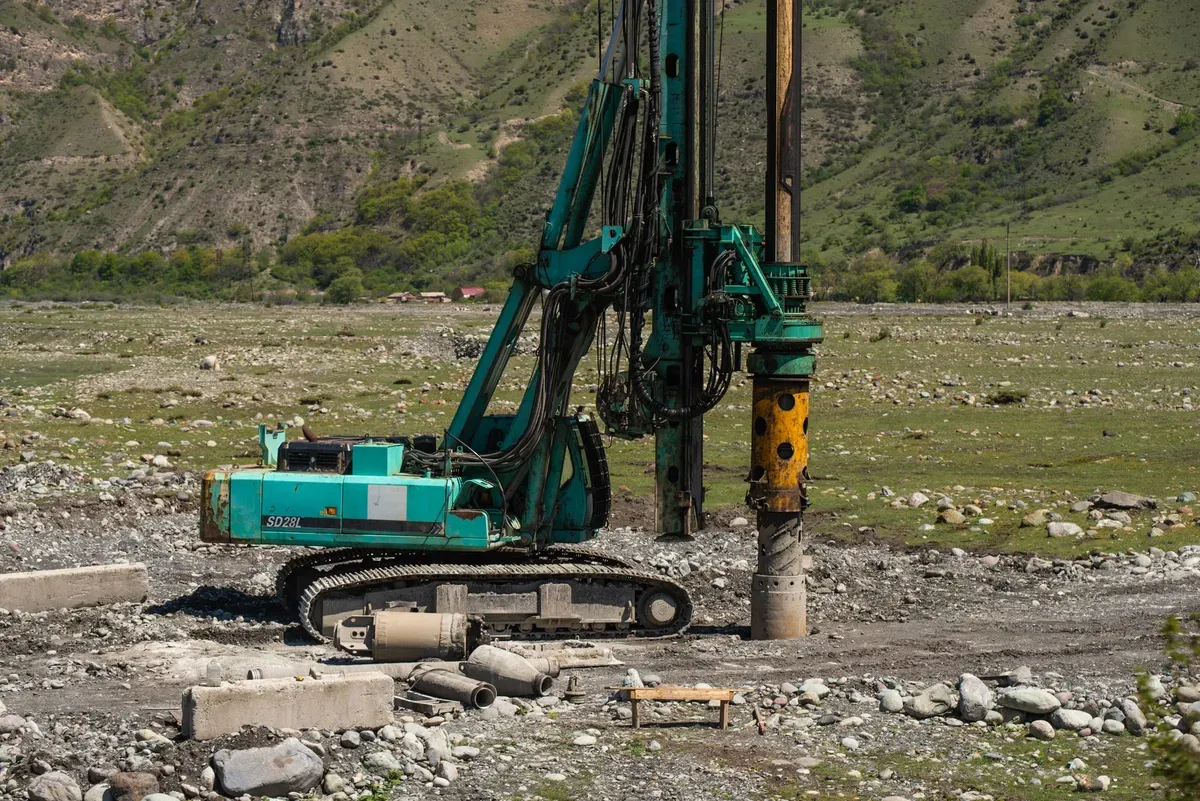
The single most important factor in borehole viability in Nelson Mandela Bay is geology, not price. The municipality sits over two very different aquifer systems, and choosing the wrong site can mean a dry hole that still costs R50,000 to R75,000 to drill in central PE (borehole-repair.co.za).
The good news is in the south. Summerstrand, Walmer, and the coastal suburbs overlie the fractured Table Mountain Group sandstones of the Uitenhage Artesian Basin. Research published via wrc.org.za puts typical yields for boreholes tapping these formations at 5 L/s to 10 L/s. That is genuinely useful water. The Coega IDZ production borehole GWA 2B, drilled to 200 metres into the same general system, achieved an estimated yield of 50 to 100 L/s (wrc.org.za). The Elizabeth Donkin Psychiatric Hospital borehole yields 14,000 litres per hour (polity.org.za). Coca-Cola Beverages SA’s Gqeberha boreholes average 27,000 litres per day per site (polity.org.za). These are industrial-grade results, but they illustrate the potential of the southern coastal formations.
The bad news is everywhere else. Boreholes drilled into the Uitenhage Group formations, which underlie a large portion of the metro north and inland, carry a failure rate approaching 40% for yields below 0.5 L/s (enviroleg.co.za). That is not a fringe outcome. It is roughly a coin flip weighted against you.
The geographic concentration of success is stark. Roughly 65% of all private boreholes in the municipal area are located in Summerstrand and Walmer (azurewebsites.net). That figure reflects both geology and risk-awareness among drillers and property owners. The Nelson Mandela University Ocean Sciences Campus borehole in Summerstrand, drilled to 199 metres, is a useful calibration point: it returned a TDS of 820 mg/L (researchgate.net), which is above the ideal drinking water threshold of 500 mg/L but within the range treatable with reverse osmosis. Water quality testing before committing to a domestic drinking supply is not optional; it costs R1,000 to R3,000 per test (talbot.co.za).
In rural NMB and hard-rock areas further inland, drilling costs rise to R60,000 to R120,000 (boreholerepair.co.za) and failure risk increases further. Before spending a rand on a driller, commission a hydrogeological desktop study for your specific erf.
“Yes, there are boreholes, but they cost a fortune (R60 000+) and can run dry if too many people do that.”
The real cost of a residential borehole in Gqeberha
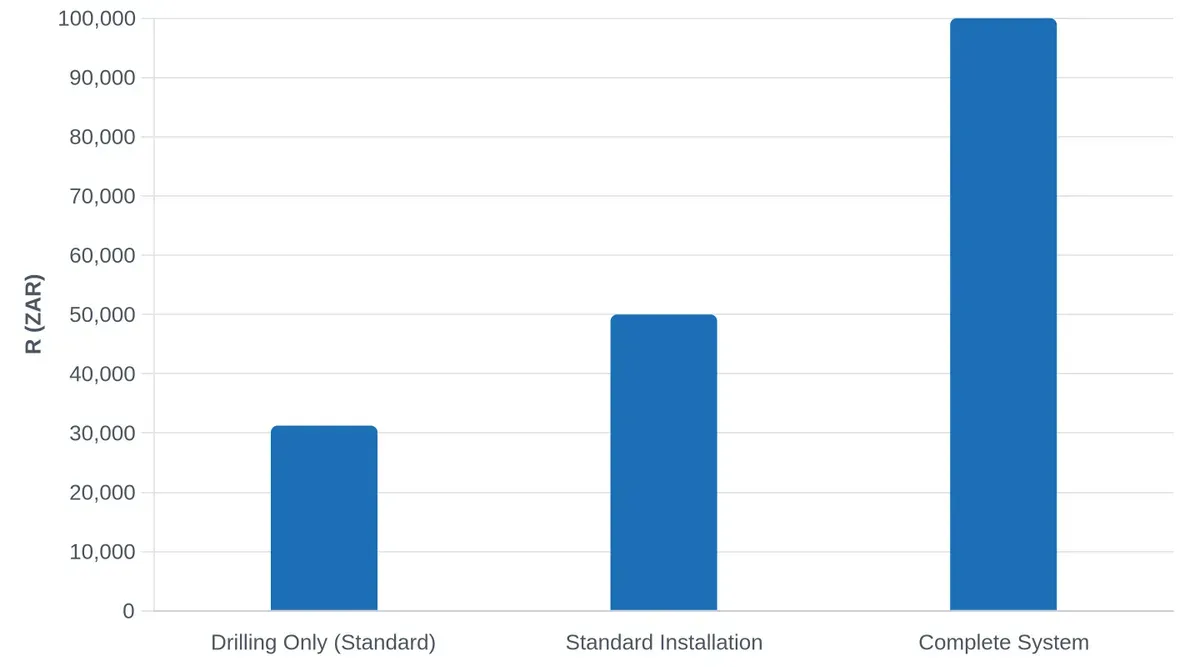
Supplier quotes almost always show drilling only. The full picture is considerably more expensive.
Drilling rates in the Eastern Cape run from R440 to R1,650 per metre depending on formation hardness (localpros.co.za). Waterpointsa.co.za quotes softer and mid-range ground at R310 to R560 per metre for drilling only. A standard residential borehole installation, drilling plus casing but excluding the pump and reticulation, comes to R30,000 to R70,000 (localpros.co.za). A complete domestic borehole system in Gqeberha in 2025 to 2026, covering drilling, casing, pump, pressure system, pipework, filtration and compliance costs, runs R100,000 to R200,000 (waterpointsa.co.za). BusinessTech has separately confirmed that a comprehensive borehole system exceeds R90,000.
One owner’s breakdown on YouTube captures what the quote sheets leave out:
“Drilling started and solid rock was reached at 21 meters so 21 meters of casing were installed = R12,600. First water hit at 25 meters. More water at 35 and then 40 meters. Driller said this is strong water but I asked to drill another 5 meters to create more space in the hole (a sump). Total depth 45 meters = R14,400. The drilling in total cost R27,000… All the drill cuttings needs to be removed and cleaned. I did this myself but you require help and a trailer to remove it. (Worst part about drilling).”
A more experienced voice reinforces the point about integration costs:
“R30,000 for a 60 m deep borehole seems way too cheap, I would double that cost. If your borehole supplies in the region of 3000+ litres per hour, go with direct irrigation and skip the tanks. I have drilled two domestic boreholes one on property I previously owned and one at my current residence. One was direct irrigation and the other indirect, with 5000l tank and secondary pump, both worked very well.”
The real cost of a tank system in Gqeberha
Tanks are cheaper to enter, faster to install, and carry zero geological risk. A standard 10,000-litre commercial system with a basic pump in Port Elizabeth is available for R31,250 (waterpointsa.co.za). Installation labour from PE contractors ranges from R2,000 to R30,000 depending on complexity, height, and number of tanks (localpros.co.za).
The main lesson from the forum community is operational: a tank is only as useful as its valving and backflow prevention. If it is not correctly isolated from the municipal supply, it can drain back into the reticulation when pressure returns, leaving you empty at exactly the wrong moment.
“My one friend had his gardener pump all of his 5k L muni backup water back into the system, he didn’t know how it worked so he did not throw the one valve. Muni water was off, and he thought nah, he is good, only to come home to an empty tank. Hy was befok [He was furious].”
Tank sizing also trips people up. One owner discovered after delivery that a JoJo listed as 5,000 litres had been updated by the manufacturer to 5,250 litres with identical external dimensions.
“The extra JoJo I ordered is 5250L and not 5k L anymore. I knew the newer ones… had the exact same dimensions as the old 5k L ones. But fsck me. You cannot tell them apart. They look exactly the same.”
For rainwater harvesting, the local evidence is more encouraging than most people assume. PE’s annual rainfall is modest but not negligible, and with adequate storage it can stretch meaningfully:
“Even in drought stricken PE there’s enough rain for our needs. You just need enough storage. I’ve got 12kl worth and have yet to drop below 50%.”
Compliance: what Nelson Mandela Bay actually requires
This is the section most supplier quotes omit entirely, and it is where the hidden costs and legal risks concentrate.
Under Clause 31 of the NMBM Water and Sanitation Services By-law, registering a borehole with the municipality is compulsory for all property owners (nelsonmandelabay.gov.za). Many homeowners assume the driller handles this. They are wrong.
“In Tshwane, eThekwini and Nelson Mandela Bay, registration of the borehole is compulsory once drilling is complete… many homeowners skip this step because they assume that the driller will handle it. But… it is also the homeowner’s legal obligation.”
The BWA registration fee is R1,185 (bwa.co.za). But that is the cheap part. If the municipality mandates re-attendance or additional testing, the charges run from R1,893 to R15,390 (nelsonmandelabay.gov.za). Non-compliant plumbing setups attract admission of guilt fines of up to R1,000 per violation (nelsonmandelabay.gov.za). Selling domestic borehole water is illegal under NMBM rules.
On the plumbing side, Clause 82 of the NMBM by-law is unambiguous:
“No consumer may connect anything to a water installation… without first ensuring that adequate measures or devices exist to prevent the deterioration in water quality in the water installation.”
Beyond municipal compliance, any borehole abstracting above the general authorisation threshold requires a Water Use Licence Application (WULA) from the Department of Water and Sanitation. The legal processing window is 300 days, but in practice backlogs push the timeline to 12 to 18 months (lexeco.co.za). Full specialist studies for a WULA cost R30,000 to over R100,000 (umvoto.com).
The municipality has also signalled it will enforce volume restrictions on existing borehole users:
“Here in PE they’ve recently told all borehole users that they have to cut back by 20%… not sure how they think they can possibly enforce it, or even measure someone’s usage, but they’re insisting on compliance…”
Residents frustrated by the compliance burden have not been quiet about it:
“So residents are forced to make alternative arrangements as the Municipality is failing it’s residents and then that’s also not good enough.”
For sectional title and HOA properties, a further procedural layer applies. Any drilling or tank installation that constitutes a structural change requires trustee approval under Prescribed Management Rule 29(2) before work begins.
Cost and specification comparison table
| Item | Tank System | Borehole System |
|---|---|---|
| Entry-level installed cost | R31,250 (10,000L with basic pump, waterpointsa.co.za) plus R2,000 to R30,000 labour | R50,000 to R75,000 drilling only (central PE, borehole-repair.co.za) |
| Full residential system | R33,000 to R61,250 typical | R100,000 to R200,000 (waterpointsa.co.za) |
| Rural/hard-rock drilling premium | Not applicable | R60,000 to R120,000 drilling only (boreholerepair.co.za) |
| Geological failure risk | None | Close to 40% in Uitenhage Group formations (enviroleg.co.za) |
| Monthly running cost (electricity) | R100 to R400 (transfer pump, intermittent use) | R500 to R1,500+ per month (waterpointsa.co.za) |
| Annual maintenance | R500 to R1,500 (cleaning, seals, pump service) | R1,000 to R2,500 (boreholerepairs.co.za) |
| Water quality testing | R1,000 to R3,000 if harvesting rainwater for potable use | R1,000 to R3,000 per test, recommended annually (talbot.co.za) |
| Municipal registration fee | Not required for closed tank backup | R1,185 BWA registration (bwa.co.za); NMBM mandatory under Clause 31 |
| WULA (if above general authorisation) | Not applicable | R30,000 to over R100,000 specialist studies; 12 to 18 months processing (umvoto.com, lexeco.co.za) |
| Time to first water | 1 to 5 days from order | 4 to 12 weeks including compliance steps |
Cost-of-ownership comparison over five years
The following projections use conservative mid-range figures from verified sources. They assume a standard residential household in Gqeberha, average electricity usage for pumping, and annual maintenance. They do not include a WULA, which would add R30,000 to over R100,000 to the borehole column if required.
| Cost category | Tank system (5-year total) | Borehole system (5-year total) |
|---|---|---|
| Initial capital (mid-range) | R47,000 | R150,000 |
| Electricity (5 years) | R12,000 | R60,000 (R1,000/month average) |
| Maintenance (5 years) | R5,000 | R8,750 |
| Water quality testing (5 years) | R2,000 (if used for potable) | R10,000 |
| Compliance and registration | Nil | R3,000 to R17,000 |
| 5-year total (mid estimate) | R66,000 | R231,750 |
The energy observation from waterpointsa.co.za is critical here: energy makes up more than half of the total cost of owning a borehole over its lifecycle. A borehole pump running daily on Eskom tariffs compounds quickly. If you are also running a generator to power the pump during loadshedding, that figure rises further. The tank system’s lower running cost reflects the fact that a pressure pump activates only on demand and draws far less current than a submersible borehole pump.
The borehole does deliver ongoing water independence that a static tank cannot. Once a good aquifer is struck and yield is confirmed, the per-litre cost over a 15 to 20 year horizon can become competitive with municipal tariffs, especially as those tariffs continue to rise. But the break-even point stretches to 10 years or more for most residential users, and it requires that the borehole does not run dry as the aquifer is drawn down by neighbouring properties. That risk is real in Summerstrand and Walmer, precisely because those suburbs concentrate 65% of the metro’s private boreholes (azurewebsites.net).
The R46-million infrastructure lesson: why private solutions matter
The St George’s Wellfield project, a municipal groundwater project valued at R46-million, was rendered inoperable by vandalism (Daily Maverick). That figure illustrates both the scale of the public groundwater resource and the institutional inability to protect it. It also underlines why home and business owners cannot rely on the municipality to solve the problem on their behalf. Private backup water capacity has moved from a luxury decision to a risk-management necessity.
The demand extends well beyond residential properties. Nomthandazo Gumede, deputy principal of Walmer High School, captured the stakes after a successful borehole project reached her school:
“If there isn’t water, we find with our learners, we cannot go on with the teaching… Now things are going to change. School is going to be normal… toilets… everything. For us this is life.”
Which solution is right for your property?
The honest answer depends on four variables specific to your erf: geology, budget, usage volume, and timeline.
A tank system is the right starting point if you are in a suburb with uncertain or unfavourable geology, if you need water security within weeks rather than months, if your capital budget is below R100,000, or if you are in a sectional title scheme where trustee approval processes are slow. Twelve kilolitres of rainwater or municipal top-up storage, correctly valved and isolated, provides meaningful resilience at a fraction of the borehole capital cost, and local evidence confirms it is enough to stay above 50% in PE’s climate given adequate collection area.
A borehole makes sense if you are in Summerstrand, Walmer, or another suburb with confirmed good yields in the Table Mountain Group formations, if your usage is high enough to justify the capital over a 10 to 15 year horizon, if you have budget for the full system including compliance and ongoing testing, and if you have confirmed via a hydrogeological assessment that your specific erf is not in the 40% failure risk zone. For businesses with high daily consumption, the Coca-Cola and hospital yield examples show what is possible, but those sites had professional hydrogeological selection behind them.
For most Gqeberha households arriving at this decision today, the lowest-risk and fastest path to water security is a correctly installed and valved tank system, with a borehole as a medium-term investment once geology is verified for your specific address.
To find out what solution is viable for your specific address in Nelson Mandela Bay, Check my address.
Get started
Is your PE address in a high-risk water zone?
Vetted local installers · honest advice first
Photo: Engin Akyurt / Pexels