- eThekwini loses approximately 635,800 kilolitres of water every single day, a non-revenue water rate of 65% (durban.gov.za, June 2026).
- The Water Services Act gives you a legal right to water. No household should go without supply for more than seven full days in any calendar year (infrastructurenews.co.za).
- Over 12,000 water leaks remained unresolved as of July 2026 (sabcnews.com), so self-supply is not paranoia, it is prudent planning.
- A 2,400-litre to 2,500-litre JoJo tank costs R2,500 to R3,200 excluding VAT. A borehole starts at R55,000 and can exceed R150,000 once purification is included.
- Qualifying indigent households (property value under R750,000, income under R7,000 per month) receive 6 kilolitres of free water per month from eThekwini.
- Domestic boreholes used for household use under 10,000 litres per day do not require a formal Water Use Licence under Schedule 1 of the National Water Act.
Why Durban South is Running Dry in 2026
The numbers behind eThekwini’s water crisis are not new, but they have worsened to a point that demands a practical response. According to durban.gov.za, the municipality loses roughly 65% of its treated water before it reaches a tap, equivalent to about 635,800 kilolitres every day. To put that in household terms, that is enough water to fill roughly 254 Olympic swimming pools wasted daily, mostly through ageing infrastructure and, in some cases, deliberate interference.
“Nearly 50% of water is lost thru leaks and you still try put a positive spin on it.”
As of July 2026, sabcnews.com reported over 12,000 unresolved water leaks across the municipality. Repair crews exist, but the backlog grows faster than it is cleared. Residents in areas like Wentworth, Isipingo, Amanzimtoti and Bluff increasingly report windows of supply measured in hours rather than days.
“In my area we are experiencing a water shortage, it’s funny how we get water at 11 pm and the water stops at 6 am, it’s been affecting us badly… when water is gone for days there’s no water tanker coming.”
The emergency tanker system, the official backstop when pipes fail, has its own credibility problem. The Tongaat Civic Association’s Rachael Naidoo has gone on record saying:
“The municipality should immediately secure water valves and pump stations to prevent the documented trend of deliberate sabotage by syndicates.”
And from a resident in Newlands, the story on the ground is simply:
“No water tankers in Newlands.”
The conclusion is uncomfortable but honest: in Durban South, the tanker is not a reliable Plan B. You need a Plan B that sits on your own property.
Your Legal Rights When Municipal Supply Fails
Before spending a cent, understand what the law already guarantees you.
The seven-day rule
Under the Water Services Act, no consumer should be without a municipal water supply for more than seven full days in any given calendar year, according to infrastructurenews.co.za. This is not an aspirational target. It is an enforceable right. If your supply has been interrupted beyond that threshold, you have grounds for a formal complaint to the municipality, and if that fails, an escalation to the Human Rights Commission or the relevant Regulator.
How to enforce your rights formally
- Log every outage in writing. Send a WhatsApp or email to your ward councillor and cc the eThekwini Water and Sanitation customer care line each time supply drops. Screenshots with timestamps are evidence.
- File a formal complaint with the municipal customer services office. Request a reference number. Without a reference number, the outage does not officially exist.
- Escalate to the Blue Drop regulator. The Department of Water and Sanitation’s Blue Drop programme holds municipalities to service delivery standards. A written complaint with logged outage dates carries weight.
- Approach the South African Human Rights Commission if the municipality refuses to respond. Access to water is a constitutional right under Section 27.
Indigent relief: who qualifies
If your property is valued at under R750,000 and your household income is under R7,000 per month, you qualify for eThekwini’s indigent relief programme, which provides 6 kilolitres of free water per month (durban.gov.za). Apply at your nearest municipal customer care office with proof of income and your rates account number. The free allocation does not exempt you from interruptions, but it reduces your bill while you install backup solutions.
Sectional title and HOA considerations
If you live in a complex or sectional title scheme, you cannot install a tank on common property without 30-day written notice to the body corporate, as required under the Sectional Titles Schemes Management Act. Get written approval before ordering hardware. Many body corporates in Durban South have fast-tracked these approvals since 2024 given the ongoing crisis, but the notice requirement remains legally necessary.
Water Quality: What Is Actually Coming Out of Your Taps
Durban’s municipal water passes basic SANS 241 testing on most days, but residents report a different experience at the tap level. News24’s WASA investigation found that Durban taps have consistently measured below acceptable chlorine residual levels, which means inadequate disinfection protection at the point of use.
“When you get water out of the tap, you can actually smell that they put bleach and all that in it… I don’t think I remember when last I smelt water that’s clean.”
Ward 64 Councillor Norman Gilbert has stated plainly: “I do not drink tap water myself because the taste and smell is not good.” When an elected ward official says this, it warrants attention.
Durban beach water hardness has been measured at 32.5 mg/l CaCO3 with a pH of 7.1 (ResearchGate), which is relatively soft. But coastal KZN’s humidity and salt-laden air accelerate microbial growth in stored water far faster than inland climates, according to Mamboko Chem’s water treatment analysis for the Durban region. Any backup tank system here must include filtration as a non-negotiable line item, not an optional upgrade.
One local homeowner discovered this the hard way:
“A month after the installation I opened out the filters to check what’s happening. It was not pleasant at all, a considerable amount of fine sand and sediment had built up already.”
Emergency Supply Options Ranked: What Each Actually Costs
There are five realistic options for Durban South households and businesses. The table below ranks them by total five-year cost of ownership, from lowest to highest capital outlay. Read the notes below the table before making a decision.
Cost of ownership comparison table
| Option | Capital outlay (ZAR) | Annual running cost (ZAR) | 5-year total (ZAR) | Key risk in Durban South |
|---|---|---|---|---|
| Bulk water delivery (tanker) | R0 (no install) | R2,650 per 5,000L delivery (laduuuuma.com) | R13,250+ (at 1 delivery per month) | No storage buffer; tanker mafia; logistics dependency |
| 2,500L polyethylene tank (JoJo or equivalent) + pump + basic filtration | R6,500 to R15,000 installed | R500 to R1,500 (filter cartridges R119 to R358 per set; cleaning every 6 to 12 months) | R9,000 to R22,500 | 2,500L covers roughly 5 days for a family of four; coastal UV and salt must be managed |
| Rainwater harvesting system (5,000L tank, guttering, first-flush diverter, filtration) | R13,000 to R25,000 installed | R800 to R2,000 (filter cartridges, annual gutter inspection) | R17,000 to R35,000 | Durban winter is dry; summer fills are excellent but unpredictable; must comply with SANS 1731:2017 |
| Modular tank system (Rainbow Reservoir or equivalent, 10,000L+) | R25,000 to R60,000 installed | R1,000 to R3,000 | R30,000 to R75,000 | Highest upfront; 12-year warranty and 40-year design life (Infrastructure News) offsets replacement risk |
| Borehole (drilling + pump + purification) | R78,000 to R165,000+ | R3,000 to R8,000 (pump maintenance, filter cartridges, water testing) | R93,000 to R205,000 | Dry hole risk without hydrologist; sulphuric/irony water common in KZN; rehabilitation costs R10,000 to R30,000 |
Notes: Installation costs assume a standard freestanding home in Durban South. Sectional title installations will vary. All figures include VAT unless stated. Five-year totals assume consistent use and no major equipment failure.
Does your Durban South property qualify for emergency water aid?
Option 1: Bulk Water Delivery
This is the fastest zero-capital solution. Laduuuuma delivers 5,000 litres of potable water for R2,650 (laduuuuma.com). For a household of four using approximately 150 litres per person per day, 5,000 litres lasts roughly 8 days. The catch is that you need storage on site before the truck arrives, and without a tank, the delivery is useless.
Bulk delivery works as a bridge while you install a permanent solution. It is not a long-term strategy, especially given documented tanker mafia interference in the Tongaat and Phoenix corridors.
Option 2: Polyethylene Storage Tank (The Practical First Step)
For most Durban South households, a 2,400L to 2,500L JoJo tank is the most cost-effective first move. The tank itself costs R2,500 to R3,200 excluding VAT (jojo.co.za). Add a small pump (roughly R1,000 for a portable unit, more for a fixed installation), plumbing fittings (roughly R1,000 in materials per Graham Mountifield’s community breakdown below), and professional installation if you are not doing it yourself, and you are looking at R6,500 to R15,000 all in.
“I built pretty decent bases and added piping… the materials for which would cost about R1000. I bought a small portable pump… also about R1000. So that’s about R4500 AT LEAST with no labour. Obviously the labour takes quite a while, it’s heavy stuff to move around. You could probably do it cheaper… but I wouldn’t consider [a R7,000] price a ripoff.”
JoJo Tanks carry a 10-year guarantee (jojo.co.za), use a UV-stabilised outer layer (Engineering News), and should not be used to store water above 40 degrees Celsius (JoJo Tanks FAQ). In coastal KZN, always position tanks in shade where possible. Polyethylene tanks with UV stabilisers can last 20 years or more; those without UV protection degrade in 10 to 12 years (Clark Tanks / Water Tank Calculator).
One important note on 3-stage filter cartridges: replacements cost R119 to R358 per set (purewater4life.co.za), and in Durban South’s sediment-heavy supply, a 3 to 6 month replacement cycle is realistic, not the standard 12 months.
Store municipal water and rotate it every two weeks to prevent stagnation, per guidance from Water Pump Group. Clean your tank every 6 to 12 months under normal use, or every 3 to 6 months if water quality is poor (ABECO Tanks).
One local resident who got the installation right sums up the value neatly:
“I had 2 slimline 1kl tanks installed with all the fixtures and labour for a little more than that… It’s made such a difference to my family with the water issues we’ve had over the last year. Significantly lower stress and anxiety compared to my neighbours.”
A word on what not to do: plumbing a backup tank only to the toilets and leaving the rest of the house disconnected is a common mistake.
“My dad put in a Jojo tank and a 0.37kW pump about 2 years ago, but for some crazy reason… it’s only plumbed into the toilets… they’re pretty much used to not having water so they have no issues collecting water in bottles/buckets.”
Budget for a proper plumber to integrate the tank with your home’s existing supply line through a float valve and check valve. The R2,000 to R4,000 extra for correct plumbing prevents exactly this scenario.
Option 3: Rainwater Harvesting
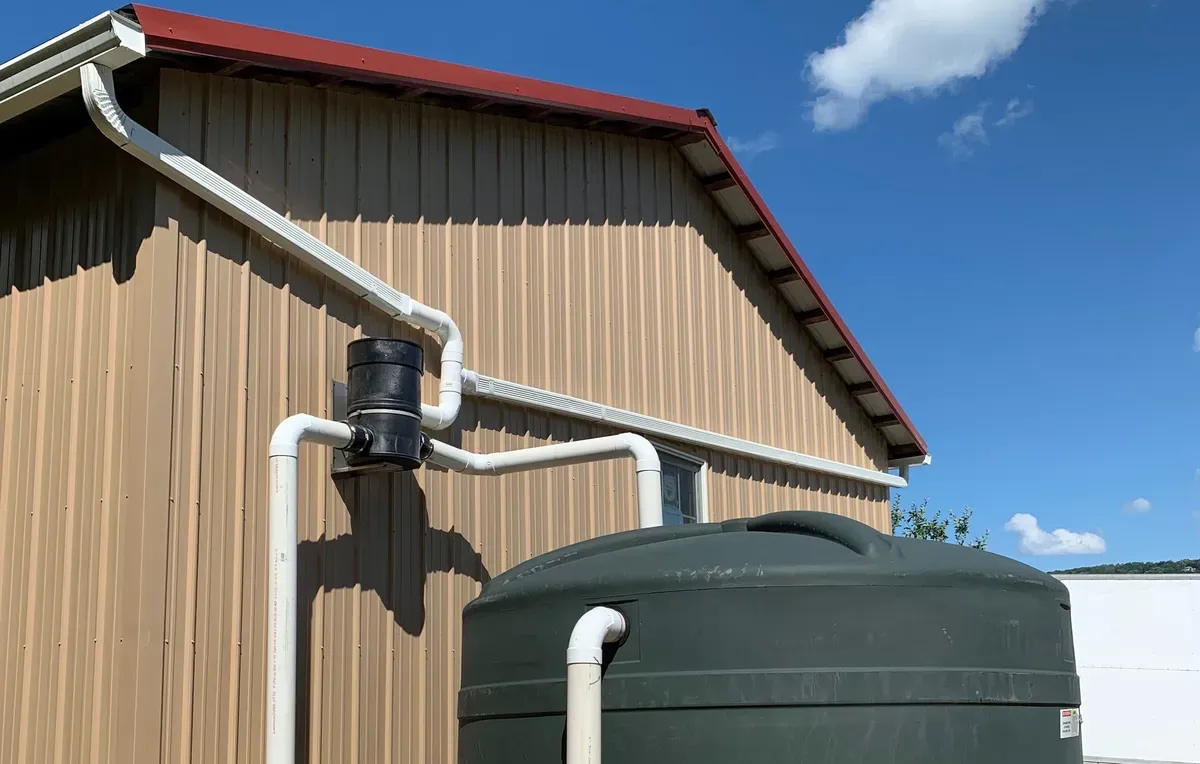
Durban South receives around 1,000 mm of rainfall annually, almost all of it falling between October and March. A 5,000-litre tank connected to a 60-square-metre roof catchment can realistically collect 30,000 to 40,000 litres per wet season. That is enough to meaningfully reduce municipal dependence for non-potable uses (toilets, laundry, garden) and, with proper treatment, for drinking.
The tank alone for a 5,000-litre system costs R8,000 to R12,000 (Enviroleg / Handyman Pretoria). Professional installation of a 1,000-litre system starts at R5,000 to R8,000 (Enviroleg). A full 5,000-litre system with first-flush diverter, guttering, and basic filtration realistically lands between R13,000 and R25,000 installed.
Compliance note: all rainwater tanks must meet SANS 1731:2017 (sans10400.co.za). Non-compliant installations can create problems with home insurance claims and, in sectional title, with body corporate approval.
The key limitation is seasonal. Durban’s winter months (May to August) are dry. If your outages are happening now, rainwater harvesting alone is not an immediate fix. Pair it with a municipal top-up tank for year-round security.
Option 4: Boreholes. The Full Picture
Boreholes are the only genuinely independent water supply option. They are also the most expensive and the highest-risk. Here is the honest breakdown.
Drilling alone costs R55,000 to R110,000 (mybroadband.co.za). Add a reputable hydrologist to site the borehole correctly, which costs R20,000 (mybroadband.co.za), and a geophysical survey at R3,000 to R5,000 (aquaearth.co.za), and you are already at R78,000 before you hit water. In KZN, groundwater is frequently sulphuric or high in iron, and one owner discovered that purification added another R27,000 to the bill.
“Filtration system around 27k. My water was too sulphuric and irony.”
Skipping the hydrologist is the single most expensive mistake Durban South residents make. One forum member put it bluntly:
“A reputable hydrologist to find a site with greater than 90% probability is R20k. Most will balk at this until they drill a dry hole… My neighbor paid for 3 dry holes, because he believes in his mom’s uncle’s cousin that throws a hat.”
If the borehole underperforms or the casing corrodes, rehabilitation costs R10,000 to R30,000 (mybroadband.co.za). Total exposure if things go wrong sits comfortably above R150,000. As one forum member captured the risk:
“So far I am down R50k for this motherfscking money pit.”
When does a borehole make sense? For businesses that need uninterrupted supply, for homes on large properties in areas with confirmed groundwater, and for anyone prepared to invest in proper siting and testing. For a typical Durban South townhouse or semi-detached home, a quality tank system is almost always the better financial decision.
Legal position on boreholes in 2026
The National Water Act’s Schedule 1 permits domestic household use of groundwater under 10,000 litres per day without a formal Water Use Licence Application (WULA). In July 2026, OUTA spokesperson Julius Kleynhans confirmed that household domestic boreholes were exempted from mandatory national registration:
“South Africans should not have to fear prosecution simply because they installed a borehole to keep water flowing when municipal systems fail. This clarification provides long-overdue legal certainty for ordinary households that have invested significant amounts of money simply to secure access to one of life’s basic necessities.”
That said, local municipal bylaws may require a notification or approval for drilling on your property. Check with eThekwini’s Water and Sanitation department before contracting a driller. Be aware that permit approval timelines through eThekwini can stretch considerably. As one resident noted about unrelated approvals:
“Plans sit in the system for months without response… I had a plan for a house alteration in Phoenix that took 1 year to get approved. Unacceptable.”
Tank Materials: What Lasts Longest in Coastal KZN
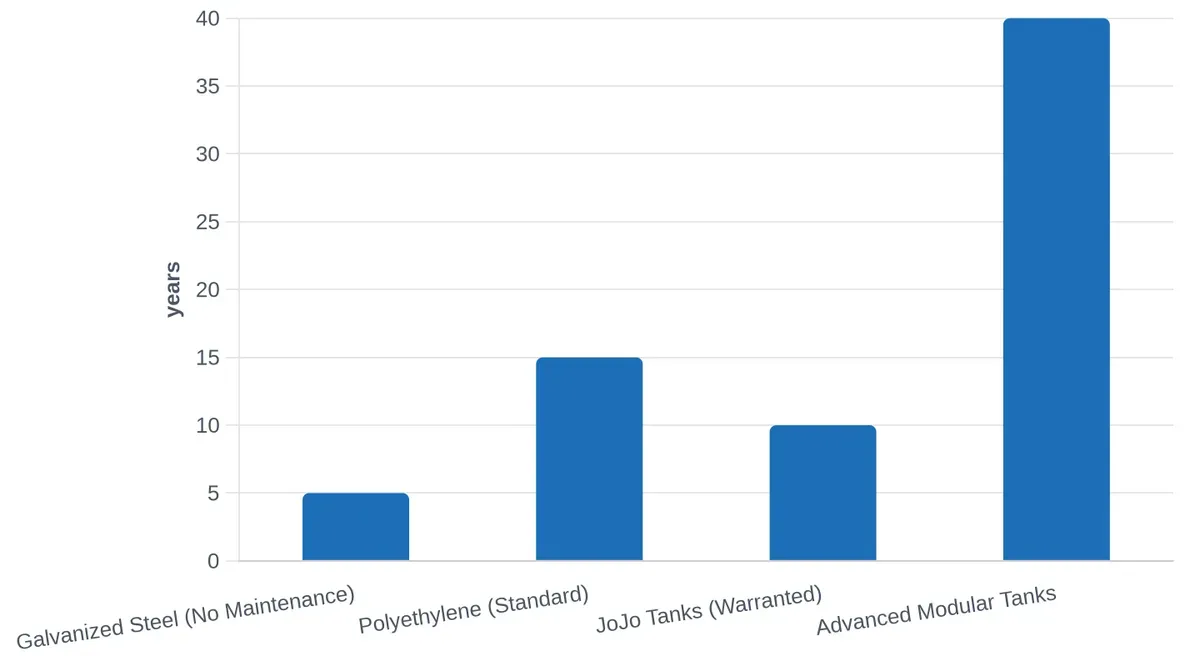
Not all tanks perform equally in Durban South’s climate. Mamboko Chem notes that KZN’s humidity and salt-laden air accelerate corrosion and promote microbial growth in open water systems far faster than inland climates. This matters when choosing tank material.
| Material | Typical lifespan in Durban South | Coastal risk | Verdict |
|---|---|---|---|
| UV-stabilised polyethylene (e.g. JoJo) | 15 to 20 years (10-year guarantee) | Low with UV stabiliser; moderate without | Best value for most households |
| XLPE (crosslinked polyethylene) | 15 to 20+ years (30 to 40% longer than standard PE) | Low | Premium option for high-use or commercial |
| Galvanised steel | Under 5 years in harsh coastal conditions; 30+ years inland with maintenance | High: corrosion at bolts, fittings and weak spots; electrolysis risk with Zincalume roofs | Avoid for Durban South water storage |
| Modular systems (e.g. Rainbow Reservoir) | 40-year design life; 12-year warranty | Low if correctly installed | Best for large-volume commercial or body corporate use |
Tax and Rebates: What SARS Will and Will Not Do
There are no SARS tax deductions for residential boreholes or water tanks (sars.gov.za). This is a fact that surprises many homeowners who assume water security installations attract the same treatment as solar. They do not. For commercial properties, a different analysis applies and an accountant’s advice is worth getting, but for residential installations, plan on zero rebate recovery.
The only financial relief available is eThekwini’s indigent support programme: 6 kilolitres free per month for households with a property value under R750,000 and monthly income under R7,000 (durban.gov.za).
Practical Checklist Before You Buy Anything
- Measure your daily use. A family of four uses roughly 600 litres per day. A 2,500-litre tank gives you about four days of autonomy. A 5,000-litre tank gives you eight to ten days.
- Check your roof structure before specifying tank size. A full 2,500-litre tank weighs 2,500 kg. Ground-level placement with a pump is safer and structurally simpler for most homes.
- Include filtration from day one. At minimum, a two-stage sediment and carbon block filter. Budget R119 to R358 per replacement set (purewater4life.co.za) and plan to replace every three to six months in this area.
- Get body corporate or HOA approval in writing before ordering anything if you are in a complex. The 30-day notice period under the Sectional Titles Schemes Management Act is not optional.
- For boreholes only: hire a hydrologist first. The R20,000 fee (mybroadband.co.za) is not wasted money. Three dry holes at R55,000 each is wasted money.
- Log every outage now so you have documentation if you need to invoke your seven-day legal right.
What This Costs Over Five Years: Side-by-Side
To make the comparison concrete, here is what a standard Durban South family of four spends under each scenario over five years, assuming one extended outage period per quarter requiring some purchased water top-up:
| Scenario | Year 1 cost (ZAR) | Years 2 to 5 annual cost (ZAR) | 5-year total (ZAR) |
|---|---|---|---|
| No backup: buy tanker water during outages (4 deliveries per year at R2,650 each) | R10,600 | R10,600 | R53,000 |
| 2,500L poly tank + pump + filtration (mid-range install R10,000) + filter replacements | R11,000 | R1,200 | R15,800 |
| 5,000L rainwater system (R20,000 install) + annual maintenance | R21,500 | R1,500 | R27,500 |
| Borehole (R100,000 mid-range all-in) + annual maintenance R5,000 | R105,000 | R5,000 | R125,000 |
The numbers are unambiguous. A properly installed poly tank system returns its capital cost in avoided tanker deliveries within 12 to 18 months, and is the lowest five-year cost option for the vast majority of Durban South households. Boreholes only make financial sense if you have a large property, confirmed groundwater, commercial-scale demand, or a strong preference for complete municipal independence and the capital to support it.
The community is reaching the same conclusion organically. As one local resident urged neighbours:
“Invest in as many tanks or containers as you can… Assuming of course a dry winter which is likely. We will all need a lot of our own water for summer.”
For Businesses: Additional Considerations
Commercial premises face additional exposure beyond household inconvenience. Water interruptions trigger health and safety compliance failures for food handlers, healthcare facilities and hospitality operators. SANS 241 compliance cannot be maintained with untreated stored water unless a certified filtration system is in place. Businesses should also note that ongoing plumbing patch repairs cost R8,000 to R15,000 per year versus R25,000 to R65,000 for a complete repipe (ServiceLink SA), a comparison that often favours the larger upfront investment for ageing commercial properties. Consult a registered plumber for a condition assessment before deciding between repair and replacement.
If your business uses open cooling towers or evaporative systems, Mamboko Chem’s analysis of Durban’s coastal air is directly relevant: salt-laden humidity accelerates corrosion and microbial growth in open water systems faster than any inland equivalent, meaning your maintenance cycles should be tighter and your water treatment chemistry reviewed annually.
Bottom Line
Durban South’s water crisis is structural, not seasonal. With 65% of treated water lost before it reaches a tap, over 12,000 unresolved leaks, and emergency tankers unreliable at best, the responsible approach is to treat backup water supply as essential infrastructure, not a luxury. The law gives you rights, but rights are only useful when backed by documentation and escalation. Meanwhile, a 2,500-litre UV-stabilised polyethylene tank with proper plumbing and a three-stage filter costs less over five years than four tanker deliveries a year and provides genuine resilience from day one.
To find out which backup water solution is permitted at your specific address and what local suppliers near you are accredited to install it, check my address.
Get started
Does your Durban South property qualify for emergency water aid?
Vetted local installers · honest advice first
Illustration: waterpointsa.co.za