Key Points
- Residential drilling in Polokwane costs R290 to R530 per metre (ourpower.co.za), but quotes from commercial directories show ranges up to R600 to R1,000 per metre (localpros.co.za) for larger or more difficult projects, always get three itemised quotes.
- Average borehole depth is 80 metres (range: 40 to 120 m) according to the Water Research Commission (wrc.org.za), but Lebowakgomo sits on Norite and Gabbro geology where water can be found at 10 to 20 metres (dws.gov.za).
- Polokwane East and Dalmada are high-risk zones: deep drilling beyond 180 metres has yielded limited success for high-producing boreholes (journals.co.za).
- A complete installed system (pump, piping, base plate, control boxes, cabling) costs R25,000 to R55,000 on top of drilling costs, with a 10-year total cost of ownership between R180,000 and R280,000 (enviroleg.co.za).
Why Polokwane Homeowners Are Drilling Now
Polokwane Local Municipality hiked water tariffs by 7.43% to 11.2% for the 2025/2026 financial year (limpopochronicle.co.za). That follows years of unannounced outages, pressure failures and, in several suburbs, full-day shutdowns with little notice. The result is that homeowners who once dismissed boreholes as a farming luxury are now seriously costing them up.
The motivation is real and it is personal.
“[The] borehole I was using [was via] a tap that was connected by the municipality and it was not reliable and that is the reason why I drilled my own borehole… They are not enough, that is why I ended up drilling my own borehole.”
For suburban Polokwane, Bendor, Fauna, Ivy Park, Thornhill, Dalmada, the question is no longer whether a borehole is a nice-to-have. It is whether the geology under your specific stand will support one at a price that makes economic sense.
“I have decided that 2024 is the year that I secure as much peace in my home as I can. To start, I have decided to buckle to the missus’ pressure for some ‘water security’ – sinking a borehole.”
Geology First: Water Table Depths by Area
Limpopo groundwater does not behave uniformly. The province sits on several distinct geological formations and your suburb’s underlying rock type determines both depth and yield before a single metre of drilling starts.
Lebowakgomo and the Norite/Gabbro Belt
Lebowakgomo is the standout performer in Limpopo. Sitting on Norite and Gabbro formations, the Department of Water and Sanitation (dws.gov.za) records water level depths of just 10 to 20 metres here. Shallow depth means lower drilling cost and faster payback. If you own property in or around Lebowakgomo, this is broadly favourable drilling territory.
Polokwane City and Surrounding Suburbs (Average Depths)
The Water Research Commission (wrc.org.za) records average domestic borehole depth for Polokwane at 80 metres, within a range of 40 to 120 metres. Within that broad range, suburb and stand matter enormously. The following is a summary based on available hydrogeological data and contractor experience:
- Bendor, Fauna, Ivy Park, Thornhill: Typically 50 to 90 metres. Basement granite and felsite underlie most of these areas. Yields are workable for domestic use but rarely exceptional.
- Seshego and extensions: Variable. Some portions have struck water at moderate depths, but infrastructure neglect means many households remain without reliable supply regardless of geology.
- Mankweng: Mixed sedimentary and basement geology. Depths vary between 40 and 100 metres depending on position relative to fractured zones.
- Mokopane (Potgietersrus) and surrounds: Water is often available at moderate depth but the area carries a documented fluoride contamination risk (see Water Quality section below).
Polokwane East and Dalmada: A Serious Caution
This is the area where you most need an independent geophysical survey before committing to drilling. Research published on journals.co.za notes explicitly that deep drilling beyond 180 metres in Polokwane East and Dalmada has yielded limited success in obtaining high-producing boreholes. Spending a very large sum on a deep hole in this zone and walking away with a low-yield result is a realistic outcome, not a worst case.
Mogwadi (Dendron): Drawdown Risk
A pump test at Mogwadi recorded in Capricorn District Municipality data (cdm.org.za) illustrates a problem common to the region: the static water level was measured at 41.2 metres, but dropped to 63.98 metres after just 12 hours of pumping at 2.62 litres per second (November 2023). That is a drawdown of more than 22 metres in half a day. If your pump is not sized and controlled to match actual aquifer recovery rates, you will run the borehole dry and risk collapsing the hole wall.
Current Drilling Costs: What Limpopo Contractors Charge in 2026
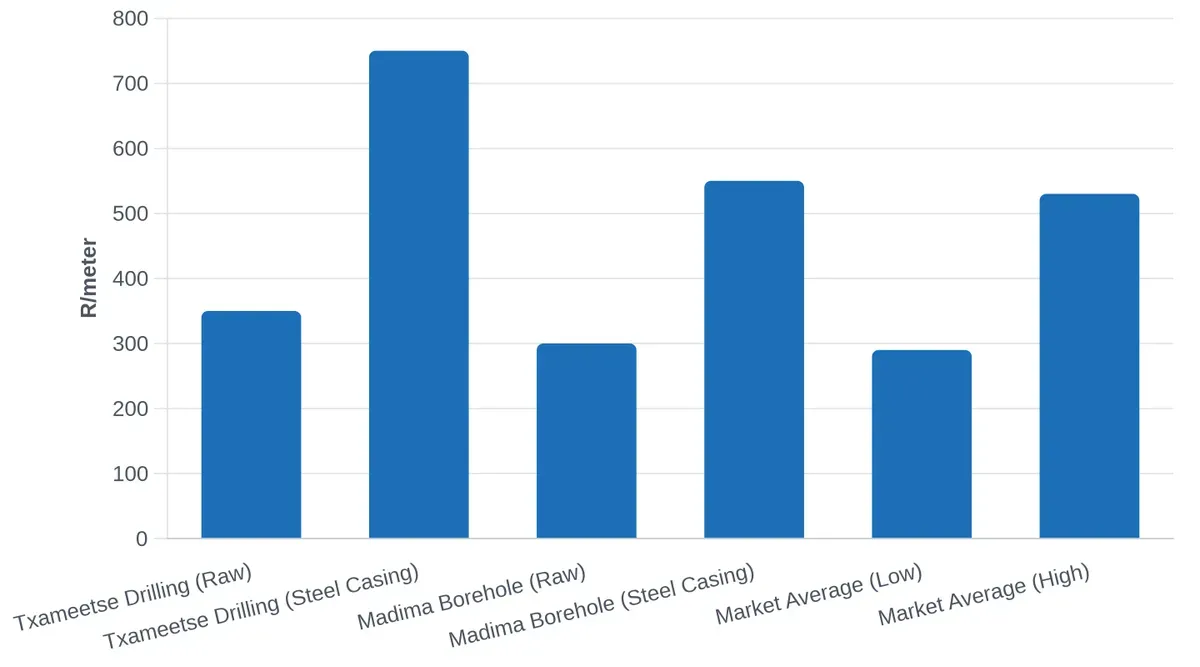
Pricing in this market sits across a wide band depending on contractor, equipment, rock hardness and whether steel casing is required. Below are rates from named local operators.
| Cost Item | Low | High | Source |
|---|---|---|---|
| Drilling (residential, per metre) | R290/m | R530/m | ourpower.co.za |
| Drilling (commercial / difficult ground, per metre) | R600/m | R1,000/m | localpros.co.za |
| Drilling only, Txameetse Drilling | R350/m | R350/m | txameetsedrilling.co.za |
| Steel casing, Txameetse Drilling | R750/m | R750/m | txameetsedrilling.co.za |
| Drilling only, Madima Borehole Drilling | R300/m | R300/m | madimaboreholeandsolargeysers.co.za |
| Steel casing, Madima Borehole Drilling | R550/m | R550/m | madimaboreholeandsolargeysers.co.za |
| Full pump installation (pump, piping, base plate, control box, cabling) | R25,000 | R55,000 | localpros.co.za |
| Basic 3-stage filtration (Sediment, Carbon, UV) | R6,792 | R6,792 | thewatersolarcompany.co.za |
| Commercial/whole-house RO system (1,000 litres/hour) | R102,749 | R102,749 | h2owarehouse.co.za |
| Annual servicing | R1,000 | R2,750 | boreholerepairspretoria.co.za |
| Routine cleaning (every 3 to 5 years) | R3,000 | R10,000 | handymanpretoria.co.za |
| 10-year total cost of ownership (Limpopo residential) | R180,000 | R280,000 | enviroleg.co.za |
What an 80-Metre Borehole Actually Costs to Drill
Using the average Polokwane depth of 80 metres:
- At R290/m: R23,200 in drilling costs alone
- At R530/m: R42,400 in drilling costs alone
- Add R25,000 to R55,000 for the pump and installation
- Add R6,792 for basic filtration
- Add R5,000 to R15,000 for the geophysical survey (recommended)
A realistic all-in first-year cost for an average Polokwane borehole sits between R60,000 and R120,000, before any water quality remediation such as iron removal or fluoride reduction is factored in.
“Borehole and pump, so zero water bills for me. Cost around R40k to get the borehole drilled (equipment hire and wages) and a few k for tanks and pumps.”
Note: this owner’s R40,000 all-in figure reflects either a very shallow strike, owner-managed equipment hire, or both. It sits below the median for Polokwane based on current contractor rates, but it illustrates what is possible when geology cooperates.
Strike Rates and Success: The Honest Picture
The borehole drilling industry in South Africa has a reputation problem, and Limpopo is not immune to it. The single most important protection you have is insisting on a geophysical survey before drilling, and a proper yield test (not a blown yield test) after drilling.
“We have encountered boreholes that delivered much more or much less than the blown yield test suggested. We often joke that drilling contractors find it easier to get paid if they report a higher blown yield rather than saying there is little or no water… Imagine investing in a large system, only to have the pump run dry after eight hours and then needing to remove it and install a smaller unit.”
A constant discharge test, run for 24 to 72 hours as required under SANS 10299-4:2003, is the only reliable way to establish true sustained yield. Any contractor who pushes back on this requirement should be treated with caution.
On the positive side, when geology and siting work together, the results can be straightforward:
“We hit water at 18 meters, and only drilled to a depth of 30 meters for a proper supply of groundwater. Thank you again!”
“My survey was done and I was told that we could get water at 30m. Once they started drilling, we struck water at 32m! It was a great all round experience…”
Both of these outcomes came from areas with favourable shallow geology. The geophysical survey in the second case predicted depth within 2 metres. That is what a professional survey is worth.
Before you call a single drilling contractor, use the address-level borehole check to see what the strike data looks like under your specific stand: Check my address.
Pump Sizing: The Most Expensive Mistake You Can Make
Getting the pump wrong after successfully drilling a borehole is the most common and most avoidable source of loss in this project. The rules are simple but frequently ignored:
“Firstly you chose a pump only after the hole has been drilled. You don’t know if there is water and how much… you need to drain the hole and do a pressure and volume test to see how much water you can pull and spec the pump and motor according to that. Just 2c from an old Senwes irrigation engineer that taught me.”
“The pump at the depth can pump 50 litres a minute but the borehole can’t produce that much and if the pump runs open it will run the hole dry. This is not good for the hole as it will start washing the hole out… Is the borehole worth it. 100% yes. No more worries about water outages and no more municipal bill for water usage.”
The standard domestic market in South Africa is dominated by 2-series wet-end submersibles because most South African boreholes cannot sustain higher extraction rates, a reflection of the country’s generally moderate aquifer yields. Oversize the pump and you either run the hole dry, collapse the wall, or burn out the motor. Undersize it and you wait all day to fill a large storage tank. Neither is acceptable.
Water Quality in Limpopo: Test Before You Drink

Clear, cold groundwater looks clean. It is frequently not. Iron, manganese, fluoride and bacterial contamination are all documented across Limpopo groundwater systems.
Mokopane carries a specific, well-documented risk: fluoride concentrations in groundwater studies from that area have measured up to 2.05 mg/L (mdpi.com). South Africa’s SANS 241 drinking water standard caps fluoride at 1.5 mg/L. Groundwater at 2.05 mg/L exceeds the limit by 37%. Long-term consumption at that level causes dental and skeletal fluorosis.
“Have it tested for minerals as well as contamination. Should be about R1000 for both. Iron problems raise its ugly head much later… My gas geyser bombed out because of this. And a 1 micron filter system is a must.”
“3 weeks ago I decided to drill for water… So far there is no signs of excess iron, nice clean sweet tasting water. I would however like to have it tested as a safety precaution.”
Both of these voices are pointing at the same truth: water that looks and tastes fine can still damage your appliances or your health over years of use. A basic mineral and contamination test costs around R1,000. A 3-stage sediment, carbon and UV filtration system costs R6,792 (thewatersolarcompany.co.za). A full commercial-grade reverse osmosis system capable of 1,000 litres per hour costs R102,749 (h2owarehouse.co.za). Budget for the level of treatment your test results actually require, not less, not more.
10-Year Cost of Ownership vs. Municipal Water: A Direct Comparison
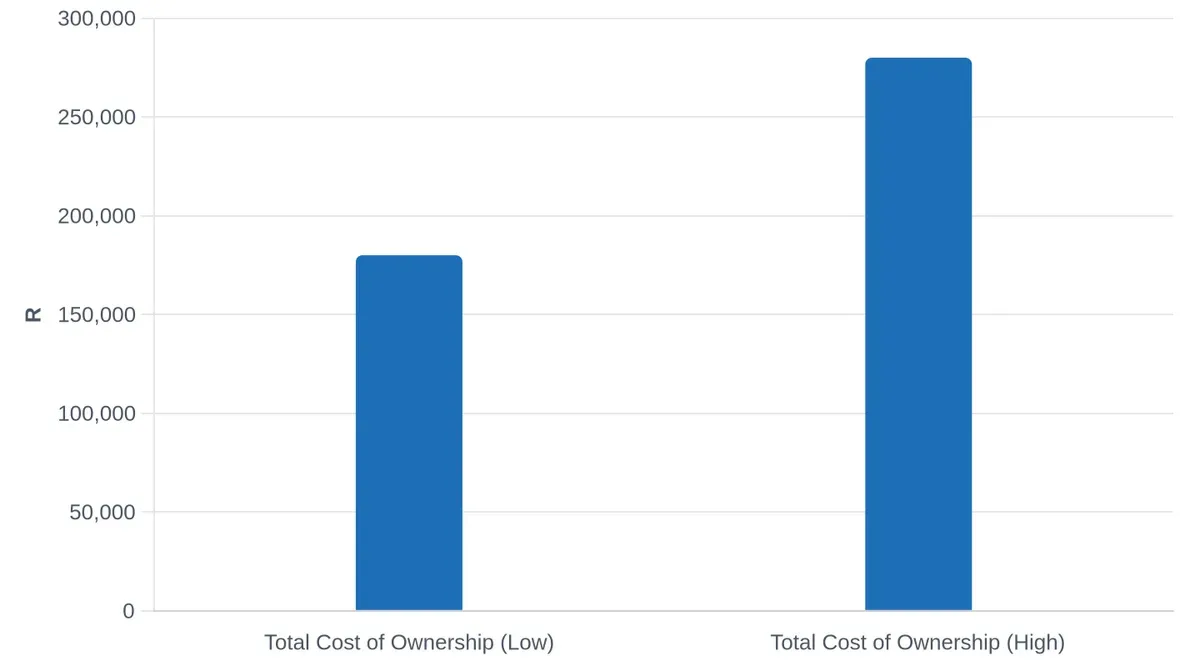
Polokwane Local Municipality hiked water tariffs by 7.43% to 11.2% for 2025/2026 (limpopochronicle.co.za). Eskom’s Homelight Prepaid tariff is R2.71 per kWh as of 1 April 2026 (citizen.co.za). Using these figures, here is how the two options compare for a household consuming 20 kilolitres per month:
| Cost Component | Municipal Water (10 years) | Borehole (10 years) |
|---|---|---|
| Capital outlay | R0 | R60,000 to R120,000 (year 1) |
| Annual water tariff (rising ~9% per year) | Approximately R60,000 to R90,000 over 10 years (tariff-dependent) | Negligible (rates levy only) |
| Annual servicing | R0 | R1,000 to R2,750 per year = R10,000 to R27,500 over 10 years |
| Pump electricity (R2.71/kWh) | R0 | Approximately R2,970 per year = R29,700 over 10 years |
| Cleaning (once in 10 years) | R0 | R3,000 to R10,000 |
| Filtration / treatment | R0 (included in tariff) | R6,792 to R102,749 (depending on water quality) |
| Total estimated 10-year range | R60,000 to R90,000 | R180,000 to R280,000 (enviroleg.co.za) |
The raw numbers are confronting: a borehole costs more over 10 years than municipal water when municipal supply is reliable. The value proposition is not purely financial. It is reliability, independence from tariff hikes compounding at up to 11.2% annually, and protection against unannounced outages that municipal infrastructure increasingly cannot prevent.
The financial case sharpens significantly if your property has a large garden, a small business operation, or livestock, uses where municipal tariffs escalate steeply into the higher consumption brackets. It also strengthens if your suburb has a history of multi-day outages, which effectively zeros out the tariff saving argument for municipal supply.
When a Borehole Is Not the Answer
Not every Polokwane stand should be drilled. The following situations warrant serious pause:
- Polokwane East and Dalmada: Deep drilling has demonstrably failed to produce high-yield boreholes in this area (journals.co.za). Budget for a thorough geophysical survey and get a very clear commitment in writing from the driller about what happens if yield is unacceptable.
- Any area where neighbours have dry boreholes: The hydrogeological principle of local consistency means that multiple dry holes nearby is strong evidence against you. Check local borehole records before drilling.
- Small stands in dense residential areas: Aquifer depletion risk is real where many boreholes draw from the same fractured zone. The Mogwadi drawdown data (cdm.org.za) is a measured example of how quickly a modest pumping rate can deplete a local water column.
- Existing borehole running dry: Deepening a dry borehole is sometimes the answer, but not always. Molepo M.S., posting on a Polokwane borehole forum, described exactly this dilemma.
“Good morning, I have existing borehole sometimes is dry. I’m thinking of doing another borehole or can I drill on the existing one. The existing borehole is around 55 m. Please advise and quotation to drill 100m including installation.”
In many cases, a 5,000 to 10,000 litre JoJo tank installation and a rainwater harvesting system will provide adequate backup at a fraction of the capital outlay, with zero geological risk. The right solution depends entirely on your actual water consumption and the specific geology under your stand.
Compliance and Permitting: What the Law Requires
Under the National Water Act (Act 36 of 1998), drilling a borehole for domestic use on your own property in a volume below the General Authorisation threshold (typically 10 cubic metres per day) does not require a water use licence. However:
- The borehole must be registered with the Department of Water and Sanitation.
- Any yield test submitted for design purposes should comply with SANS 10299-4:2003, which requires a constant discharge test of 24 to 72 hours duration.
- Limpopo provincial bylaws and local municipality regulations may impose additional requirements, particularly for boreholes near septic tanks, stormwater channels or communal aquifer zones.
Non-compliance does not just carry a legal risk. It also affects your ability to sell the property: a borehole that cannot be shown as registered and tested is a liability, not an asset, in a property transfer.
The Community Reality Check
It is worth acknowledging that boreholes drilled by or for communities in Limpopo have not always delivered on their promise. The private homeowner experience and the public infrastructure experience are different, but both carry lessons about execution risk.
“They always promise to complete the job so that residents get water. We were happy when VDM drilled a borehole but it has been a year, and the borehole is not yet working. We are not sure why it is not working.”
The lesson for private buyers is the same as for municipalities: drilling a hole is not the end of the project. A hole without a properly installed, matched, tested and maintained pump is a useless hole. Completion risk is real. Build project milestones and payment gates around verified deliverables: hole depth confirmed, yield tested to SANS standard, pump installed and running, water tested.
Step-by-Step: How to Commission a Borehole in Polokwane Correctly
- Check your suburb’s hydrogeological data before engaging any contractor. DWS borehole data is partially available online. Your municipality may also hold local aquifer maps.
- Commission an independent geophysical survey (electrical resistivity or seismic refraction). Budget R5,000 to R15,000. Do not let the drilling contractor do their own survey without independent verification.
- Get three itemised quotes with per-metre rates clearly separated from casing, pump, installation and VAT.
- Drill the hole. Monitor depth logs during drilling. Insist on seeing cuttings and noting any water strikes as drilling progresses.
- Conduct a SANS 10299-4:2003 compliant yield test (24 to 72 hours constant discharge). This is the document that specifies your pump.
- Test the water. Spend the R1,000 on a full mineral and microbiological analysis before specifying filtration. Budget R6,792 minimum for a 3-stage system (thewatersolarcompany.co.za).
- Install the correctly sized pump. Never before steps 5 and 6.
- Register the borehole with DWS and retain all documentation for future property transactions.
- Service annually (R1,000 to R2,750 per year) and clean every 3 to 5 years (R3,000 to R10,000).
Follow these nine steps and the probability of reaching a 10-year total cost inside the R180,000 to R280,000 range (enviroleg.co.za) is high. Skip steps 2, 5 or 6 and you are gambling.
Before you call a single drilling contractor, use the address-level borehole check to see what the strike data looks like under your specific stand: Check my address.
Get started
Get accurate drilling quotes for your Polokwane borehole
Vetted local installers · honest advice first
Photo: Павел Хлыстунов / Pexels