Key points
- Pretoria drilling rates run from R300 to R700 per metre (boreholehub.co.za), but the drill-only invoice is only one part of a R60,000 to R140,000 turnkey project (ourpower.co.za).
- Geology splits Pretoria into two very different markets: high-yield dolomite zones in Centurion and the west versus harder quartzite and granite in Pretoria East and the far north.
- Centurion has 50 active sinkholes (citizen.co.za) and the City of Tshwane legally bans drilling in specific dolomite-underlain suburbs. Penalties reach R20,000 or 12 months imprisonment (citizen.co.za).
- Tshwane implemented a 10 percent water tariff increase on 1 July 2026 (tshwane.gov.za). High-volume users now pay R64.26 per kilolitre (tshwane.gov.za), making payback periods of 5.7 to 9.7 years realistic (boreholehub.co.za).
- A proper 24-hour pump yield test costs roughly R4,500 (Ourpower Borehole Calculator) and is the single investment most likely to save you from an expensive mistake.
- Legal domestic extraction in the Johannesburg and Pretoria catchment is capped at 150,000 litres per year by the Department of Water and Sanitation.
Why geology, not the drill company, sets your price
Ask three drillers for a quote in Pretoria and you will get three very different numbers, even for neighbouring streets. The reason is almost never the driller’s margin. It is the rock beneath your garden. Pretoria sits at the intersection of several distinct geological formations, and each one demands different equipment, different drilling time, and different depths before water appears.
The practical consequence is straightforward: a rate sheet from a driller in Centurion cannot be pasted onto a Hatfield job, and a Garsfontein neighbour’s story about a quick, cheap strike says nothing reliable about what your stand will produce. Understanding the four main geological zones before you request a single quote is the most cost-effective thing you can do.
The four geological zones and what they mean for your budget
Zone 1: Malmani Dolomite (Centurion, Laudium, Pretoria West)
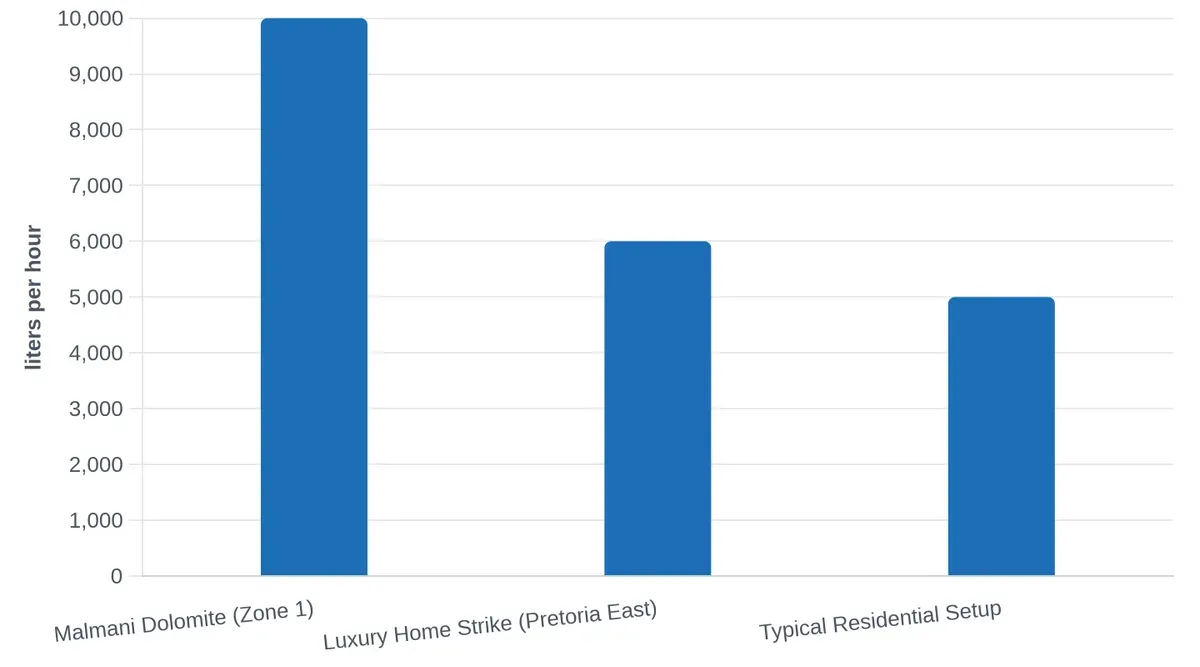
This is Pretoria’s most productive and most dangerous aquifer belt. When a driller intersects a fracture or cave in the Malmani Dolomite, yields frequently exceed 10,000 litres per hour (Drillers and Geological data). At shallow depths, this means cheap drilling and abundant water. The community post below captures what a good dolomite strike looks like in practice:
“Borehole Yield Test at Montana Pretoria, borehole pump at only 31 metres and yield of 6,000 litres per hour, not bad at all.”
The problem is structural. Dolomite is porous. Water fills those pores. When extraction lowers the water table, air replaces water in the voids, removing the support that keeps the ground above stable. A Reddit commenter explained the feedback loop plainly:
“The fact remains that sink holes are on the increase in that area and the more people pump water out of the ground the more sink holes will appear. Water fills the porous dolomitic rock… Once the water table drops due to over extraction, the porous dolomitic rock becomes filled with air.”
Centurion currently has 50 active sinkholes (citizen.co.za). The City of Tshwane’s response is a legal prohibition on borehole drilling in specific dolomite-mapped suburbs under its land-use regulations (enviroleg.co.za). Drilling in a restricted zone without approval can cost you up to R20,000 or 12 months imprisonment, imposed by the TMPD (citizen.co.za). Checking your stand’s dolomite risk zone classification before spending a single rand on a driller is non-negotiable in this part of Pretoria.
The Six Fountains residential estate in Pretoria East (which sits on a different geology but illustrates the HOA approval layer many estates add) requires a R3,000 deposit plus a R1,000 non-refundable road fund fee before any drilling takes place (sixfountainshoa.co.za). Similar administrative fees apply across many gated communities in the metro, regardless of geology.
Zone 2: Pretoria Group Quartzite and Shale (Hatfield, Garsfontein, Faerie Glen, Lynnwood)
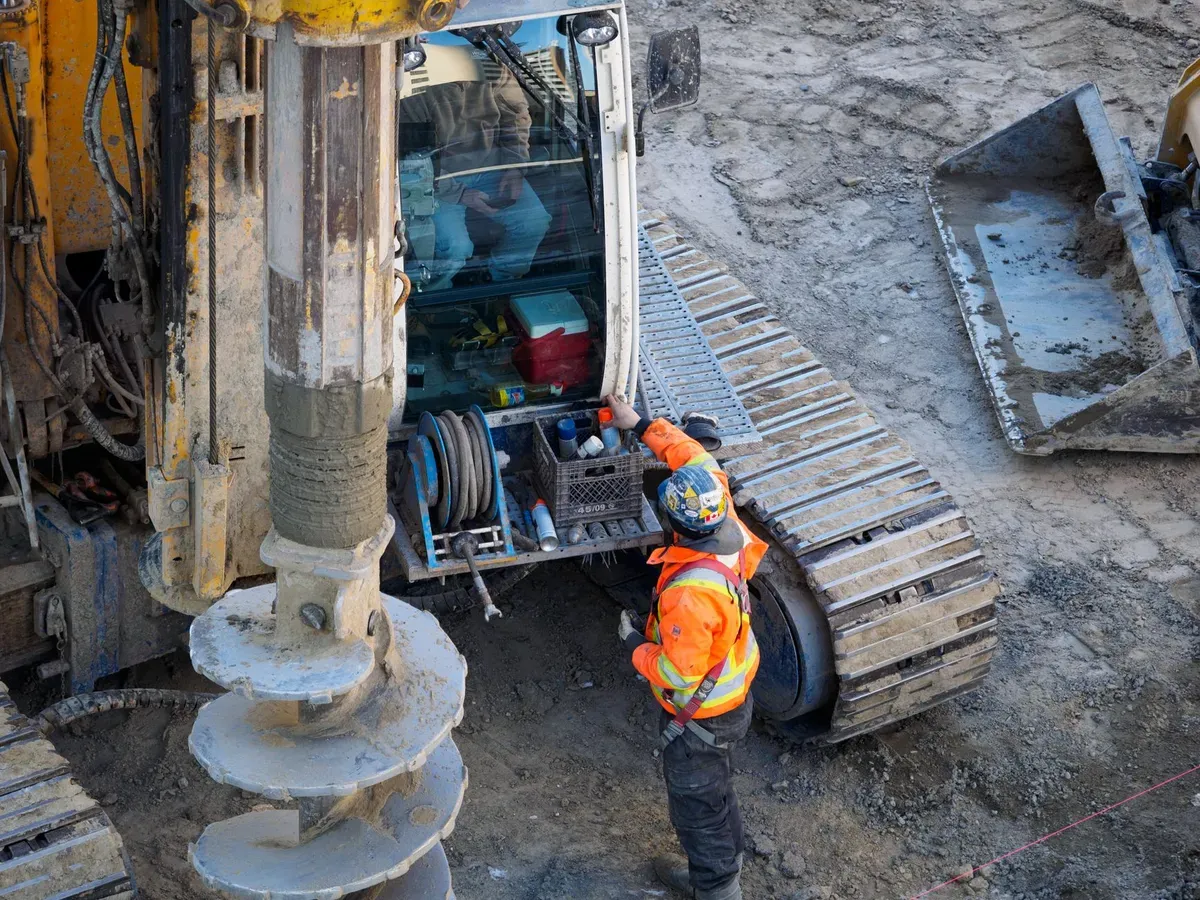
The eastern suburbs sit on the Pretoria Group, a sequence of quartzite, shale, and phyllite. Quartzite is hard and slow to drill, which pushes per-metre costs upward. Typical percussion drilling runs to depths of 30 to 80 metres in this zone (boreholehub.co.za), and a standard 55-metre domestic setup costs between R40,000 and R90,000 for the drilling component alone (boreholehub.co.za). Per-metre rates in quartzite fall within the R300 to R700 range quoted by boreholehub.co.za for Pretoria broadly, but the harder formations push projects toward the upper end of that band.
The good news from Garsfontein is that successful strikes in this zone can deliver water for decades:
“It will last for another 5 decades according to the soil engineers report! Best R40k I ever spent.”
A longer-term Pretoria East story reinforces this:
“We got a borehole about 7 years ago. Apparently, we got an underground river running about 55 metres down. The water pressure is better than our normal tap pressure… The pH is 7.8, so on the higher side of neutral.”
A confirmed productive strike at a luxury home in Lombardy Estate (Pretoria East) returned approximately 6,000 litres per hour (myproperty.co.za). That figure is an outlier for the zone. Many Pretoria East residential stands produce between 500 and 2,000 litres per hour. The spread is wide enough that a hydrogeological siting survey, costing R3,500 to R15,000 (boreholehub.co.za), is money well spent before committing to a drill.
Zone 3: Bushveld Granite Complex (Pretoria North, Montana, Equestria fringe)
Granite is the hardest and most unpredictable formation in the metro. Fracture networks are the only water source; matrix porosity is negligible. Drilling costs per metre track toward the higher end of the R350 to R1,500 national range (BoreholeHub Guide). Miss the fractures and you have a dry hole. Hit them and yields can be generous, as the Montana yield test referenced above showed. The lesson here is that siting accuracy matters more in granite than anywhere else in Pretoria, and skimping on the geophysical survey is the riskiest economy you can make.
Zone 4: Mixed Alluvial and Weathered Rock (Centurion East, Irene, Silver Lakes fringe)
The southern and south-eastern transitional zone combines shallow weathered rock with occasional alluvial lenses. Depths are often shallower than Pretoria East, but sustained yield can be patchy. The risk of a borehole running dry after initial success is higher here than in primary aquifer zones, and one Reddit contributor from r/Pretoria described exactly this outcome:
“Recently did the bore hole thing and ran dry in a few months. The machine couldn’t drill that far down. So best idea for cost and water quality is go to any neighbours that have [one] check the depth.”
This matches a documented pattern in Johannesburg’s transitional zones as well. A Blairgowrie homeowner with a reported yield of 1,500 litres per hour found the borehole running dry by 3pm every day within three months. The cause was a quick blow test rather than a controlled pump test (Andy Plumbers case study). The principle applies equally to Pretoria’s mixed-geology suburbs: the driller’s blow yield figure is not the same as a sustained aquifer yield.
What you will actually pay: a 2026 cost table
| Cost item | Low estimate | High estimate | Source |
|---|---|---|---|
| Hydrogeological siting survey | R3,500 | R15,000 | boreholehub.co.za |
| Site survey and preparation | R1,500 | R10,000 | Borehole Repairs Johannesburg |
| Drilling (per metre, Pretoria) | R300 | R700 | boreholehub.co.za |
| Even Borehole Drilling base rate (verified 2026) | R320/m | R320/m | boreholehub.co.za |
| Typical 55m domestic drill (Pretoria East) | R40,000 | R90,000 | boreholehub.co.za |
| 24-hour pump yield test | R4,500 | R4,500 | Ourpower Borehole Calculator |
| Water quality testing (basic) | R1,500 | R3,000 | EnviroLeg |
| SANS 241 full lab panel | R1,750 | R3,714 | sanswater.co.za |
| Submersible pump (supply and install) | R8,000 | R20,000 | market range |
| Plumbing from borehole to house | R8,000 | R20,000 | market range |
| Pressure booster pump and pressure tank | R8,000 | R20,000 | market range |
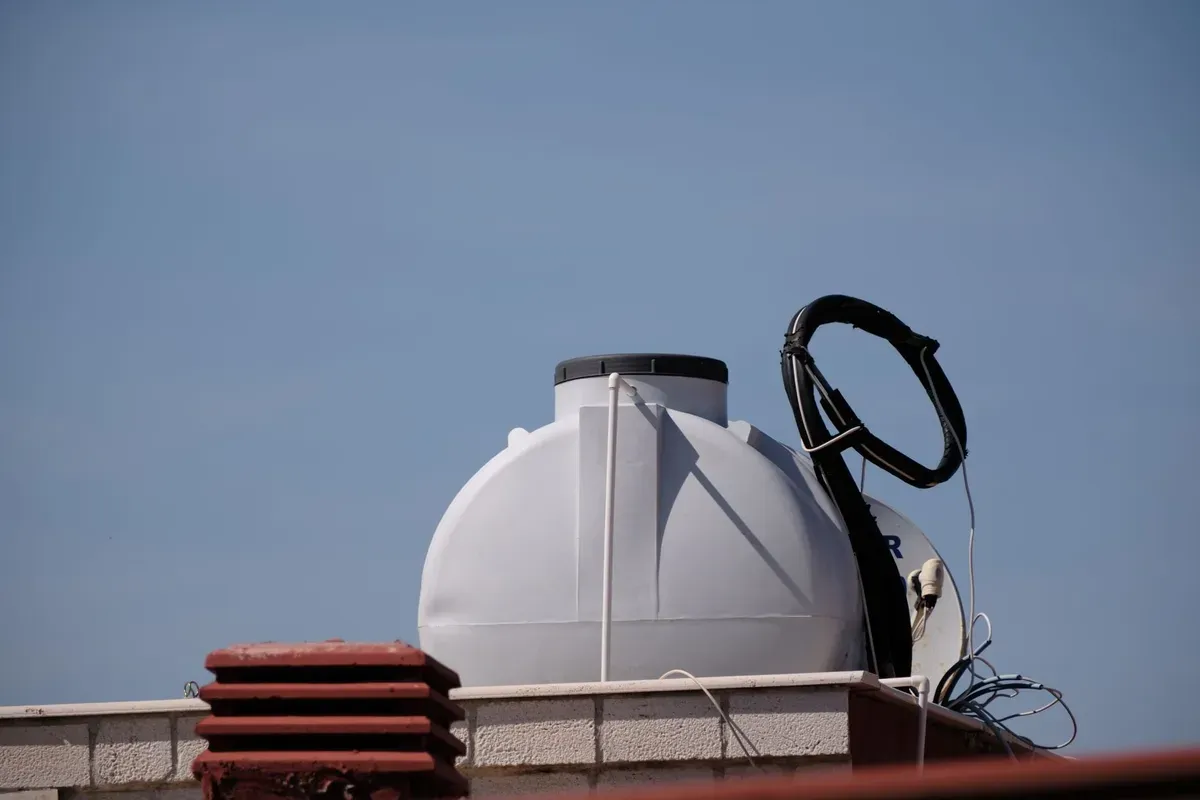
| 5,000 L JoJo vertical storage tank | R9,585 | R9,585 | EnviroLeg Tank Prices |
| Filtration and water treatment | R3,000 | R25,000+ | Andy Plumbers Cost Guide |
| HOA deposit and road fee (where applicable) | R1,000 | R4,000 | sixfountainshoa.co.za and market |
| Full turnkey domestic package | R60,000 | R140,000 | ourpower.co.za |
| LiquaFlo 2026 quote (60m, tanks, booster pumps) | R82,600 | R82,600 | liquaflo.co.za |
| Pump repair or replacement | R5,000 | R20,000 | waterpointsa.co.za |
The cost shock most buyers do not see coming
The drill invoice is the most visible number in a borehole project, which makes it the most effective tool for low-ball quoting. The real budget trap is the equipment and infrastructure that follows. A detailed Fairland, Randburg case study (geologically similar to parts of Pretoria East) broke down exactly how a R45,000 verbal quote became a R100,000+ total bill:
“The drilling company quoted R45,000 and we thought that was the total cost. Then we found out we still needed a pump, a tank, plumbing to the house, and water treatment… The drilling cost R48,000 for a 60-metre borehole… Then reality set in. They needed a submersible pump (R12,000 installed), plumbing from borehole to house (R18,000), a pressure booster pump and tank (R18,000), water testing (R2,500), and because the test showed high iron, a filtration system (R25,000). Total: roughly R100k+.”
A Gauteng forum member with direct personal experience confirmed a very similar breakdown:
“I paid around 55k for 50m to 60m drilling, with casing. Borehole pump was around 30k. Filtration system around 27k. My water was too sulphuric and irony.”
The LiquaFlo 2026 turnkey quote of approximately R82,600 for a fully equipped 60-metre setup with tanks and booster pumps (liquaflo.co.za) represents the mid-range for a professionally scoped project that includes surface infrastructure from day one. It is a more honest starting point than any drill-only rate.
Cost-of-ownership comparison: borehole versus municipal supply at 2026 Tshwane tariffs
Tshwane implemented a 10 percent tariff increase on 1 July 2026 (tshwane.gov.za). High-volume residential users paying above 60 kilolitres per month now face a tariff of R64.26 per kilolitre (tshwane.gov.za). A household consuming 25 kilolitres per month in that top bracket spends roughly R1,607 per month on water alone, or approximately R19,280 per year, before basic charges and VAT.
| Scenario | Year 1 | Year 3 | Year 7 | Year 10 |
|---|---|---|---|---|
| Municipal only (R1,600/month, 5% annual escalation) | R19,200 | R42,252 cumulative | R107,682 cumulative | R164,078 cumulative |
| Borehole (R82,600 install, R200/month running costs) | R85,000 | R89,800 cumulative | R99,400 cumulative | R106,600 cumulative |
| Saving versus municipal (Year 10) | Approx. R57,000 ahead |
This rough model aligns with the 5.7 to 9.7 year payback range cited by boreholehub.co.za for a standard residential setup offsetting a R2,000-plus monthly municipal bill in Gauteng. The crossover point moves earlier every year tariffs rise. One Pretoria forum contributor summed up the present sentiment among homeowners:
“Here in Pretoria outages is now measured in days not hours anymore. Just the last 3 weeks 3 days then 4 days, currently off again… Unfortunately solar has become a necessity no matter what you pay… Same with sinking a borehole.”
The longer-term savings story can be even more compelling where the installation is done well. One borehole owner shared their outcome over time:
“Over R80k in savings since installing the meter with very little maintenance. I no longer use the triple blue filters (last used over a year ago) and only using the in tank UV light.”
Component quality plays a direct role in those long-term numbers. A Gauteng homeowner who chose premium parts explained the logic:
“Total cost was around R100K… I also used quality parts (e.g. Franklin motor). I could have used cheaper components and saved R30K in the short term… There is also very little maintenance as a decent borehole pump should last 20+ years with zero maintenance…”
If the pump does fail, budget R5,000 to R20,000 for repair or replacement (waterpointsa.co.za). This is the dominant ongoing cost item in the ownership cycle and the strongest argument for specifying quality components from the outset.
The yield test: the R4,500 insurance policy
The yield test (roughly R4,500 via Ourpower Borehole Calculator) is almost always the item cut from a budget when costs escalate during a project. It is also the item whose absence causes the most expensive failures. Putter Geological Services put it plainly in Afrikaans, but the meaning translates directly:
“Daardie kort toets meet net hoe vinnig die pomp trek, nie of die boorgat gaan hou nie.” (That short test only measures how fast the pump draws, not whether the borehole will sustain it.)
A proper 24-hour constant-rate pump test measures the aquifer’s recovery rate, not just the pump’s extraction rate. The difference is the difference between a borehole that runs dry by mid-afternoon every day and one that supplies a household indefinitely. Given that Centurion’s Thabo M. reported that checking nearby borehole data (before drilling) revealed four dry holes in his immediate area and saved him R60,000 before he committed to a drill (HelloPeter), the pre-drill investigation phase deserves at least as much budget respect as the drill itself.
Legal extraction limits and the Department of Water and Sanitation
A successful high-yield borehole does not grant unlimited extraction rights. The Department of Water and Sanitation caps private domestic borehole extraction in the Johannesburg and Pretoria catchment at 150,000 litres per year. That works out to approximately 410 litres per day, or roughly 12 kilolitres per month, which is adequate for efficient garden irrigation and toilet flushing but not for a household attempting full independence from municipal supply at above-average consumption levels. High-extraction users need a water use licence, a process that involves a separate application and fee. Plan your system around the legal limit before sizing your pump.
What a proper installation does for your property value
The resale question comes up in almost every borehole forum discussion. The evidence is consistent: a neat, documented, certified installation adds demonstrable value. A messy, undocumented one may actually deter buyers. One experienced voice in the property community framed it this way:
“After seeing some people’s installations, I would be very circumspect, not just any install would create value. People may perceive it as something that would require a whole lot of extra maintenance. I do think that a proper, neat and certified installation, using reputable and contemporary kit, properly documented, together with purchase slips and warranties, would add some value.”
The documentation requirement is practical, not bureaucratic. Purchase slips, installation certificates, water test results, and a yield test report are the evidence that transforms a borehole from a perceived liability into a marketable asset. Keep every document from day one.
Suburb-by-suburb quick reference for Pretoria buyers
- Centurion (central and north-west): Check dolomite zone classification before any other step. If your stand is in a restricted area, drilling is illegal. If it is not restricted, yields can be extremely high at relatively shallow depths. Budget for a full geological clearance process in addition to standard project costs.
- Hatfield and surrounds: Pretoria Group quartzite. Expect drilling to run 40 to 70 metres before a meaningful fracture. Budget toward the upper end of the R40,000 to R90,000 drilling range (boreholehub.co.za). Water quality is generally good but test before connecting to household supply.
- Garsfontein: Mixed quartzite and transitional geology. Productive strikes are well-documented in this suburb (see joker08 above). Depth to water varies and neighbour data is the fastest free intelligence you can gather before commissioning a survey.
- Faerie Glen: Similar to Garsfontein. Weathered and fractured quartzite. Yields are moderate to good where fractures are intersected. A siting survey (R3,500 to R15,000 via boreholehub.co.za) is a worthwhile investment at this geology uncertainty level.
- Pretoria East (Lynnwood Ridge, Mooikloof, Equestria): The granite and quartzite mix demands the most rigorous siting work. Dry holes are a real risk in granite. The 55-metre benchmark depth from boreholehub.co.za applies here, but deeper holes are common. Even Borehole Drilling’s verified 2026 base rate of R320 per metre (boreholehub.co.za) is a useful floor figure for comparing quotes in this zone.
How to avoid the most common scams and overcharges
The Pretoria drilling market has reputable operators and opportunists. Four red flags that consistently appear in homeowner complaints:
- Drill-only quotes presented as total project costs. Any quote that does not include pump, plumbing, tanks, and water testing is incomplete. Compare only turnkey figures.
- The ‘Boeretoets’ or quick blow yield. As Putter Geological Services noted, this measures pump speed, not aquifer capacity. Insist on a 24-hour constant-rate pump test (approximately R4,500).
- No registration or DWAF licence. All water use beyond the 150,000-litre annual domestic limit requires a licence from the Department of Water and Sanitation. A driller who dismisses this question is a driller who may expose you to regulatory risk.
- No written specification for casing depth and diameter. Casing protects the borehole from surface contamination and structural collapse. Get the specification in writing before work starts.
As Naledi K, a Midrand and Pretoria reviewer put it after a previous bad experience led her to a vetted contractor: “Vetted installer, fair price, water in two days. Wish I’d found this before I lost money to a fly-by-night.”
Is your Pretoria address in a borehole-approved zone?
The bottom line for Pretoria buyers in 2026
A realistic Pretoria borehole budget starts at R60,000 and reaches R140,000 for a complete, functional, tested installation (ourpower.co.za). The geology beneath your specific stand, not the drill company’s brochure rate, determines where in that range you will land. Tshwane’s July 2026 tariff increase to R64.26 per kilolitre at the high-usage band (tshwane.gov.za) has shortened payback timelines meaningfully. The 5.7 to 9.7 year recovery period (boreholehub.co.za) assumes disciplined use within the 150,000-litre legal annual limit (Department of Water and Sanitation). Do the siting survey, do the yield test, document everything, and compare only turnkey quotes. The residents who regret their boreholes almost always skipped one of those steps. The ones who saved over R80,000 in municipal bills did not.
Before you request a single drilling quote, check whether your specific address sits in a dolomite-restricted zone or a productive aquifer corridor. Check my address to see what the geology and regulatory data say about your stand before you spend a rand.
Get started
Is your Pretoria address in a borehole-approved zone?
Vetted local installers · honest advice first
Illustration: waterpointsa.co.za