Key Points
- Legal requirements differ by municipality: Cape Town requires visible signage, Johannesburg recommends at least 1,000 litres per 100 m2 of roof area, and eThekwini exempts tanks under 5,000 litres from relaxation applications.
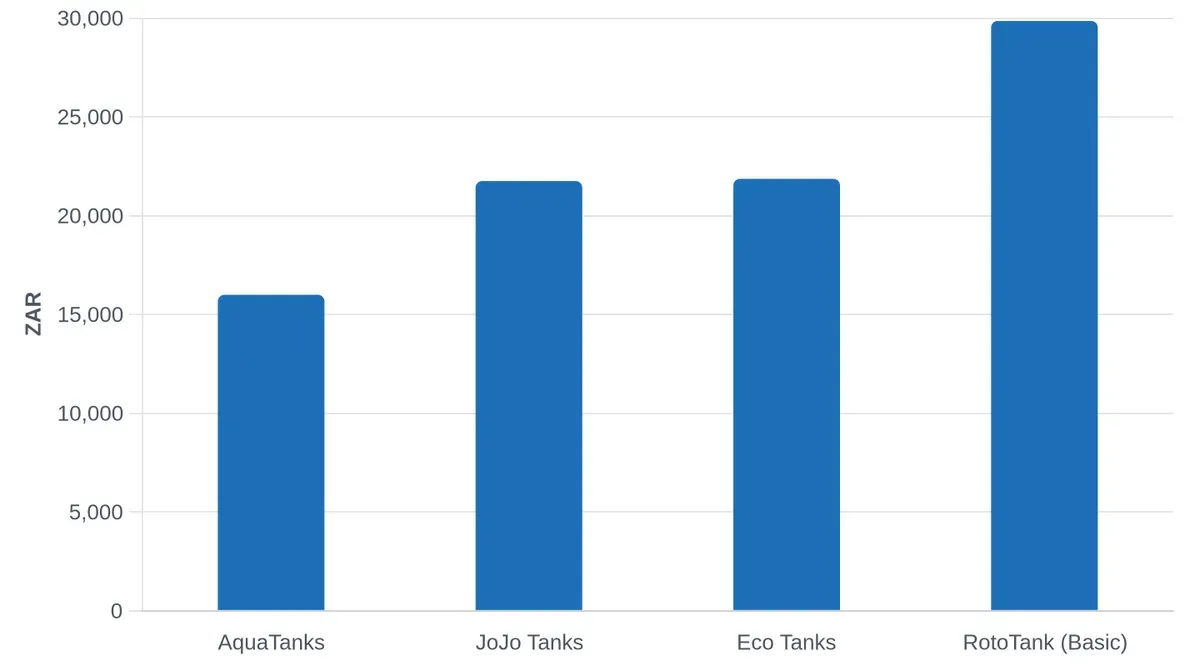
- A 10,000-litre tank costs between R15,999 (AquaTanks) and R21,868 (Eco Tanks at Plumblink). A fully installed large system runs R35,000 to over R80,000.
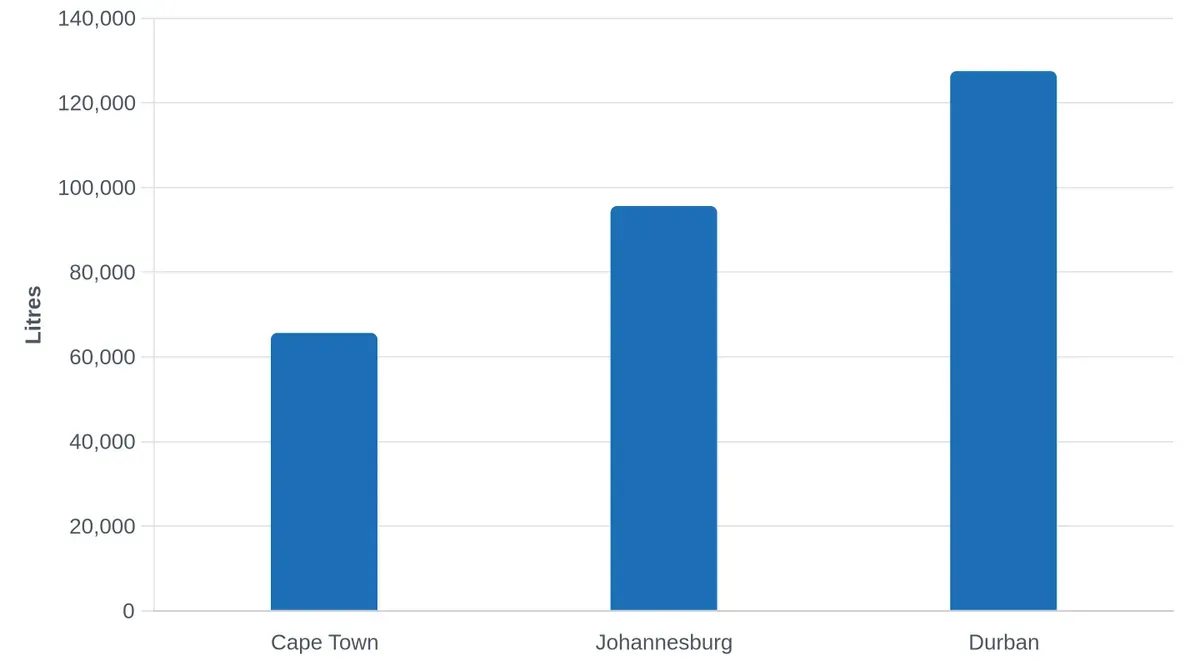
- Theoretical annual yield from a 150 m2 roof ranges from 65,600 litres in Cape Town to 127,500 litres in Durban, depending on local rainfall.
- Payback period for a standard residential setup is 3 to 7 years, but only when you account for all ongoing costs: filters, UV bulbs, pump replacement, and tank cleaning.
- A rainwater tank without backup power for the pump is only half a solution during both load-shedding and municipal outages.
- Greywater return pipes must be lilac (Pantone 522) under IOPSA guidelines. SANS 1307 governs solar water heaters, not rainwater harvesting.
Why This Guide Exists
Social media groups across South Africa are full of confident claims about rainwater harvesting: that it is illegal in certain cities, that a 1,000-litre tank is perfectly adequate, that the savings will pay for the system in two years. Very few of those claims come with actual legislation, real installer quotes, or an honest look at what the system costs to run over a decade.
This guide cuts through that noise. Every rand figure below is drawn from a verified supplier price or a published municipal tariff. Every legal statement traces to a specific bylaw or government source. And the owner voices woven through the article are real people who have already installed, maintained, and sometimes regretted their choices.
“Here in PE it’s considered ‘stockpiling’ and frowned upon. I’ve seen a lot of FB posts claiming it’s actually illegal but, when pressed, they can’t seem to qualify that with actual legislation.”
That comment captures a problem that runs through the entire rainwater harvesting conversation in South Africa. Myths spread faster than facts. The truth is more nuanced, and more useful, than either the enthusiasts or the sceptics suggest.
Is Rainwater Harvesting Legal in South Africa?
Yes, rainwater harvesting is legal for residential use across South Africa, but the conditions attached to that permission vary considerably by municipality. There is no single national statute that either permits or prohibits it. Instead, authority falls to local government, and three metros have taken meaningfully different approaches.
Cape Town
The City of Cape Town requires that all properties using alternative, non-drinking water resources display official signage that is clearly visible from a public thoroughfare (capetown.gov.za). This is not optional. If you plumb a rainwater tank into your home’s reticulation and do not put up the prescribed sign, you are non-compliant. The sign alerts emergency services and visitors that non-potable water may be present in the system.
It is also worth noting that SANS 1307, which some installers cite in the rainwater context, strictly governs domestic solar water heaters, not rainwater harvesting systems (scribd.com). Do not let a supplier quote that standard as the governing specification for your tank installation.
Johannesburg
New developments in Johannesburg are guided to provide rainwater harvesting capacity of at least 1,000 litres per 100 square metres of impervious roof or surface area (joburg.org.za). On a typical 150 m2 double-storey footprint, that translates to a minimum 1,500-litre requirement for new builds. Note that this is a development guideline for new construction, not a retrofit obligation on existing homes.
“Here by us it’s actually a bylaw for townhouse complexes and apartment buildings to have backup tanks.”
eThekwini (Durban)
eThekwini Municipality takes the most permissive stance of the three major metros. Their bylaws explicitly exempt rainwater tanks from a relaxation application provided the tank volume does not exceed 5,000 litres (durban.gov.za). Above that threshold, you may need to apply for a formal relaxation, which adds time and cost to your project. If you are in Durban and planning a 5,000-litre install, confirm with your ward office before breaking ground.
Greywater Pipe Colour Coding
If your system recirculates any greywater or uses a dual-pipe arrangement, the return pipes must be lilac, specifically Pantone 522 (iopsa.org). This is an IOPSA requirement and exists to prevent accidental cross-connection with potable supply lines. A licensed plumber will know this. A general handyman may not.
How Much Water Can Your Roof Actually Collect?
Before you buy a single fitting, run the numbers for your own roof. The industry standard yield formula is straightforward (WaterPoint SA Research Findings):
Roof Area (m2) x Annual Rainfall (mm) x Collection Efficiency (80% to 90%)
Using a 150 m2 roof and an 85% collection efficiency, the theoretical annual yields across three major South African regions are:
| Region | Annual Rainfall (approx.) | Theoretical Annual Yield (150 m2 roof) |
|---|---|---|
| Durban / KwaZulu-Natal | Approx. 1,000 mm | 127,500 litres (127.5 kL) |
| Johannesburg / Gauteng | Approx. 750 mm | 95,625 litres (95.6 kL) |
| Cape Town / Western Cape | Approx. 515 mm | 65,662 litres (65.6 kL) |
These are theoretical maximums. Real-world collection is lower: the first-flush diverter discards the first few litres of each rain event to remove roof contamination, gutters lose water to splash and overflow, and prolonged dry spells mean the tank may be empty for months at a time. Durban’s high annual rainfall is concentrated across more frequent events, which suits harvesting well. Cape Town’s winter-dominant rainfall means a large storage tank is needed to bridge the dry summer months.
“1000L is far too little, I can only last 3 days if I economise.”
That experience is common. A 1,000-litre tank sounds like a meaningful reserve until you do the arithmetic on household daily consumption, which typically runs between 100 and 200 litres per person per day for a standard family.
Tank Prices: What You Will Actually Pay in 2026
Tank prices shift with resin costs and rand volatility. The figures below were current at the time of research and give you a solid baseline for negotiations.
10,000-Litre Tanks
| Product | Price | Source |
|---|---|---|
| AquaTanks 10,000L Vertical | R15,999 | aqua-tanks.co.za |
| JoJo Tanks 10,000L (via Plumblink) | R21,756 incl. VAT | plumblink.co.za |
| Eco Tanks 10,000L (via Plumblink) | R21,868 incl. VAT | plumblink.co.za |
| RotoTank 10,000L Combo (tank + 1.1 kW pump) | R29,860 | rototank.co.za |
| RotoTank 10,000L Combo with Plinth | R48,925 | rototank.co.za |
20,000-Litre Tanks
| Product | Price | Source |
|---|---|---|
| Flowbin SA 20,000L JoJo-style Vertical | R53,399 | flowbinsouthafrica.co.za |
| AfriPumps JoJo 20,000L | R65,312 incl. VAT | afripumps.co.za |
Bladder Tanks (Alternative Formats)
| Product | Price | Source |
|---|---|---|
| Damsak 50,000L Heavy-Duty Lay-Flat Bladder | R34,000 | damsak.co.za |
| Rent-A-Bladder Temporary Storage | R600 per day | rentabladder.co.za |
“I would rather go JoJo if the price difference is small. Better quality in my opinion.”
JoJo backs that preference with substance: the brand offers a 10-year UV protection guarantee and an 8-year product warranty (jojo.co.za). When a tank is installed outdoors and exposed to South African sun for a decade, UV stability matters considerably. A R5,000 price saving on a lesser brand can disappear in one replacement or structural failure.
Complete System Costs: From Tank Only to Fully Integrated
The tank price is only one component. What you will actually spend depends heavily on how deeply you integrate the system into your home.
| Setup Type | Description | Total Installed Cost |
|---|---|---|
| Basic (garden use only) | Tank, downpipe diverter, gravity-fed tap | R5,000 to R15,000 |
| Small/Medium Integrated (2,000L to 5,000L) | Tank, pump, first-flush diverter, basic filtration, plumbed into house | R15,000 to R35,000 |
| Large Integrated (10,000L and above) | Large tank, booster pump, multi-stage filtration, UV sterilisation, plumbed reticulation | R35,000 to over R80,000 |
A 1,000-litre to 2,500-litre system costs R10,000 to R28,700 for initial installation according to buildersingauteng.co.za. Real owner breakdowns on forums confirm this range holds:
“I did mine myself and it cost me probably about R11k. Concrete slab – R2500 (I used premix, but would be cheaper if I bought individual cement, sand and stone) 2500L africa tank – R2000… DAB Pump – R2000 (usually R4500, got it on clearance)…”
That DIY figure assumes you have the skills to do the plumbing work yourself. For those who do not, professional labour adds to the cost:
“When I enquired they said between 2.5 and 4k [for basic installation labour].”
A more complex integrated setup with filtration tells a different story:
“2,500lt system cost me R29k, could have been R24k if I went with a non-slimline tank… Filtration alone won’t make up such a big gap, it’s only around R5k extra.”
The Hidden Costs: Ongoing Maintenance Over 15 Years
This is where most buyer guides go quiet, and it is the section that matters most to your long-term financial picture.
| Maintenance Item | Cost | Frequency | Source |
|---|---|---|---|
| 3-stage Big Blue filter replacements | R700 to R1,500 per year | Annual (more frequent for rainwater) | purewater4life.co.za |
| 55W UV steriliser bulb replacement | R450 to R650 per bulb | Annual to biennial | purewater4life.co.za |
| Professional tank cleaning | R500 to R2,000 per clean | Every 2 to 3 years | thehandymanjohannesburg.co.za |
| Booster pump replacement | R2,000 to R10,000 | Every 5 to 10 years | waterpumps.co.za |
| Total 15-year projected OPEX | R44,250 to R50,250 | Full 15-year horizon | mybroadband.co.za |
“The UV filter was about R1800 and I bought 3 replacement lamps for R450 each… The original UV filter bulb is still going 2 years in; the 3-stage filters have been replaced twice. Got to do another replacement somewhere in September. I suppose one would have to replace them more frequently for rainwater.”
That last observation is important. Rainwater carries more suspended particulates, bird droppings, leaf tannins, and biological matter than municipal supply. Filters used on a rainwater system will typically need replacing more often than the same filters used on a municipal backup tank. Build a higher maintenance frequency into your budget model if you intend the rainwater system to handle household water rather than just garden irrigation.
“Any system requires maintenance and testing – there is no install and forget option.”
The Cost-of-Ownership Comparison: Municipal vs. Rainwater Harvesting
To understand whether a rainwater system makes financial sense, you need to compare what you would spend on municipal water over the same period against what the system costs to buy, install, and maintain.
Municipal tariffs at the upper consumption bands are currently (WaterPoint SA Research Findings):
- Cape Town (10.5 to 35 kL band): R49.96 per kL
- Johannesburg (proposed 2026/27, 20 to 30 kL band): R64.53 per kL
- eThekwini / Durban (above 30 kL): R83.60 per kL excluding VAT
Using a Durban household that harvests 90,000 litres (90 kL) per year from a 150 m2 roof (a conservative estimate below the theoretical 127,500 L maximum), and displacing that volume from the municipal bill at R83.60 per kL, the annual saving would approach R7,524. Against a large integrated system costing R60,000 installed, payback would occur in roughly 8 years, sitting at the longer end of the 3 to 7 year range cited by WaterPoint SA Research Findings for standard residential setups. A smaller, simpler system with lower OPEX could hit the 3 to 4 year mark in a high-rainfall, high-tariff location.
Johannesburg households benefit from a higher municipal tariff (R64.53 per kL) but collect less rain annually (95,600 litres theoretical on 150 m2). Cape Town sits at the toughest end: lower rainfall, lower tariff, and seasonal concentration means a large storage tank is essential to bridge the dry summer, adding capital cost.
“Rainwater harvesting cost me about R1 per litre of storage… R2000 for the.75kw pump… At the end of the day there is probably zero cost savings but I have water. EDIT: these days you need to include the cost of a backup power supply for the pump.”
That edited comment points to a cost that almost every buyer forgets at the planning stage.
The Load-Shedding Trap: Your Pump Needs Power
A rainwater tank connected to a pressure pump is useless the moment the power goes off, unless you have made separate provision. This is not a minor caveat. It is the single most common installation regret among South African owners.
“I had previously installed a 2500litre jojo tank with a 750Watt booster-pump to supply water during shut-offs… Now this 750Watt booster-pump was too big to handle by my 800Watt inverter and would not run it… I realized after a day or two that the two deep solar batteries I had was too small, to handle the load… Went and bought two 100Amp/hr [batteries].”
The startup surge current of a booster pump can be two to three times its running current. An inverter and battery bank sized for lighting and device charging will often fail to start a 750W or 1.1 kW pump. If you are budgeting a rainwater system, include the cost of a correctly sized inverter and battery bank in your capital planning from day one. The RotoTank combo at R29,860 includes the pump but not the backup power. That gap needs to be closed explicitly.
Water Quality and Filtration: What You Need for Household Use
Garden irrigation and toilet flushing require minimal filtration. Washing machine, shower, and kitchen sink use require more. Drinking water requires a full treatment chain.
A standard residential filtration stack for non-potable household use typically includes a first-flush diverter on the downpipe, a sediment pre-filter, a multi-stage Big Blue housing (sediment, activated carbon), and a UV steriliser. For drinking, a reverse osmosis unit is added at the point of use.
“We have a 5000l water tank at home that we use for rainwater harvesting, run through a three-filter system for general household use and a reverse osmosis system for drinking water… Living in PE, a water tank is definitely a must-have.”
The UV steriliser installation costs R5,000 to R6,000 per tank (mybroadband.co.za), with individual replacement bulbs at R450 (mybroadband.co.za). One owner reported annual running costs for UV lamp replacements of R3,000 per tank (mybroadband.co.za) on a heavily used system. Balancing chlorine in rainwater tanks manually is genuinely difficult:
“99% of the time there’s either too much chlorine so that you’ve got swimming pool water coming out of your tap and the chlorine overwhelms the active carbon filter, or not enough so that the water smells musty due to decomposition of organic matter, which means that it’s no longer microbially safe.”
This is a strong argument for UV sterilisation over manual chlorination for any system where harvested water enters the household reticulation. The upfront cost is higher, but the management burden is dramatically lower and the safety margin is consistent.
Pump Selection and Common Pitfalls
The pump is the component most likely to fail first and create the most frustration. Budget pumps from generic brands have a poor track record in the South African market:
“I have been through 2 Ingcos, they are all the same kak with different branding. I have changed to one of the digital ones now.”
Even premium variable-speed drive pumps are not immune to electrical faults in the South African grid environment. A pressure pump controller, which cycles the pump based on tank level rather than instantaneous tap demand, significantly extends pump life by eliminating short-cycling. One owner with four tanks on compacted sand (no concrete) and a pump controller reported no issues after six to seven years of operation.
The pump sizing question is also non-trivial. A pump sized for a large system will overwhelm a small inverter during load-shedding, as the story above illustrates. A pump too small will not maintain adequate pressure for showers and washing machines. Get a written specification from your installer that matches pump output to your household demand and your backup power capacity simultaneously.
How an Integrated Municipal Backup System Works
“The main line feeds into a Jojo tank, tank connects to the pump… filters connect to the house. The municipal pressure is high enough that the pump doesn’t turn on… When the pump detects that the pressure drops below a certain amount i.e. in the event of a water outage, it turns on. So the water in the tank is still being cycled.”
This describes the most practical residential configuration: the tank is kept topped up by municipal supply during normal operation, and the pump activates automatically when municipal pressure drops. The rainwater inlet (from the downpipe and first-flush diverter) feeds the same tank. During a prolonged municipal outage, the harvested rainwater provides the backup volume. This dual-feed approach makes the most of both sources and keeps the stored water cycling rather than stagnating.
Sizing Your System: A Practical Summary
Use these rules of thumb to anchor your planning:
- For emergency backup only (3 to 5 days): 2,500 to 5,000 litres minimum for a family of four.
- For meaningful monthly saving on municipal bills: 10,000 litres and above, with a proper pump and filtration stack.
- For near-full rainwater independence in a high-rainfall area: multiple 10,000-litre tanks in series, with a large-capacity pump and full treatment chain. Budget R80,000 or more installed.
- For Johannesburg new builds: check that your plans meet the 1,000 litres per 100 m2 development guideline (joburg.org.za) before submission.
- For eThekwini properties: keep your first tank at or under 5,000 litres to avoid the relaxation application process (durban.gov.za).
- For Cape Town: install the mandatory signage before the system goes live (capetown.gov.za).
What the Numbers Actually Mean for Your Decision
Here is the honest summary. A rainwater harvesting system in South Africa is not primarily a financial investment in most cases. It is a resilience investment. The payback period of 3 to 7 years (WaterPoint SA Research Findings) assumes consistent rainfall, reasonable OPEX discipline, and a municipal tariff that continues to rise. All three of those assumptions are reasonable but not guaranteed.
What is guaranteed is that a 5,000-litre tank, a properly sized pump, a basic three-stage filter, and backup power for that pump will keep your household functioning through municipal outages, water restrictions, and supply disruptions that are likely to be recurring features of South African life for the foreseeable future. The financial case is secondary to that core resilience argument.
“Savings only ito [in terms of] reduced monthly cash expenditure. Not cheaper. Similarly water just want backup if water off!”
That is an honest framing. Go into this with eyes open: the system costs money, it requires maintenance, it needs power to function, and the financial return depends heavily on your location, rainfall, and tariff band. But for most South African homeowners, the peace of mind of knowing the taps will work regardless of what the municipality does next month is worth the capital outlay on its own terms.
Ready to see what options apply to your specific address and municipality? Check my address to get a personalised view of local bylaws, typical yield figures, and installer availability in your area.
Get started
Ready to size and install your rainwater harvesting system?
Vetted local installers · honest advice first
Photo: Shubham Prajapat / Pexels