Key points
- Bospoort Water Treatment Plant 3 runs on 3 of its required 5 pumps, and the Kortbegrip System operates on just 1 of 3 pumps, according to the DA’s formal complaint against Magalies Water, outages are structural, not occasional.
- Rustenburg borehole water hardness has been measured above 300 mg/L CaCO3 (very hard) according to an Aquatico Water Quality Evaluation Report, and research into local irrigation borehole samples found non-compliance with standard limits for domestic use on turbidity, nitrate, iron, manganese and chromium, test before you drink.
- Drilling costs in Rustenburg start at R18,000 to R30,000 for drill-and-casing only, per PE Drilling, before pumps, tanks, filtration or electrical connections are added. North West per-metre rates average R350 to R500, per BoreholGuide.
- A standard 5,250L JoJo tank costs R6,199 at Leroy Merlin and a 4,750/5,000L tank costs R6,899 at Builders Warehouse, storage is affordable, and for most Rustenburg households facing intermittent supply it is the cheapest adequate fix.
- Rustenburg Local Municipality proposed a 9% increase on the residential water basic charge for the 2026/2027 financial year, according to ActionSA’s tariff review, making continued full municipal dependence more expensive every year.
- The DWS borehole registration process via e-WULAAS carries a processing lead time of 90 days, plan well ahead or face legal exposure.
Why Rustenburg’s water supply keeps failing

Rustenburg is one of South Africa’s most economically productive cities, anchored by the world’s richest platinum deposits. Yet its residents face rolling water outages that stretch from days into weeks. The reason is not a single dramatic failure, it is the slow accumulation of deferred maintenance, infrastructure theft, and under-resourced repair crews.
According to the DA’s January 2026 statement on the Rustenburg water crisis, Bospoort Water Treatment Plant 3 is running on only 3 of the 5 pumps it requires. The Kortbegrip System is worse: 1 functional pump out of 3. The Tlhabane Reservoir, which should serve large parts of the city, remains completely non-operational because the Mafenya Pump Station was never energised, as recorded by SAnews reporting on the joint DWS and Magalies Water task team. These are not temporary faults waiting for a repair crew. They represent years of accumulated underinvestment.
Infrastructure theft compounds the problem directly. In February 2025, an RLM Electrical Department employee was arrested in possession of R800,000 worth of stolen copper cables. That single incident illustrates how the municipality’s repair budget is consumed by criminal activity from within its own ranks.
Against this backdrop, the government’s National Water Action Plan, launched in July 2026, confirms that the Rustenburg situation is not unique, it is part of a national pattern of collapsing municipal infrastructure that is pushing property owners toward private backup solutions. Even the private sector has been forced to act: Glencore and Magalies Water launched a bulk water pipeline project to secure supply for the Platinum Belt’s mining operations, a measure that underscores just how severe the shortfall has become.
One community voice captured the lived reality: “Thankfully we have a JoJo tank on the roof, which catches us for quite some time, but when it runs out, we have to rely on a tanker, or try to get a tanker out here to supply us with water.” That is not a long-term solution, it is a symptom of a system that has stopped working.
Wellpoints are not an option in the Platinum Belt, here’s why
Residents who have read about wellpoints solving water problems in Cape Town’s sandy soils should understand immediately: Rustenburg’s geology makes wellpoints physically impossible for most properties. The city sits on the Bushveld Igneous Complex (BIC), one of the world’s largest layered igneous rock formations. The underlying norite, gabbro, and pyroxenite are hard crystalline rock, a hand-held percussion drill cannot touch them. Heavy-duty pneumatic rigs are required just to begin.
This means that groundwater access in Rustenburg requires a full borehole, typically drilled to between 60 and 120 metres to reach fractured rock aquifers. The capital risk is real. Drilling costs in the region start at R18,000 to R30,000 for drill-and-casing only, per PE Drilling. Per-metre rates across North West average R350 to R500, according to BoreholGuide. Add a submersible pump, pressure tank, electrical connection, and filtration system, and a completed domestic borehole installation can run from R60,000 upward, with no guarantee of water at the end.
At the JST Provincial Hospital, a commercial-grade borehole was found to yield 7,000 litres per hour. That is an exceptional result for the region, and domestic boreholes should not be planned around it. Residential yields vary enormously depending on fracture patterns in the underlying rock, and a neighbour’s successful borehole offers no guarantee your own site will perform similarly.
The water quality problem you cannot ignore in a mining area
Even when a Rustenburg borehole hits water, the water itself carries risk that does not apply in most South African suburbs. This is a platinum mining belt. Decades of mining activity, failing municipal sewage plants, and shallow industrial waste sites mean that shallow aquifers are particularly vulnerable to contamination.
An Aquatico Water Quality Evaluation Report, cited on Scribd, found Rustenburg borehole water hardness above 300 mg/L CaCO3, classified as very hard. Separately, ResearchGate-published research into local irrigation borehole samples found the water did not comply with standard limits for domestic use on turbidity, nitrate, iron, manganese and chromium. These are not cosmetic issues. Iron and manganese affect taste and plumbing; elevated nitrates are a health risk for infants; chromium contamination in a platinum mining region carries serious long-term health implications.
The practical implication: any borehole sunk in the Rustenburg area must be tested before use, and multi-stage filtration, including at minimum a sediment filter, an iron/manganese removal stage, and UV sterilisation, should be treated as mandatory rather than optional. Importantly, the municipal water supply tells a different story: Rand Water’s October 2025 report showed E. coli levels of 0 mpn/100mL and a Total Dissolved Solids average of just 159 mg/L in its supply to Rustenburg, and the 2025 AfriForum Water Quality Watch Report classified RLM’s drinking water as safe. The contamination risk is in the ground, not in the treated municipal supply.
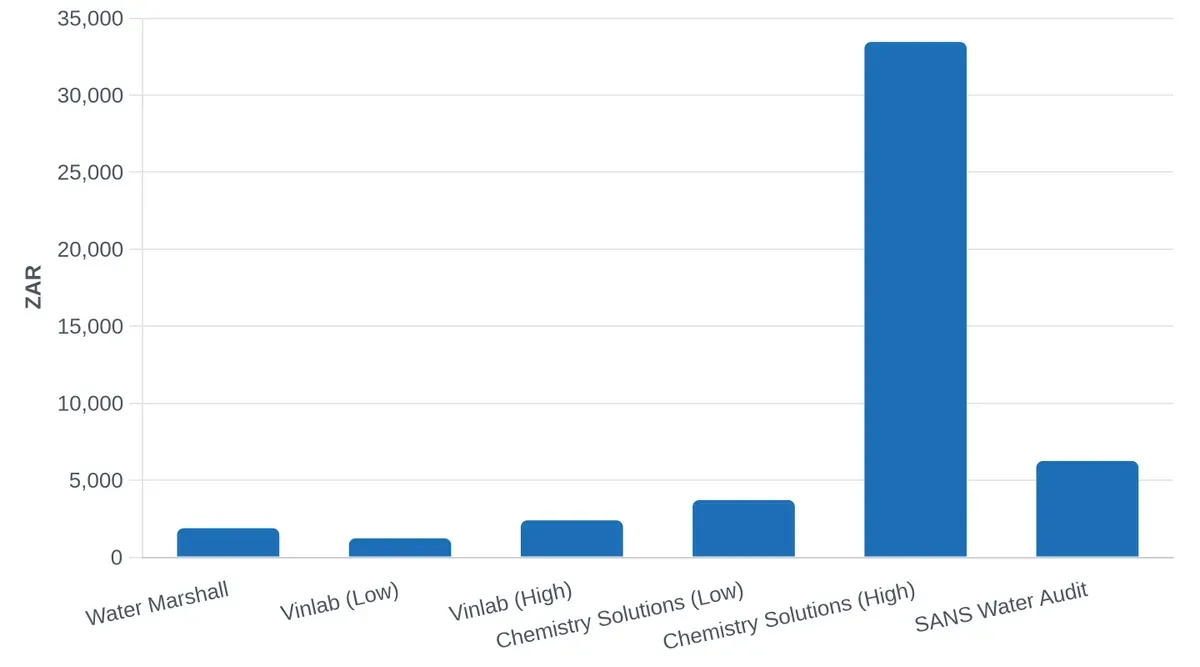
Water quality testing in South Africa costs between R1,229 and R2,396 at Vinlab, R1,885 at Water Marshall, R6,250 for a full SANS 241 audit at SANS Water, and R1,750 for a standard drinking water chemistry panel at H2O Guru. Test before you use, and retest annually in a mining area.
The cheapest adequate fix: backup tank as a municipal bridge
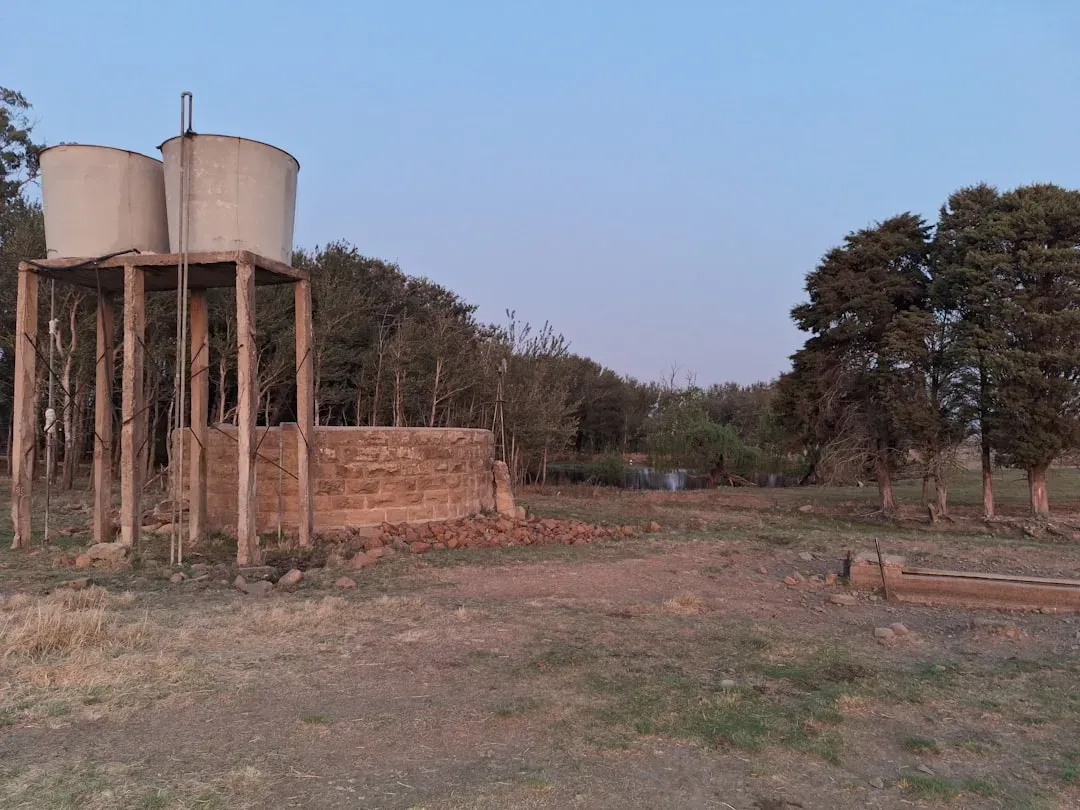
For most Rustenburg homeowners, the crisis is not that there is no municipal water, it is that the supply runs on a restricted schedule. Affected wards often receive water for a few hours per day. A backup tank system solves this problem completely, at a fraction of the cost of a borehole, and without any geological risk.
The principle is straightforward: a tank is plumbed into the municipal line with a non-return valve and a booster pump. When municipal pressure is present, even at 4:00 AM, the tank fills automatically. When pressure drops, the pump draws from the tank and the household notices nothing. No tanker deliveries. No buckets. No R60,000 risk.
| Option | Typical installed cost (ZAR) | Geological risk | Water quality risk | Best suited to |
|---|---|---|---|---|
| 5,250L JoJo backup tank (municipal-fed) | R7,000-R15,000 | None | Municipal supply (tested safe) | Intermittent supply outages |
| Full domestic borehole (60-120m) | R60,000+ | High (dry-hole risk) | Requires full SANS 241 testing and filtration | Complete municipal independence |
A standard 5,250L JoJo tank is available from Leroy Merlin at R6,199. A 4,750/5,000L equivalent costs R6,899 at Builders Warehouse. For a family of four using roughly 200 litres per day, a 5,000L tank provides approximately two to three days of supply through any outage window, more than enough to bridge Rustenburg’s typical scheduled cuts.
In Motlhabe, residents unable to access any supply were paying R5 for 25 litres from neighbours with functioning systems. At that rate, a 5,000L tank’s worth of water would cost R1,000 per fill from an informal supplier. A properly installed backup tank pays for itself within months for any household currently buying tanker water.
Ready to find out whether a backup tank, wellpoint, or borehole is the right fit for your specific address? Check my address for a free feasibility report and a recommendation matched to your street’s real groundwater data and supply history.
If you do drill: registration, compliance and realistic costs
For homeowners who have assessed the situation and determined a borehole is genuinely necessary, perhaps for a smallholding, an agricultural property, or a site with very poor municipal supply prospects, the legal and financial reality must be planned for carefully.
All boreholes used for purposes other than domestic garden watering must be registered with the Department of Water and Sanitation through the e-WULAAS online system. The processing lead time is 90 days. That is not a suggestion to delay registration, it is a legal requirement, and starting late creates compliance exposure.
Drilling costs in the North West average R350 to R500 per metre, per BoreholGuide. At 80 metres depth, a realistic mid-range for Rustenburg’s fractured rock aquifers, that is R28,000 to R40,000 for drilling alone, before casing, pump, pressure vessel, electrical connection, pipework, and filtration are costed. The baseline from PE Drilling of R18,000 to R30,000 reflects the minimum drill-and-casing cost only.
Unauthorised water connections carry a minimum fine of R3,000 plus costs, or a prison term of no less than three months, under Rustenburg Local Municipality’s bylaws. The BWA (Borehole Water Association) annual membership for 2026 is R5,750 and provides access to legal guidance, driller directories, and water use compliance support, worth considering before you sign a drilling contract.
Is your Rustenburg address affected by the water crisis?
What the 9% tariff hike means for your decision timeline
Rustenburg Local Municipality proposed a 9% increase on the residential water basic charge and a 9.01% increase on electricity for the 2026/2027 financial year, according to ActionSA’s tariff review. Compounded over several years, rising tariffs change the return-on-investment calculation for private water infrastructure significantly.
A backup tank system with a modest booster pump costs roughly R7,000 to R15,000 installed. At current and rising tariff rates, every litre you use from stored municipal water during a pressure window is already paid for, you are not paying a tanker premium or an emergency delivery surcharge. For households currently spending on tanker deliveries, the payback period on a backup tank is short.
For boreholes, the maths is less straightforward. The capital cost is higher, the ongoing maintenance is real (pump replacement, annual water testing, filter media changes), and the quality risk in the Platinum Belt adds filtration costs that suburban borehole owners elsewhere do not face. A borehole makes economic sense when municipal supply is completely unreliable and a backup tank cannot bridge the gap, not as a first response to scheduled outages.
As one community voice put it: “This is a man-made crisis caused by corruption, mismanagement and a lack of accountability across all spheres of government.” That assessment is accurate. And until accountability improves, the honest answer for most Rustenburg homeowners is to stop waiting for the municipality to fix itself and install the cheapest system that keeps their taps running.
The first step is knowing what your specific address can support. Check my address and get a feasibility report based on real groundwater and supply data for your street, then talk to a vetted installer who knows the Platinum Belt’s geology.
Get started
Is your Rustenburg address affected by the water crisis?
Vetted local installers · honest advice first
Photo: Павел Хлыстунов / Pexels