Key points
- SANS 241:2025 tightens turbidity to a strict maximum of 1.0 NTU and sets a minimum free chlorine residual of 0.1 mg/l in distribution networks.
- Compliance is no longer just about passing a parameter checklist. The updated standard now explicitly includes sections on borehole water and regular testing schedules, requiring a documented risk assessment, targeted monitoring, and recorded corrective action.
- Routine full baseline analysis is required every two years under SANS 241:2025.
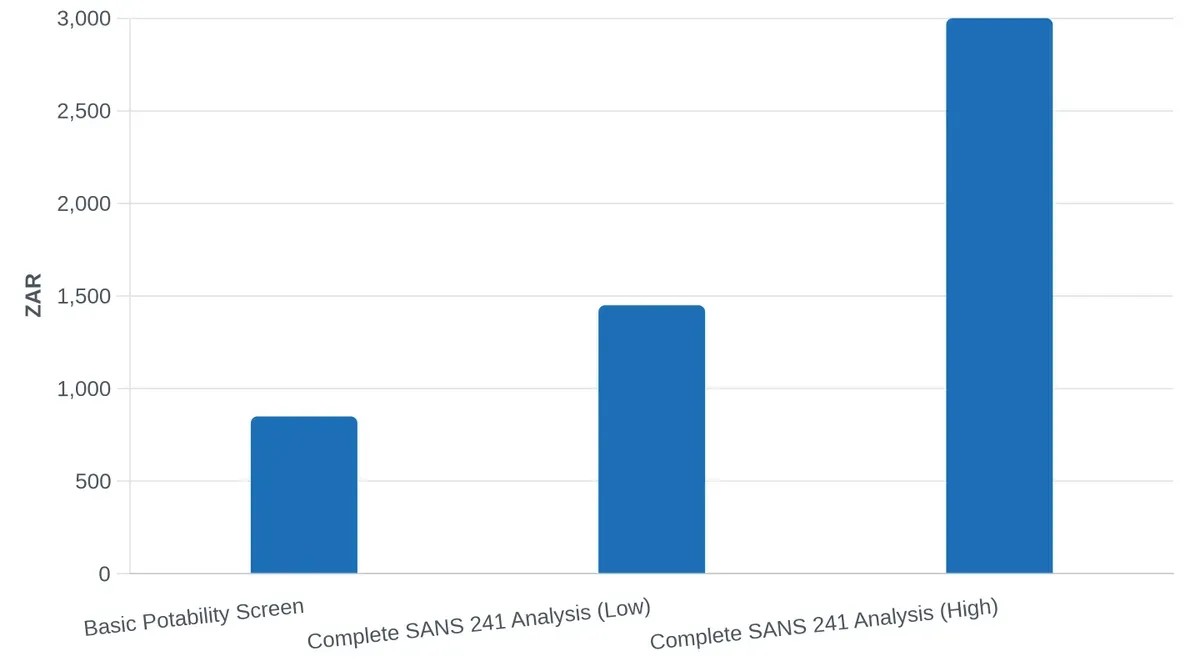
- Lab costs range from around R850 for a basic potability screen (waterquotes.co.za) to R3,714 for a complete core essentials panel (The Chemistry Solutions Company), with an R899 call-out fee for on-site sampling in Cape Town.
- The 2023 Blue Drop Report found that 51% of South Africa’s municipal water supply systems had unsafe water, making private backup water quality an urgent personal responsibility.
- Certain trigger events, flooding, nearby infrastructure work, a change in water colour or smell, and installation of new filtration equipment, require retesting outside the biennial cycle.
Why SANS 241:2025 is a genuine inflection point for private water users
South Africa’s national drinking water standard was revised with the release of SANS 241:2025, and the new edition is not a cosmetic update. Infrastructure News describes the shift as moving from simple checklist compliance to system-wide risk management, warning that systems previously deemed compliant may no longer meet the updated criteria. For anyone drawing water from a private borehole, a rainwater harvesting tank, or a municipal backup tank, the changes carry direct practical consequences, whether you supply your household, a smallholding, or a sectional title complex.
The context makes the update urgent. The 2023 Blue Drop Report found that 51% of South Africa’s municipal water supply systems were supplying unsafe water. Municipalities are legally required to supply every resident with a minimum of 25 litres of safe, potable water per day, but in practice that guarantee is unreliable across large parts of the country. Private boreholes and storage tanks have become infrastructure, not luxuries, and SANS 241:2025 now treats them accordingly.
A resident in Hammanskraal captured the human cost bluntly:
Get started
Is your borehole or tank water SANS 241 compliant?
Vetted local installers · honest advice first
Photo: Павел Хлыстунов / Pexels