Key points
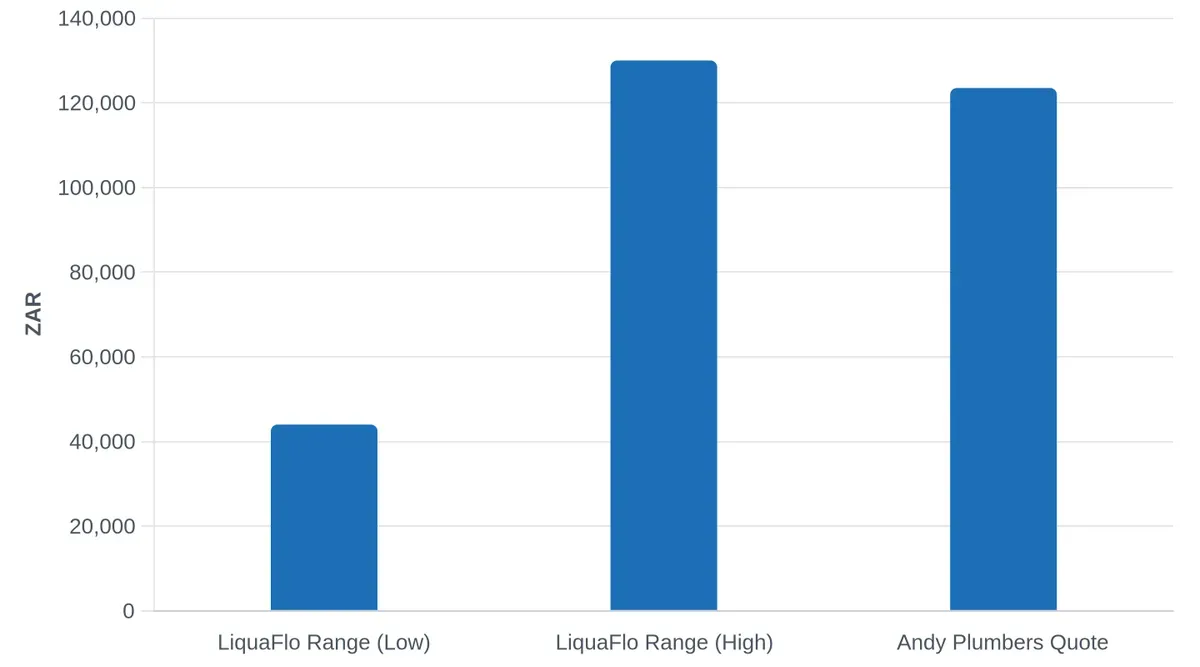
- A complete residential solar borehole system costs between R44,000 and R130,000+ depending on depth, pump type, and whether you already have a hole in the ground (LiquaFlo).
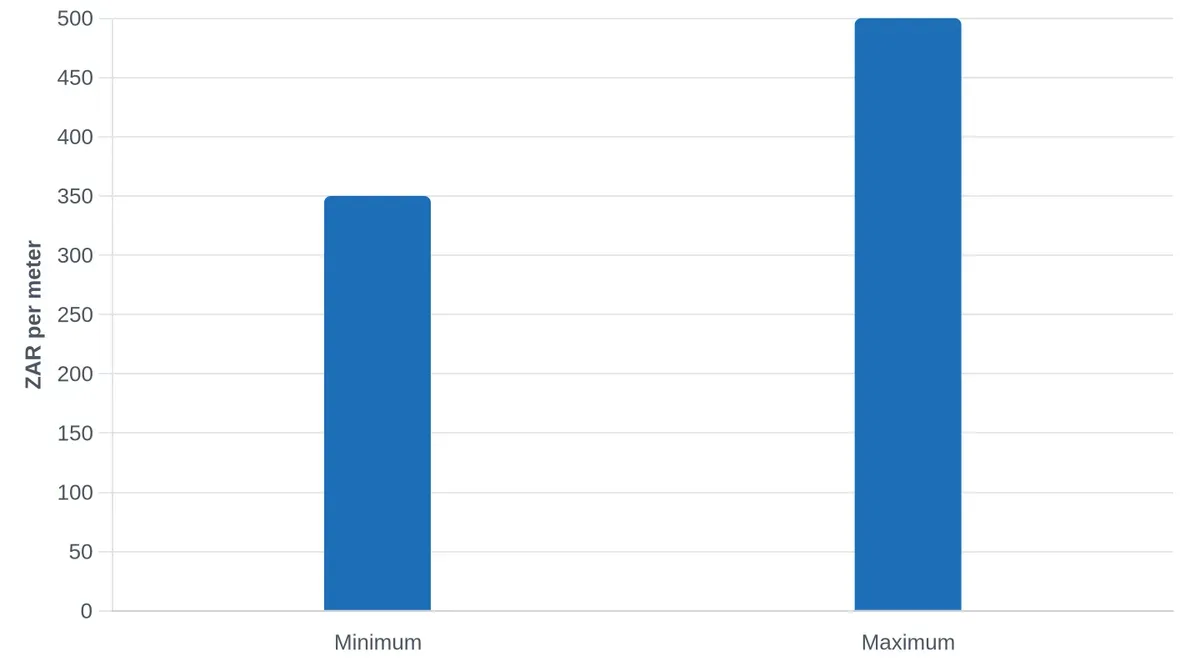
- Drilling alone in Gauteng runs R350 to R500 per metre (Groundwater Surveys), so a 60-metre hole adds R21,000 to R30,000 before a single component is fitted.
- Solar pumps must be oversized: a 500W pump needs 650W of panels (Bundu Power), and output planning is based on just 5.5 peak sun hours per day.
- Running a generator through load-shedding cycles costs R10.13 per kWh (MyBroadband) compared to near-zero marginal cost for solar pumping once the capital is recovered.
- Most year-two failures trace to three causes: undersized inverters tripped by startup surge, lead-acid batteries destroyed by Stage 6 depth-of-discharge, and pump motors damaged by voltage-frequency distortion at depth.
- City of Johannesburg water tariffs rose 12.5% on 1 July 2026, with upper-tier consumption above 200 kl billed at R77.77 per kilolitre, making borehole payback faster for high-volume users.
Why people are still installing boreholes even as load-shedding eases
South Africa’s grid has been more stable in recent months than it was at the height of Stage 6, but the underlying reasons people turned to boreholes have not gone away. Municipal water supply remains unreliable across large parts of Gauteng, the Western Cape, and KwaZulu-Natal. Tariffs keep climbing: the City of Johannesburg pushed water prices up 12.5% on 1 July 2026 (joburg.org.za), and households consuming above 200 kilolitres per month now pay R77.77 per kilolitre at the upper tier. The Water Demand Management Levy alone adds R107.74 to every Joburg account each month regardless of usage. For a property with a productive aquifer below it, those numbers make a solar borehole system look increasingly attractive on paper.
The problem is the gap between the brochure and the driveway. Installers quote widely varying prices, forum horror stories about pump failures accumulate, and the engineering compromises that cause most year-two collapses are almost never explained during the sales process. This guide works through each of those issues with real numbers and real owner experiences.
What a complete system actually costs in 2026
There is no single price for a solar borehole system because the variables compound quickly: depth of aquifer, yield and water quality, pump size, whether you need a new borehole or are retrofitting an existing one, the size of the storage tank, and whether the pump will be fed from a dedicated solar array or integrated into a whole-home solar installation.
LiquaFlo Borehole Solutions publishes a range of R44,000 to R130,000+ for a full system from scratch. Andy Plumbers quotes R123,500 for a complete new 60-metre residential system. Those two data points bracket the realistic market for a straightforward residential installation.
Breaking the cost into components helps:
| Component | Indicative cost range | Source |
|---|---|---|
| Drilling (Gauteng, per metre) | R350 to R500/m | Groundwater Surveys |
| 60-metre hole (drilling only) | R21,000 to R30,000 | Derived from above |
| Solar borehole pump (basic) | R8,000 to R19,000 | AfriPumps |
| Dedicated solar panels | R6,000 to R7,000 | AfriPumps |
| 10 kWh lithium battery bank | Market standard for residential | solarpanelenergy.co.za |
| 50 kWh battery bank (battery only) | R80,000 to R120,000 | solametsi.co.za |
| Emergency pump replacement | R12,000 to R18,000 | boreholepros.co.za |
| Complete 60m residential system (installed) | R123,500 | Andy Plumbers |
| Full system range (scratch) | R44,000 to R130,000+ | LiquaFlo |
“Don’t forget the price of a submersible pump for the borehole which, depending on which you go for, can cost R50k or even more for a reliable solar pump with dedicated panels.”
User lkpat on MyBroadband, discussing high-end solar borehole pump costs
That owner’s ceiling of R50,000 for pump-plus-panels alone is consistent with the upper range quoted by AfriPumps. The lower end of that spectrum buys you a pump that will work in a clean, shallow, low-sand-content borehole. The upper end buys stainless-steel impellers, a brushless BLDC motor, and a controller that handles variable voltage gracefully, which is exactly what matters during patchy solar output.
“Drilling the borehole is expensive. I installed my own water tank, pump and did the piping for 6k total if I remember correctly. The most expensive thing was the fittings and piping.”
User wingnut771 on MyBroadband, explaining DIY savings on the non-drilling components
Wingnut771’s experience illustrates an important structural point: drilling is the one component you cannot DIY, and it dominates the budget for any new installation. If you already have a cased borehole, the economics shift considerably in your favour.
How solar actually powers a borehole pump: the engineering reality
A solar borehole setup is not simply a matter of pointing panels at the sun and plugging in a pump. There are three engineering constraints that most sales conversations skip over.
Peak sun hours and practical output
Bundu Power’s sizing guidance bases all output calculations on 5.5 peak sun hours per day at maximum capacity. In practice, winter in Johannesburg delivers considerably fewer usable hours, and shading from trees or buildings reduces effective output further. A system that fills a 5,000-litre tank comfortably in December may leave it half-full in July.
“Come winter I was caught panel-light due to shading and low rake angle… not having to cramp your lifestyle does [matter].”
A South African forum owner discussing winter solar shortfalls
The fix is simple but adds cost: Bundu Power’s rule is to oversize the solar array by 30% relative to pump wattage. A 500W pump therefore needs 650W of panels, not 500W. Most installers who skip this step do so to hit a lower quote price, and the customer discovers the shortfall in June.
Startup surge current
This is the single most common cause of inverter trips and, eventually, inverter damage when a borehole pump is integrated into a whole-home solar system.
“Don’t consider kw when looking at inverters in this case – look at the maximum amps. Borehole pumps pull ridiculous amps when starting – my 2.2kw uses up to 35 amps to start up. It has tripped my 8kw inverter a few times.”
Veteran user Johandup on PowerForum
A 2.2 kW pump drawing 35 amps at startup is pulling the equivalent of a 7.7 kW load for the fraction of a second the motor needs to overcome inertia. If your inverter’s surge rating does not comfortably exceed that figure, you will have nuisance trips at best and a damaged inverter at worst. The correct solution is either a soft-starter (adds R2,000 to R5,000 to the system cost) or a variable-frequency drive (VFD).
VFDs introduce their own complication at depth:
“The pump is a single phase 2.2kW sitting at around 82 meters. I was looking at the INVT VFD and was told that it was necessary to also add a sine wave filter for depths greater than 30 meters.”
PowerForum user on VFD installation at depth
The sine wave filter prevents voltage spikes from the VFD’s pulse-width modulation from degrading the motor winding insulation over time. At 82 metres, with the cable itself acting as a capacitive load, skipping the filter is a way to turn an R18,000 pump into a replacement job within two years.
Dedicated array versus shared home solar system
The cleanest engineering solution, and the one most likely to survive Stage 6+ load-shedding reliably, is a completely separate DC solar array dedicated to the borehole pump. No inverter in the loop means no surge-current problem, no battery drain, and no integration complexity.
“I have had a solar borehole pump for over 12 years… It is a completely separate off-grid solution. (50m head and 3000L/H from a dedicated 185W panel)… It lives under the panels out in the mountains with +40C in summer and snow in winter and the microcare is built like a tank.”
Forum owner discussing the resilience of dedicated off-grid DC solar pumps
Twelve years of operation across alpine temperature extremes, from a 185W panel, with a 50m head and 3,000 litres per hour output, is an extraordinary real-world datapoint. The trade-off is that this approach only pumps during daylight, so adequate storage capacity is mandatory.
Why most installations fail in year two
The failure modes cluster into four categories, and the good news is that all four are preventable with correct specification at the time of installation.
The battery problem
When borehole pumps are integrated into whole-home backup systems, the battery bank takes punishment that lead-acid chemistry cannot survive long-term. Stage 6 meant up to 10 hours of load-shedding per day in some schedules. That depth of discharge, repeated daily, kills an AGM battery fast.
“AGM battery degraded after ~8months… The expectation was that ~100W for two hours of load shedding would not drop below 50% SoC. Unfortunately we experienced a few suburb outages which ran into 6+ hours each… most of my colleagues had to have the battery replaced within the first year.”
User system32 on PowerForum, on real-world AGM degradation
“Even the numbers on most deep cycle batteries are BS. Don’t waste your money on anything other than lithium.”
MyBroadband Forum Member on lead-acid versus lithium reliability
The most popular battery capacity for residential solar installations is 10 kWh (solarpanelenergy.co.za). If you intend to run a borehole pump through the battery bank during load-shedding, that 10 kWh needs to be lithium iron phosphate (LiFePO4) chemistry, sized with the pump’s surge current and runtime factored in. Running any borehole pump from a lead-acid bank under Stage 6 conditions is, as the forum evidence shows, a reliable way to replace batteries within twelve months.
The water table problem
A pump that worked perfectly can stop delivering water for a reason that has nothing to do with the pump itself.
“Boreholes that worked five years ago run dry.”
Aqua Earth hydrogeologist, on water table depletion
As more properties in a suburb install boreholes, the shared aquifer is drawn down. Shallow boreholes in weathered rock are most vulnerable. The Tshiping Water User Association documented failures of 30m to 50m shallow boreholes in weathered lava in the Northern Cape between 1998 and 2008 as a direct result of this effect. The practical implication for anyone specifying a new installation today is to drill deeper than the minimum necessary yield suggests, build in a pump set-depth buffer, and install a dry-run protection sensor from day one.
The pump quality problem
“In places like South Africa or Zambia, the conditions are harsh. You cannot use a cheap plastic pump and expect it to last five years.”
Installer advice on abrasive sand and silt wear in SA conditions
Abrasive silt and sand in the water column wear through plastic impellers quickly. Stainless-steel or cast-iron impeller stages are worth the premium for any borehole with measurable turbidity. A pump replacement when something goes wrong costs R12,000 to R18,000 including extraction and reinstallation (boreholepros.co.za). That emergency cost erases two to three years of water bill savings in a single callout.
The installation quality problem
The safety and reliability failures that appear in year two often have their roots in the original installation. Rein Snoeck Henkemans, CEO of Alumo Energy, has described the problem bluntly:
“AC and DC cables crammed into single trunking systems, live wires without proper conduits, and inverters that don’t meet National Rationalised Specifications… These flaws do more than reduce efficiency, they create serious risks of fire, electrocution, and total system failure.”
Rein Snoeck Henkemans, CEO of Alumo Energy
The tank-level automation layer is also frequently botched. Ultrasonic distance sensors are the obvious choice for a JoJo tank overfill cutoff, but moisture inside the tank corrodes them:
“An ultrasonic distance sensor is one option but moisture has been a problem for some… I’ve resorted to a Sonoff flood probe hanging from the top with an eWeLink automation to stop a solar borehole pump.”
MyBroadband user on moisture destroying ultrasonic level sensors in JoJo tanks
A pump running into an overflowing tank is wasted energy and, in a worst case, a flooded garden or damaged structure. The automation solution does not need to be complex, but it does need to be moisture-proof.
Cost-of-ownership comparison: solar borehole versus grid water versus generator
The table below compares the realistic long-term cost position of three approaches for a household consuming approximately 20 kilolitres per month in Johannesburg.
| Approach | Capital cost | Ongoing monthly cost (indicative) | Key risk |
|---|---|---|---|
| Municipal grid water only | R0 | Variable by tier; R77.77/kl above 200 kl (joburg.org.za); levy R107.74/month | Tariff increases (12.5% in July 2026); supply interruptions |
| Solar borehole (dedicated DC array, no battery) | R44,000 to R130,000+ | Near zero marginal cost; maintenance budget of R3,000 to R6,000 per year | Aquifer depletion; pump failure (R12,000 to R18,000 emergency replacement) |
| Solar borehole (integrated whole-home system, lithium battery) | R80,000 to R180,000+ depending on battery size | Near zero marginal cost; battery replacement in 8 to 12 years | Inverter surge trips; undersized battery bank drained by pump load |
| Generator backup for municipal supply | R15,000 to R40,000 | R10.13 per kWh (MyBroadband); fuel, oil, and service costs accumulate fast | Diesel at R26.03/litre (autotrader.co.za); noise; fuel availability |
The generator comparison deserves emphasis. At R10.13 per kWh, a generator is not a cost-effective long-term water security solution. One forum owner with five years and 30 hours on his generator clock explained it this way:
“Generators are necessary and have a place, as a last resort. They are like camping: cheap and fun to play with especially when novel, but not on an ongoing basis. I get to run mine in maintenance slots, have had it for 5 years but only around 30 hours on the clock.”
Veteran forum user on the reality of long-term generator reliance
The solar borehole’s payback period depends almost entirely on current municipal water spend and how quickly tariffs continue to rise. For a high-volume user at the upper CoJ tier paying R77.77 per kilolitre, the numbers accelerate significantly. For a household using 10 to 12 kilolitres per month at the lower tiers, the payback horizon is longer and the case rests more on supply security than pure cost recovery.
What a setup that survives Stage 6+ actually looks like
Based on the engineering evidence and owner experience compiled above, a residential solar borehole installation that holds up through extended load-shedding shares these characteristics:
- Borehole depth at least 20 metres below the minimum productive zone, with a professional geohydrological assessment before drilling.
- Stainless-steel or cast-iron impeller pump, sized to the static and dynamic water level with a dry-run protection sensor hard-wired in series.
- Dedicated DC solar array sized at 130% of pump wattage (Bundu Power rule), with panels at the correct seasonal rake angle for the installation’s latitude.
- If integrated into a home inverter: a soft-starter or VFD with sine wave filter for depths beyond 30 metres, and an inverter with a surge rating that comfortably exceeds the pump’s startup current.
- LiFePO4 battery chemistry only for any battery-backed configuration. The 10 kWh popular tier is adequate for overnight storage; anything running a 2 kW pump through multiple Stage 6 cycles should be sized upward accordingly.
- Control panels and battery enclosures installed in ventilated spaces, not cramped ceiling voids. As libertytechnologies.co.za notes: batteries hate heat.
- Tank level automation using moisture-rated sensors or a flood probe solution, not exposed ultrasonic sensors.
- A storage buffer large enough to cover at least four days of household consumption. According to Nedbank’s Avo Water platform, a 2,400-litre JoJo tank covers roughly four days for a household using 600 to 700 litres per day, which means most households need a minimum of 2,500 litres of storage, and 5,000 litres is a more practical target for extended outage resilience.
Design a solar borehole that survives Stage 6+
What the price history tells you about timing
Solar component prices have dropped considerably since the peak load-shedding period. One owner who paid close to R120,000 for a system at that peak reacted to current quotes with surprise:
“Holy ****! Prices have dropped a ton! We paid almost R120k for a virtually identical system during the peak of load shedding…”
Owner on a South African forum reacting to current solar system pricing
That price compression has stalled somewhat as demand has stabilised. The R44,000 to R130,000+ range from LiquaFlo and the R123,500 figure from Andy Plumbers reflect the current market, not a discount window. Buyers who waited for prices to fall further have largely seen the sharpest reductions already absorbed.
The one question to answer before you spend anything
Before committing to any borehole installation, the single most important question is whether a productive aquifer exists under your property at a commercially drillable depth. Drilling at R350 to R500 per metre (Groundwater Surveys) and finding nothing, or finding water at 120 metres when your neighbourhood’s water table has been drawn down by adjacent boreholes, turns a sound investment into an expensive hole.
A borehole water yield survey, which maps the local geological record and satellite data for your specific address, is the step most buyers skip because it feels like an extra cost before the main spend. It is actually the step that determines whether the main spend makes any sense at all.
To see what the groundwater potential looks like at your specific address before you call a driller, Check my address.
Get started
Design a solar borehole that survives Stage 6+
Vetted local installers · honest advice first
Photo: Liisbet Luup / Pexels