- Ekurhuleni implemented an 11% water tariff increase on 1 July 2026 (centralnews.co.za), adding financial pressure on top of ongoing supply failures.
- The Almac bulk reservoir in Nigel has cost R44 million and remains incomplete after seven years and three contractors (groundup.org.za).
- Gauteng metros collectively lose an estimated 1 billion litres of treated water per day through pipe leaks (politicsweb.co.za), making short-term municipal fixes unlikely.
- 80% to 83% of East Rand boreholes yield less than 2 litres per second (wsp.com), so borehole viability must be tested before you commit.
- A storage tank alone is not a backup water system. The plumbing integration routinely costs more than the tank itself.
- Connecting a booster pump directly to the municipal supply line is strictly illegal under SANS 10252-1. A break tank is required.
- All plumbing connecting storage to the potable network must be completed or certified by a registered plumber who issues a Certificate of Compliance (IOPSA regulations).
Why East Rand Residents Cannot Wait for the Municipality
Springs, Nigel, and Brakpan sit within the City of Ekurhuleni, a metro that has been candid about the gap between its infrastructure ambitions and its delivery record. The clearest illustration is the Almac bulk water reservoir in Nigel. According to groundup.org.za, the project has consumed R44 million, cycled through three separate contractors, and still has no confirmed completion date.
“Residents have not been told when the project will be completed… years of delays, millions of rand spent, and three contractors later.”
The human cost of these delays is not abstract. Alra Park resident Cherdene Padayachee told GroundUp in October 2026 about the daily reality of searching for water while caring for a dependent family member.
“Water is life. My son’s life depends on it. The municipality needs to urgently fix our water supply.”
Ekurhuleni did acknowledge the financial burden of its July 2026 tariff adjustment. City spokesperson Zweli Dlamini stated that the increases had been “kept as balanced as possible” while allowing the municipality to maintain and upgrade infrastructure. But an 11% increase on a supply that regularly fails is a hard sell for residents.
“[The tariff hikes will] place additional pressure on households and businesses but… the increases had been kept as balanced as possible while allowing the City to maintain, repair and upgrade critical infrastructure.”
At the system level, politicsweb.co.za reports that Gauteng metros collectively lose approximately 1 billion litres of treated water every day through aging, leaking pipes. That structural loss is not something any single capital project fixes quickly. For homeowners in Springs, Nigel, and Brakpan, the rational response is to build independent water security rather than wait.
Option 1: Municipal Storage Tank (JoJo or Equivalent)
A storage tank connected to your municipal supply is the most common entry point. It fills during periods of normal supply and discharges via a booster pump when the mains fail. The concept is simple. The cost is not.
What residents actually pay
JoJo lists basic 2,400L to 5,000L tanks at R2,800 to R6,000 (jojo.co.za). That figure is where the common misunderstanding begins. The tank is a container. Making it a functional backup system requires a concrete plinth or stand, a booster pump, a pressure vessel, automatic switchover valves, backflow prevention, pipework, electrical connections, and a registered plumber to certify the installation.
“I bought a R6,000 JoJo tank online thinking that was the hard part… The connection needed a stand… 30 metres of pipe… a booster pump, a pressure vessel, an automatic switchover valve… Labour and materials: R48,000. The total system cost R54,800… The lesson: the tank is just a container. The plumbing makes it a water backup system.”
That R54,800 outcome is not universal, but it illustrates what happens when site conditions (long pipe runs, awkward positioning, electrical work) drive up labour. More typical quotes from the community suggest a properly installed, legally compliant system sits in the R20,000 to R30,000 range for a 2,500L to 2,700L setup.
“Received a quote from one of the JoJo approved installers… 2,700 litre tank, 0.55 kW pump, 3 stage big blue UV filter, concrete plinth, electrical connections, piping, valves etc: R23,900.”
“I was quoted R20k for a 2,500lt tank including all fixtures and copper piping, the ground needs to be leveled, tank mounted against wall and lifted on lintels, lever valve and the electric box and power pump.”
The cheapest credible route is DIY, but it carries real legal risk unless you understand the compliance requirements before you start.
“I installed my own water tank, pump and did the piping for 6k total if I remember correctly. The most expensive thing was the fittings…”
The compliance layer you cannot ignore
SANS 10252-1 prohibits connecting a booster pump directly to the municipal supply line. A break tank is required. Any connection of stored water back to the potable network must be completed or certified by a registered plumber who issues a Certificate of Compliance (IOPSA regulations). Physical separation via an air gap, or an approved Reduced Pressure Zone (RPZ) backflow-prevention valve, is mandatory to prevent stored water from contaminating the municipal mains (City of Johannesburg Water Services By-laws 2023, applicable as a comparable standard across Gauteng metros).
What happens when you skip this? Stored water can drain back into municipal pipes when pressure drops, leaving your tank empty and potentially contaminating a neighbour’s supply.
“My one friend had his gardener pump all of his 5kL muni backup water back into the system… Muni water was off, and he thought nah, he is good, only to come home to an empty tank.”
The fix is straightforward when installed correctly from the start. As one technically experienced forum member summarised: “The biggest regulatory problem is to prevent inadvertent backfeeding of your water into the municipal system and that is easily prevented with the correct installation of a non return valve.” Non-compliance caught during a municipal audit or at property sale can cost R3,000 to R12,000 to rectify (WaterPointSA 2026 data), and re-complying to secure a plumbing CoC at time of sale typically runs R5,000 to R15,000 (WaterPointSA).
Stored hot water: the Legionnaires risk
SANS 10252-1 (Edition 3.2) requires stored hot water to be maintained at a minimum of 55 degrees Celsius and to reach 60 degrees for at least one hour per day to prevent Legionella growth. If your backup tank feeds a geyser or warm-water circuit that sits idle for days, this is a genuine health consideration, not a theoretical one.
Option 2: Rainwater Harvesting
Rainwater harvesting captures roof runoff into storage tanks, typically using first-flush diverters to discard the most contaminated initial flow. For non-potable uses (toilet flushing, garden irrigation, laundry), it is a cost-effective complement to any primary backup system.
One forum user described a decade of running a combined rainwater and municipal top-up arrangement with home reverse osmosis for drinking water:
“Home RO system from rainwater collection in the rainy season, supplemented with municipal water when the tanks (20,000L) run dry. Absolutely the way to go. Been doing that for almost ten years now and haven’t looked back.”
The honest limitation for Springs, Nigel, and Brakpan is rainfall seasonality. Gauteng receives most of its rain between October and March. A 10,000L tank that fills reliably in summer can run dry within weeks during the dry winter months when municipal outages are also common. As one experienced forum member put it:
“We have both. If I had to choose, borehole wins hands down… Even if you install a 10kL tank, it does not last very long once you start watering a garden. Also, dry spells… Not saying rainwater harvesting is bad, but if your water table is only 15m deep…”
Rainwater harvesting works best as a secondary system layered on top of either a municipal backup tank or a borehole, not as a standalone primary supply.
Option 3: Borehole
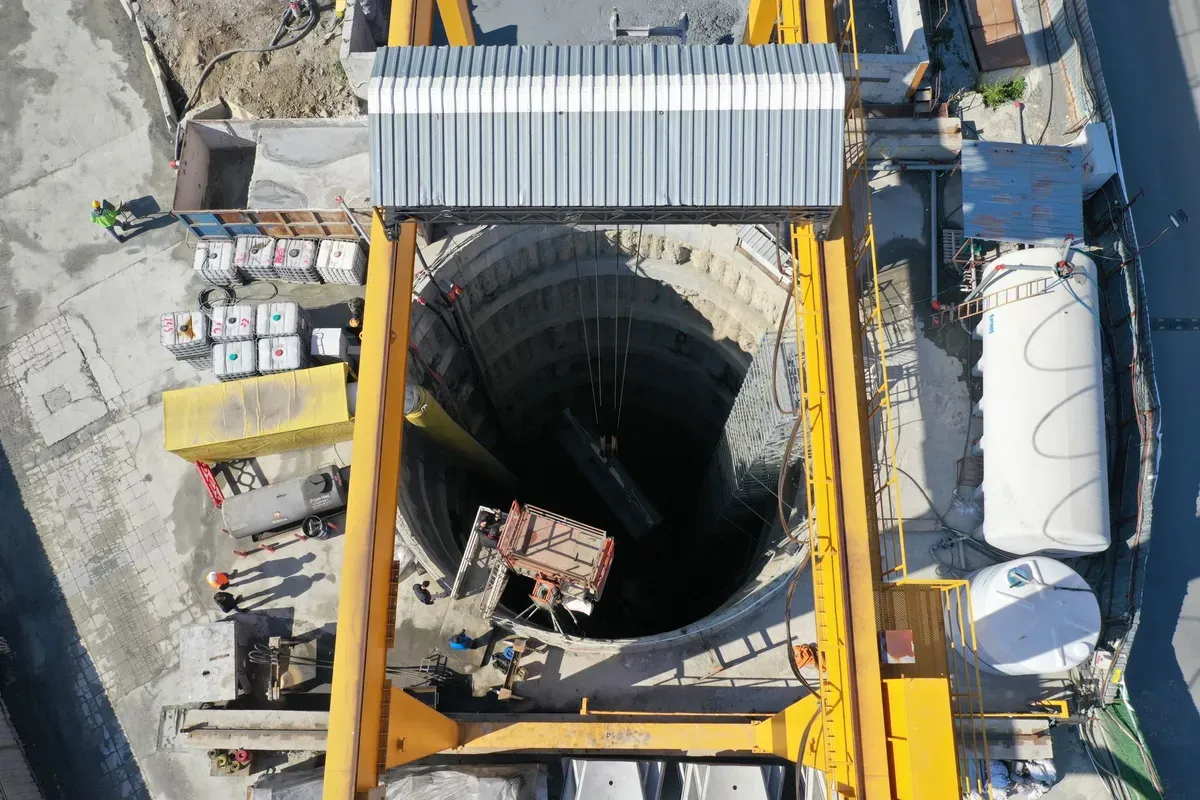
A borehole offers the highest degree of supply independence of any residential option. It draws groundwater regardless of municipal pressure and, properly treated, can supply the full household. The costs, risks, and regulatory requirements are also substantially higher than a storage tank.
Geological reality in the East Rand
According to wsp.com, 80% to 83% of boreholes drilled in the East Rand yield less than 2 litres per second. That is a critical planning figure. A 2 L/s yield sounds usable, but a household of four using 200 litres per person per day needs 800 litres daily. At 2 L/s you can theoretically fill that in under seven minutes of pumping, but actual recoverable yield depends on aquifer recharge rates, not just peak flow. A borehole that tests at 1.5 L/s at commissioning may sustain 0.6 L/s in a dry August. Any serious installer should provide a 72-hour pump test report before final sign-off.
What you will actually pay
Drilling in the East Rand costs R500 to R1,000 per metre (boreholehub.co.za 2026). At 60 metres, that is R30,000 to R60,000 for drilling alone, before casing, pump, filtration, storage, electrical connections, or compliance work. Two real-world anchor prices from verified suppliers: LiquaFlo’s 60m installation in Boksburg came to R82,600 all-in (liquaflo.co.za); Ironstone Boreholes quotes a standard 70m borehole without surface tanks at R49,450 (ironstoneboreholes.co.za). These two prices bracket a realistic market range.
An owner who went through the process shared a detailed breakdown:
“I paid around 55k for 50m to 60m drilling, with casing. Borehole pump was around 30k. Filtration system around 27k. My water was too sulphuric and irony.”
That owner’s total exceeded R112,000 precisely because the water chemistry required serious treatment. The East Rand sits on dolomitic and gold-bearing geology. Iron, manganese, sulphur, and pH problems are common. A SANS 241 full baseline lab analysis costs R1,299 (thechemistrysolutionscompany.com), or R3,150 including VAT for the standard SANS 241/SANS 1657 package at H2O Guru. The Brakpan area average for standard residential safety testing runs R1,500 to R3,000 per test (boreholeinstallers.co.za). Budget for annual retesting: a full parameter panel from a SANAS-accredited lab costs R1,800 to R4,500 (h2oguru.co.za).
Ongoing costs: electricity and maintenance
The annual electricity cost for a residential submersible borehole pump runs R2,400 to R8,400 depending on pump size and usage (ourpower.co.za). One owner using a 1.7 kW pump for four to five hours per day confirmed this range from practical experience:
“My household uses plus minus 18 units per day, the 1.7 kW borehole pump runs for 4 to 5 hours per day… cost me a lot to have it repaired, that’s why I am looking at solar power.”
An annual comprehensive service plan in Gauteng costs R1,500 to R2,200 (boreholepros.co.za). Borehole emergency repairs, covering a dropped pump or burnt motor, run R8,000 to R15,000 per incident (afripumps.co.za). Advanced rehabilitation such as hydrofracturing or re-casing costs R50,000 to R75,000 on the East Rand (boreholehub.co.za). Dry running remains the number one emergency call-out for borehole service companies in Gauteng (boreholesure-pumps.co.za), and it is almost entirely preventable with a properly set low-water cutoff relay.
The long-term economics are compelling when the system is built correctly from the start:
“There is also very little maintenance as a decent borehole pump should last 20+ years with zero maintenance… I used quality parts (e.g. Franklin motor). I could have used cheaper components and saved R30K in the short term.”
Legal requirements specific to Ekurhuleni
Drilling a borehole in the East Rand without prior written permission from the municipality is a direct violation of Section 85 of the Ekurhuleni Water Bylaws (enviroleg.co.za). Apply before you drill. The registration process also requires notification to the Department of Water and Sanitation under the National Water Act. These are not bureaucratic formalities: an unregistered borehole cannot be legally transferred with a property and creates liability that surfaces at exactly the worst moment, the point of sale.
Option 4: Greywater Recycling
Greywater systems divert water from showers, basins, and laundry for reuse in toilet flushing and garden irrigation. The Ecogator 120L standalone entry-level unit retails at R9,000 (evcostcalculator.co.za). More integrated systems, with filtration and UV treatment, run significantly higher. Greywater is not a primary water source: it reduces municipal draw by 20% to 40% for a typical household but cannot substitute for potable supply. It pairs well with any of the three primary options above.
Pump Selection: One Technical Point Worth Knowing
For surface-mounted booster pumps on storage tank systems, the choice between a standard pump-with-pressure-vessel setup and a variable speed drive (VSD) pump matters. The pressure vessel approach is cheaper upfront but requires more maintenance. As one technically experienced forum user noted:
“If you don’t want a pressure-tank, your only option is a DAB/VSD pump.”
VSD pumps cost more upfront (typically R4,500 to R9,000 versus R1,500 to R3,500 for a fixed-speed unit with pressure vessel) but eliminate waterlogging of the pressure vessel and reduce wear from constant start-stop cycling. For a system expected to run daily during outages, the lifecycle argument for a VSD unit is sound.
Cost and Performance Comparison Table
| Solution | Installed Cost (East Rand) | Annual Running Cost | Supply Independence | Key Risk |
|---|---|---|---|---|
| Municipal backup tank (2,500L, compliant install) | R20,000 to R30,000 typical; up to R55,000 on complex sites | R800 to R2,400 (electricity); occasional pump maintenance | 1 to 3 days storage; refills only when mains restore | Empty during extended outages; backflow if non-compliant |
| Rainwater harvesting (10,000L system) | R15,000 to R35,000 | Minimal; occasional first-flush diverter cleaning | Seasonal; unreliable May to August in Gauteng | Dry-season vulnerability; not potable without treatment |
| Borehole (60m, full system, East Rand) | R49,450 to R82,600 (drilling and pump); R112,000+ if heavy treatment required | R2,400 to R8,400 electricity; R1,500 to R2,200 service; annual water test R1,800 to R4,500 | Full independence if yield is adequate; continuous supply | 80% to 83% of East Rand boreholes yield under 2 L/s; sulphur and iron common |
| Greywater recycling (Ecogator 120L entry level) | From R9,000 | Low; filter maintenance only | Reduces municipal draw by 20% to 40%; not a standalone supply | Contamination risk if incorrectly plumbed to potable circuits |
Is your East Rand address served by a reliable backup water option?
True Cost of Ownership: 10-Year Comparison

The table below models a 10-year cost of ownership for the two most common choices for East Rand homeowners: a 2,500L municipal backup tank system and a 60m borehole. All figures use the lower end of verified ranges to give a conservative comparison. Inflation is not modelled. Emergency repairs are shown as a probability-weighted average.
| Cost Element | Backup Tank (10 yr) | Borehole (10 yr) |
|---|---|---|
| Installation (mid-range verified) | R24,000 | R66,000 |
| Electricity (10 years, low estimate) | R8,000 | R24,000 |
| Annual service plan (10 years) | Not typically applicable | R15,000 to R22,000 |
| Water testing (annual, 10 years) | Not typically required | R18,000 to R45,000 |
| Emergency repairs (1 incident, probability-weighted) | R2,000 to R5,000 | R8,000 to R15,000 |
| Municipal water savings (10 yr, 20 kL/month reduced to 6 kL at current tariff) | Partial offset | Near-full offset |
| Approximate 10-year total (before savings) | R34,000 to R37,000 | R131,000 to R172,000 |
One backup tank owner who plumbed a 5,000L JoJo directly to their washing machine tracked the usage impact: municipal consumption dropped from 20 kL to 6 kL per month. At Ekurhuleni’s post-July 2026 tariffs, the differential saving over 10 years is material. The borehole carries a higher capital and running cost but delivers supply independence that no tank system can match during a multi-day outage. The correct answer depends on your household’s risk profile and the geological viability of a borehole on your specific property.
“The water is very clear and so far it’s been as good/clean as municipal… We went from an average of 20kL per month before the water restrictions to 6kL so it’s been a good investment.”
Four Things to Confirm Before You Sign Any Quote
- Borehole: get a written yield estimate before drilling. Ask the driller what the success rate is in your specific suburb and whether a refund or partial credit applies if the hole is dry. You cannot know yield before drilling, but you can know the geological risk upfront. 80% to 83% of East Rand boreholes yield under 2 L/s (wsp.com).
- Tank system: confirm the quote includes a CoC. If the quote does not mention a Certificate of Compliance, the installation is either DIY or non-compliant. Both create liability at property transfer and risk a R3,000 to R12,000 rectification bill (WaterPointSA).
- Check for Ekurhuleni borehole permission. Section 85 of the Ekurhuleni Water Bylaws requires written permission before any drilling (enviroleg.co.za). Ask to see the application receipt before the rig arrives on your property.
- Water quality test before treating. Do not buy filtration equipment before you know what you are treating. A SANS 241 baseline analysis starts at R1,299. Spending R27,000 on a filtration system designed for the wrong contaminants, as one forum owner did, is an avoidable loss.
The Practical Starting Point
For most Springs, Nigel, and Brakpan homeowners, the logical sequence is: start with a compliant municipal backup tank to cover short outages, test your site’s borehole viability in parallel, and add greywater recycling or rainwater harvesting as a third layer if your property allows it. None of these decisions should be made on a supplier’s word alone. The first step is confirming what is actually feasible at your address, because groundwater depth, municipal infrastructure, and geological conditions vary street by street across the East Rand.
Use the WaterPointSA address checker to see what backup water options are viable at your specific property before you request a single quote: Check my address.
Get started
Is your East Rand address served by a reliable backup water option?
Vetted local installers · honest advice first