Key points
- Tshwane extracts 926 million litres per day, 40% over Rand Water’s licensed bulk supply limit of 662 million litres, according to Rand Water data.
- Between 39% and 40% of all treated water is lost to infrastructure leaks before it reaches residents, per 2025/2026 municipal oversight data.
- An August 2026 Magalies Water infrastructure report points to a potential ongoing shortfall of approximately 15 megalitres per day.
- Tshwane’s spending on emergency water tankers has surged 500% according to August 2026 municipal budget behaviour data, a sign that the crisis is structural, not seasonal.
- A typical South African household needs approximately 2,000 litres per week (MyBroadband 2024), while essential daily use runs between 150 and 200 litres per day.
- A complete municipal backup system costs R14,000 to R35,000 installed. Boreholes run from R29,790 for a 40m residential drill to R82,600 turnkey for 60m and deeper.
- Tshwane’s 2023 Blue Drop Score is 86.4%, classified as Medium Risk by the Department of Water and Sanitation’s 2023 Blue Drop Report, meaning water quality monitoring matters alongside quantity.
- Running borehole and rainwater systems into your municipal supply line without a physical air-gap can cost you R200,000 in fines.
Why Tshwane’s Water Problem Is Not Going Away
Pretoria residents have lived through rolling outages for years, but the numbers behind the 2026 situation are qualitatively worse than previous cycles. Rand Water’s own data shows Tshwane extracting 926 million litres per day against a licensed bulk supply limit of 662 million litres, a 40% over-extraction. When a city draws 40% more water than it is legally permitted, tanker deliveries and burst-pipe patches are not solutions. They are delay tactics.
The political dimension compounds the infrastructure problem. In September 2026, Tshwane’s mayor unilaterally disconnected electricity to a Johannesburg Water reservoir in Centurion over an unpaid municipal debt, worsening the region’s already constrained supply. When a single political dispute can cut water to thousands of households overnight, a household backup plan is not optional, it is basic risk management.
“Rand Water calls on the above-mentioned customers [City of Tshwane] to reduce their consumption to avoid system collapse, which will inevitably affect other customers as well.”
Rand Water (Official Statement, Feb 2025)
Water expert Dr. Anthony Turton put the emergency tanker strategy in blunt terms:
“In effect, it is robbing Peter to pay Paul, and at best, it is reducing the risk of rioting, but just by a fraction.”
Dr. Anthony Turton (Water expert, via MyBroadband 2026)
Meanwhile, between 39% and 40% of treated water is lost to infrastructure leaks before it reaches a single tap, according to 2025/2026 municipal oversight data. An August 2026 Magalies Water infrastructure report adds a preliminary estimate of approximately 15 megalitres per day in ongoing shortfall. Even if residents reduce consumption, the pipe losses alone guarantee pressure drops and unplanned outages across Pretoria, Centurion, Midrand and the townships on the city’s northern and western margins.
Routine maintenance makes things worse. Major areas in and around Ga-Rankuwa faced a sweeping 12-hour water shutdown in September 2026 for municipal meter replacements, the kind of planned outage that becomes a crisis when there is no on-site storage to bridge the gap.
“Families in Winterveld, Tshwane have been without reliable water for weeks. Instead of clean water from the taps, they’re forced to rely on dirty water from tankers.”
City of Tshwane Ward Councillor (Sept 2026)
The 500% surge in emergency tanker spending recorded in August 2026 municipal budget behaviour data confirms the city is not fixing infrastructure at anywhere near the pace needed. For a homeowner in Pretoria East, Centurion, Soshanguve or Mabopane, waiting for the municipality is not a strategy. Building your own backup is.
Understanding Tshwane’s Specific Pressure and Water-Quality Conditions
Before you buy a tank or drill a borehole, two local factors shape every decision: low or intermittent municipal pressure, and water quality.
Pressure: Tshwane’s distribution network loses pressure during outages and during the low-pressure recovery period after supply is restored. A standard 0.5 to 1.0 HP booster pump installed at R4,500 to R17,000 (local service providers) compensates for this, but it must be matched correctly to your tank configuration. A PowerForum user from Pretoria learned this at cost:
“I checked the pump before installing… it worked as expected, it ran for about 3 hours non stop. Adendorf say it [now starting and stopping after 5 seconds] is because I don’t have enough pressure on the inlet…”
A PowerForum user from Pretoria trying to install a 0.37kW pump experiencing pressure starvation.
The lesson: size your pump to your tank inlet pressure, not just your household outlet demand. A plumber who has worked specifically in Pretoria’s low-pressure suburbs will know the difference.
Water quality: Tshwane’s 2023 Blue Drop Score is 86.4%, classified as Medium Risk by the Department of Water and Sanitation’s 2023 Blue Drop Report. That score covers treated municipal water. Borehole water in parts of the Highveld can carry elevated iron, manganese or hardness, and must be tested independently. The annual cost of a water quality test is approximately R1,500 (local provider data), a cost that should be built into any borehole budget. Annual filtration servicing adds R1,000 to R2,500 per year. One Pretoria geyser issue worth flagging: hard borehole water accelerates element scaling. One user on the DIY forums advised specifically swapping standard elements for a PTC hard-water element:
“Hard Water Element without Pocket”
A user specifically advising ditching standard elements for a PTC element to combat local mineral scaling.
A standard mechanical geyser thermostat replacement costs R450 (local provider data), but repeated element burnout from scale or from running a dry geyser during outages costs far more. According to plumber-pretoria.co.za, element burnout follows directly when a geyser runs without water around it. During any extended outage, turn your geyser off at the DB board before your storage runs dry.
Solution 1: JoJo Tank Municipal Backup (The Most Common Starting Point)
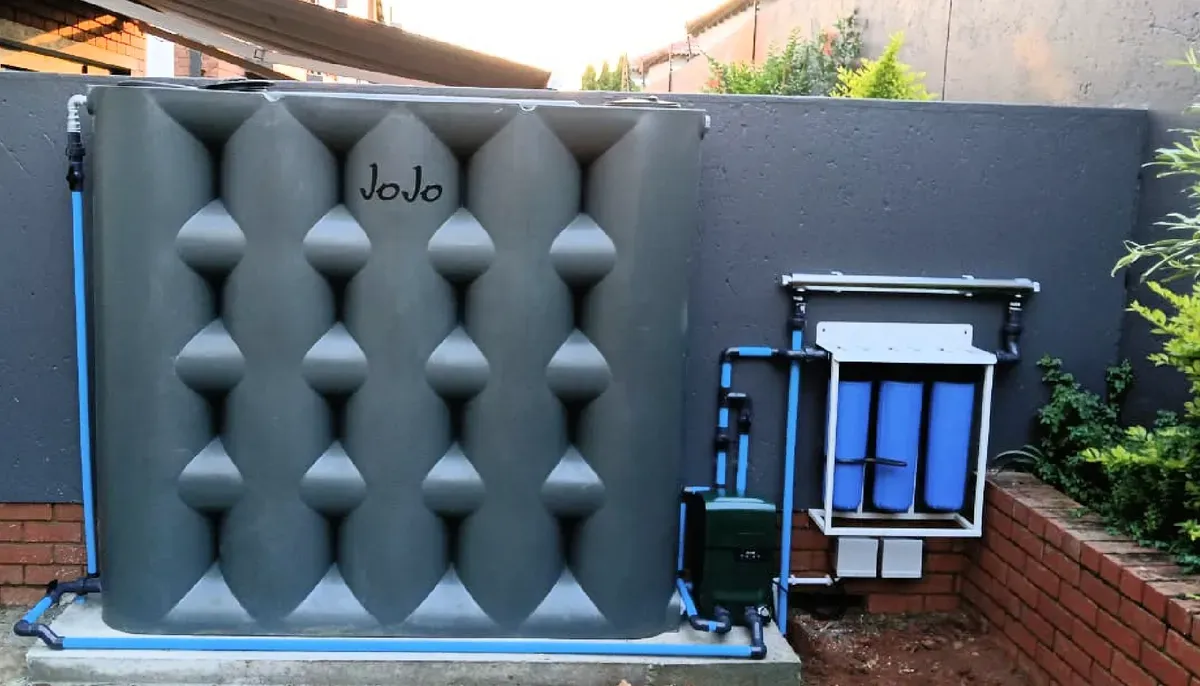
The simplest and fastest backup for most Pretoria homeowners is a poly storage tank plumbed into the municipal supply line with a pressure pump. When municipal pressure drops, the pump pulls from the tank. When supply returns, the tank refills automatically via a float valve.
A typical South African household requires approximately 2,000 litres per week (MyBroadband 2024). At 150 to 200 litres per day for essential use, a 2,500 litre tank gives you 12 to 16 days of essentials-only cover. A 5,000 litre tank takes you to 25 to 33 days, enough to outlast almost any municipal outage on record in Tshwane.
One MyBroadband forum user described a well-executed setup:
“I got a jojo plumbed in line with the municipal system that gives me 4 days of backup water at my normal use… I got a 2,400l jojo with a 1,1kw pump that only works when the main line pressure drops”
User on MyBroadband Forum discussing municipal backup systems.
Another user, akescpt on MyBroadband, broke down the installation bill itemised:
“Jojo tank float – R300, Tank to pump connector kits – R300, Piping and connectors – R1500… Electrical wiring and conduit – R2000… When I enquired [about labour] they said between 2.5 and 4k.”
User akescpt on MyBroadband sharing installation costs.
One maintenance point that most brochures omit: sludge accumulates at the bottom of every storage tank. One experienced tank owner had a firm view on the right time to install a drain tap:
“JoJo tank with a bit of pipe and a stop cock so you can drain all the sludge out of the tank and into your garden every now and then. Vacuuming is a pain in the derriere, but I just have to wait for the dry season when the tanks are low so I can drain them and fit the bilge tap. So my advice is to fit the bilge tap before you put any water in the tank!!”
On the necessity of draining sludge.
Tank manufacturers recommend cleaning every 1 to 2 years regardless of filtration. Budget for it.
Also note: a full 5,000 litre poly tank weighs 5 tonnes (getsolvd.com). Do not position it on a suspended floor slab or on soft fill without a concrete pad and engineering sign-off. This catches more homeowners off guard than any other installation detail.
Check my address to see what tank size and pump configuration fits your pressure zone and household demand in Tshwane.
Solution 2: Rainwater Harvesting
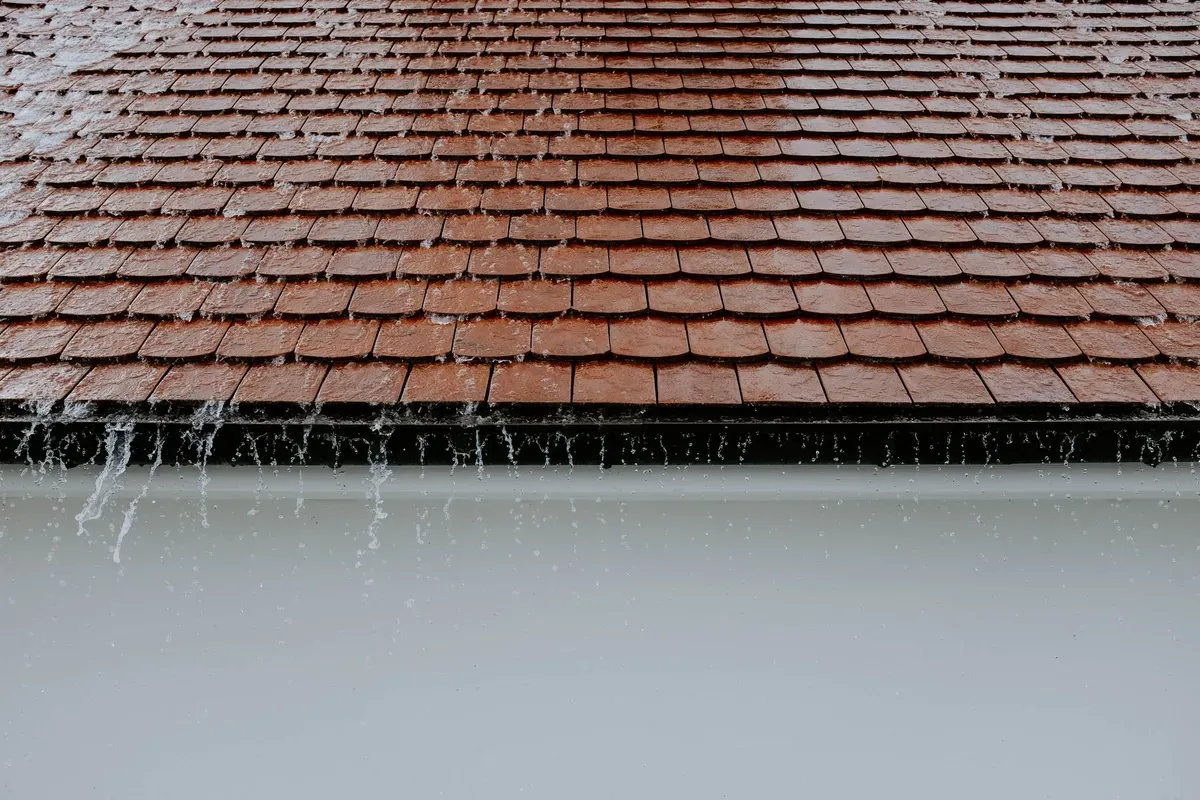
Pretoria’s summer rainfall (roughly October to March) makes rainwater harvesting a viable supplement to municipal or tank storage, but not a replacement. A full household rainwater setup installed costs R18,000 to R35,000 (servicelinksa.co.za). A basic 5,000 litre tank and pump setup for garden use costs R12,000 to R22,000 (servicelinksa.co.za).
The critical legal point for Gauteng residents: under the Johannesburg 2023 Water Services By-laws, harvested rainwater cannot be blended with the municipal supply. Tshwane applies equivalent cross-contamination rules. You must maintain a physical air-gap between your rainwater tank circuit and the municipal network. Violating this carries a fine of R200,000 for individual or household accounts, and Tshwane’s official position is zero cross-contamination tolerance for all alternative supply connections.
One forum user had a straightforward rainwater plan in place before a dry spell hit:
“I’ll use the rain water I harvest in a Jojo tank and the 300 odd litres of drinking water stored in the garage. I’ll be ok.”
User pinball wizard on MyBroadband discussing rainwater harvesting.
Roof catchment water is not potable without filtration. Tiled and IBR roofs accumulate dust, bird droppings and chemical runoff. A 3-stage Big Blue filter set costs R600 to R1,050 (purewater4life.co.za) and is the minimum treatment before using harvested rainwater indoors. For tank sanitation, an HTH Scientific Mini Reservoir Floater (600g) retails at R139.90 from builditshop.co.za and prevents algae and bacterial growth in stored water.
One experienced owner’s honest assessment of what the Cape Town panic-buying rush taught South Africa:
“People bought Jojo tanks which at the end is not suitable for potable water use without expensive filters and pumps and whatnot.. Most of those tanks were for capturing rain water from polluted roofs… And most of those tanks would have run dry within a week or two in any case…”
On water tank reality vs expectations.
The lesson for Tshwane in 2026 is the same: storage capacity and water quality treatment are two separate problems. Budget for both.
Solution 3: Borehole
A borehole is the highest-capital, lowest-ongoing-cost option for Pretoria homeowners with suitable geology. The numbers are significant and the variables are many.
Baseline drilling in Gauteng runs R280 to R500 per metre (Facebook community data). A 40m residential borehole in Pretoria cost R29,790 in 2024 (enviroleg.co.za). A full turnkey installation at 60m and deeper, including tank and filtration, reaches R82,600 (boreholepros.co.za). Add a solar pump with dedicated panels and the figure can exceed R50,000 for the pump system alone:
“Don’t forget the price of a submersible pump for the borehole which, depending on which you go for, can cost R50k or even more for a reliable solar pump with dedicated panels.”
On the true cost of borehole backup setups.
One project manager who drilled to 160 metres gave a real-world cost breakdown:
“We stopped at 160m using Steel Casing… R280 per meter drilling and R420 per meter steel casings. It’s a life time investment.”
Project Manager on Facebook discussing borehole drilling costs.
The single largest risk in Pretoria and Centurion is drilling blind, without a hydrogeological yield assessment. Dolomite geology in parts of Centurion further complicates permissions. One Centurion reviewer described the consequence of checking yield data first:
“Showed me the real boreholes near me, 4 of them came back dry. Saved me R60k before I drilled. Went with a tank instead.”
Thabo M, Centurion reviewing borehole yield checks versus drilling blind.
When things go wrong with a borehole, repair costs are steep. One MyBroadband user recounted a wrong-class pipe failure:
“The guy pulled the pump and informed me the pipe had burst, the installer used the wrong class pipe… quoted me on fixing the whole mess… About R20k for everything.”
User Polymathic on MyBroadband discussing borehole repair costs.
The legal framework for borehole extraction is straightforward: no registration is required for up to 50 kilolitres (50,000 litres) per day, which covers virtually every residential property. Extraction between 50 and 100 kilolitres per day must be registered with the National Department of Water and Sanitation. Above 100 kilolitres per day requires a full DWS water licence (renot.co.za). For context, 50 kilolitres per day is 25 times a typical household’s weekly requirement.
It is worth noting that private groundwater usage is surging across South Africa and the government is drafting regulations that would require residential borehole owners to register their wells and install water metres. The legal hurdles around borehole drilling are rising, which makes simpler tank-based solutions more practical for many urban homeowners.
Annual maintenance for a borehole must include a water quality test at R1,500 and filtration servicing at R1,000 to R2,500 (local provider data). Dry-run pump motor burnout is the most common callout issue on residential boreholes (myriadgreen.co.za), so a dry-run protection relay is a non-negotiable installation item, not an optional extra.
Solution 4: Atmospheric Water Generation (AWG)
AWG units extract moisture from ambient air and filter it to drinking water standard. They are grid-dependent, they produce modest volumes, and they work best at humidity levels above roughly 50%, which Pretoria’s summer months provide. In the dry Highveld winter, output drops.
Entry-level units producing 20 litres per day retail at R12,000 to R12,999 (pricecheck.co.za). The Airwater AW70, rated at 70 litres per day, costs R18,999 ex VAT (airwater.co.za).
Two owner reviews from Airwater users give a realistic output picture:
“Thank you so much Ray, the machine is working like a bomb I must tell you. We are getting about 40 litres a day here in Cape Town.”
Owner Desmond C. via Airwater reviewing their AWG unit.
“I bought myself an Airwater machine… I get around 10 litres every 8 hours… service is excellent!”
Owner Anton R. via Airwater reviewing their AWG unit.
AWG is best positioned as drinking-water security alongside a larger-volume storage or borehole system, not as a household’s sole backup. At 20 to 40 litres per day, it covers drinking and cooking for a family of four, but not bathing, sanitation or laundry.
One additional maintenance note specific to AWG and any system that uses collection tubes: inactivity creates its own problem.
“If you have a couple of days that no-one is using the tub, the tubes will boil off water. This can increase calcium deposits in your system.”
A user discussing water boiling off and system damage from calcium buildup during periods of non-use.
Spec and Cost Comparison Table
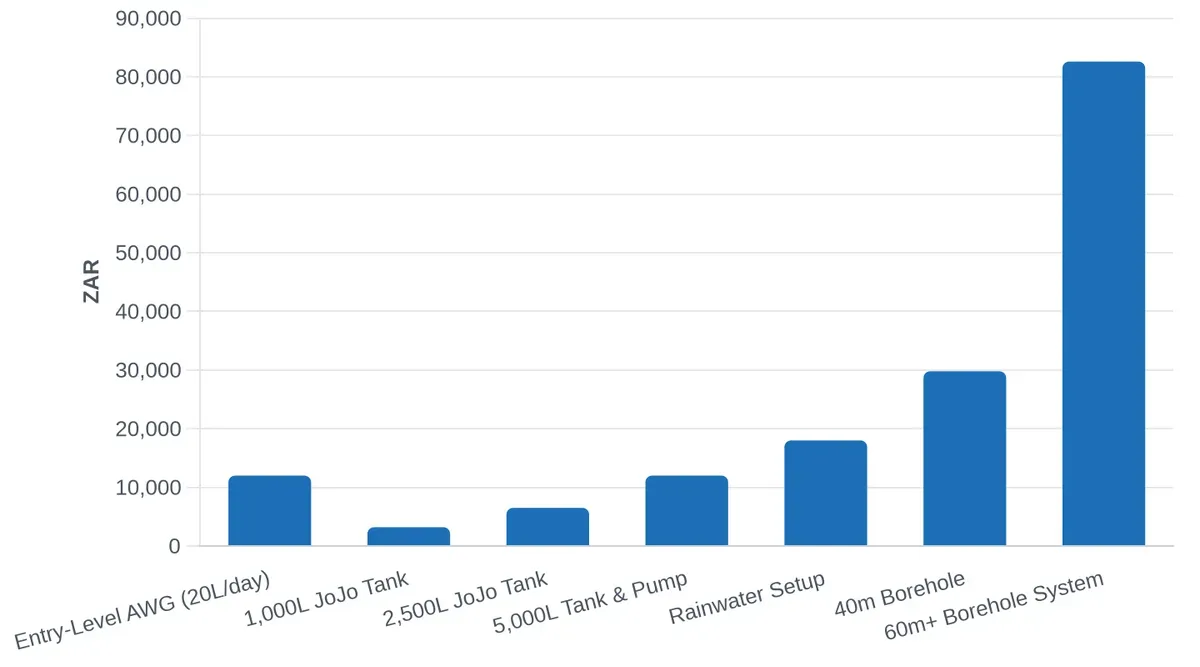
| Solution | Typical Setup Cost (ZAR) | Capacity or Output | Annual Running Cost | Key Limitation in Tshwane |
|---|---|---|---|---|
| 1,000L JoJo tank (basic) | R3,200-R3,900 (tank only) | 5 to 7 days essential use | Filter sets: R600-R1,050; sanitation: ~R140 | Insufficient capacity for extended outages |
| 2,500L JoJo + pump system | R6,500-R8,200 (tank) + R4,500-R17,000 (pump installed) | 12 to 16 days essential use | Pump power: ~R76.95/month (0.75kW, 1hr/day) | Pressure starvation if pump undersized |
| Full municipal backup system | R14,000-R35,000 installed | Household-wide backup | Filter, pump maintenance: R2,000-R4,000 | Still dependent on municipal refill |
| Rainwater harvesting (full) | R18,000-R35,000 installed | Seasonal; supplements storage | Filtration servicing: R1,000-R2,500 | Cannot blend with municipal supply by law |
| 40m borehole (residential) | R29,790 | Dependent on yield test | Water test R1,500 + filtration R1,000-R2,500 | Dry-hole risk without yield assessment |
| 60m+ borehole (turnkey) | R82,600 | Municipal-independent supply | Pump, filter, annual test: R4,000-R8,000 | Dolomite zones restrict drilling in Centurion |
| AWG entry-level (20L/day) | R12,000-R12,999 | 20 litres/day (drinking water only) | Electricity; filter replacement annually | Output drops in dry Highveld winter |
| Airwater AW70 (70L/day) | R18,999 ex VAT | Up to 70 litres/day (drinking) | Electricity; filter replacement annually | Grid-dependent; not a total-household solution |
Cost-of-Ownership Comparison: 5-Year Horizon
Capital cost alone does not tell the story. Here is a realistic 5-year total cost of ownership across the three most common Pretoria homeowner scenarios, using the verified figures in this article. All numbers are in ZAR and assume average annual maintenance.
| Scenario | Year 1 Capital | Annual Running | 5-Year Total (est.) | Municipal Independence |
|---|---|---|---|---|
| 2,500L tank + booster pump (full backup) | R14,000-R25,000 | R3,000-R5,000 | R26,000-R45,000 | Partial (still needs municipal refill) |
| Rainwater harvesting (full household) | R18,000-R35,000 | R2,500-R4,500 | R28,000-R53,000 | Seasonal supplement only |
| 60m+ borehole (turnkey, with solar pump) | R82,600-R135,000+ | R5,500-R11,500 | R104,600-R181,000+ | Full (subject to yield) |
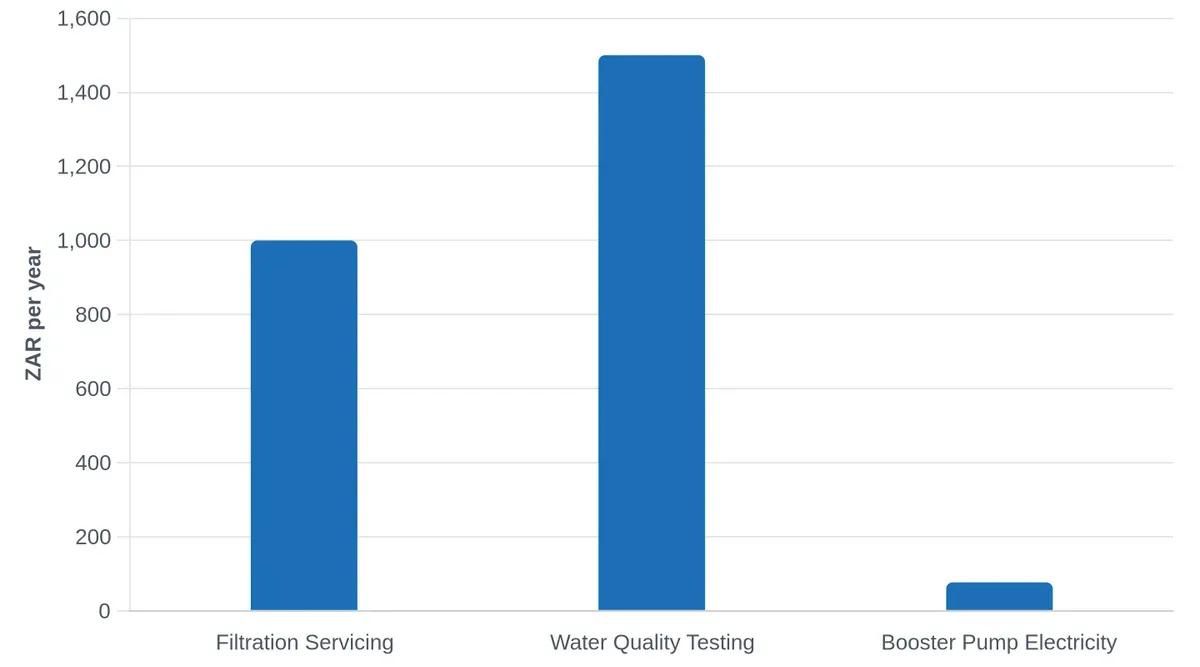
Running cost estimates include annual water quality testing (R1,500), filtration servicing (R1,000 to R2,500), booster pump electricity at R76.95 per month for 0.75kW/1hr daily (tshwane.gov.za), and filter set replacement (R600 to R1,050 per year). Borehole figures include annual pump inspection and water test. All figures are estimates based on verified local provider and forum data. Your actual costs will depend on site conditions, installer, and usage.
Legal Compliance: What Pretoria Homeowners Must Get Right
The legal requirements are simple, but the penalties for getting them wrong are not. Three rules cover almost every residential installation in Tshwane:
- No cross-connection. The internal borehole or rainwater supply network may not be connected directly to the municipal water system, per tshwane.gov.za. This is not a guideline. The fine for illegal connections is R200,000 for individual accounts.
- Borehole registration thresholds. Extracting up to 50 kilolitres (50,000 litres) per day requires no registration (renot.co.za). Between 50 and 100 kilolitres per day, you must register with the National Department of Water and Sanitation. Above 100 kilolitres per day, a full DWS water licence is required.
- Rainwater cannot be blended into municipal supply. The Johannesburg 2023 Water Services By-laws, which set the standard applied across Gauteng, explicitly prohibit blending harvested rainwater into the municipal network.
The regulatory landscape is also tightening at a national level. South Africa’s first major overhaul to its national drinking water standard in a decade now classifies private boreholes, tankers and refill stations as water providers, meaning homeowners using alternative water sources face much stricter legal quality and risk-management compliance going forward.
The sentiment in parts of the DIY community about dolomite bylaws in Centurion reflects genuine frustration:
“Okay i’m 100% convinced this is cadres making sure people are dependant on their water trucks. Nothing to do with geology.”
On Dolomite bylaws in Centurion.
Whatever one thinks of municipal governance, the legal exposure is real. Use a registered installer who will provide the compliance paperwork. One Midrand homeowner put the cost of not doing so plainly:
“Vetted installer, fair price, water in two days. Wish I’d found this before I lost money to a fly-by-night.”
Naledi K, Midrand on the dangers of using unvetted installers.
What Pretoria Homeowners Actually Regret: A Summary of Forum Wisdom
Across the MyBroadband forums, PowerForum threads and Facebook groups reviewed for this article, the recurring regrets from Pretoria-area homeowners cluster around five themes:
- Undersizing the tank. A 1,000 litre tank sounds substantial until you do the maths: at 150 litres per day essential use, it covers fewer than 7 days. The minimum recommendation from multiple forum veterans is 2,500 litres for a family of four.
- Skipping the yield assessment before drilling. As Thabo M from Centurion illustrated, four dry boreholes near his property meant a yield check saved him R60,000 before a single drill bit hit the ground.
- Using the wrong pipe class on the borehole. Polymathic’s R20,000 repair bill for a wrong-class pipe failure is a preventable cost. Specify Class 10 uPVC or HDPE pipe in your installation contract.
- Not fitting the drain tap before filling. Sludge in a full tank is expensive to remove. Fit a bilge drain valve at installation, not after the first clean.
- Running geysers during outages. Element burnout from a dry geyser is one of the most common post-outage plumber callouts in Pretoria. Turn the geyser off at the DB board when your storage drops below one-quarter full.
For those who got it right, the benefit is clear. One Tshwane resident, with borehole and solar already in place, had a simple view of where the municipality fits into his household budget:
“Thank fck I have borehole and solar… just don’t want to give Tshwane a cent more than I have to.”
On independence from the council.
Next Step: Know What Your Address Can Actually Support
The right solution for your property depends on your suburb’s geology, municipal pressure zone, borehole yield probability and your household’s daily demand. Before committing R14,000 or R82,600 to an installation, check what the data says about your specific address. Check my address to see local borehole yield records, pressure zone data and recommended system configurations for your part of Tshwane.
Get started
Does your Pretoria address support a backup tank or borehole?
Vetted local installers · honest advice first
Photo: Doğan Alpaslan Demir / Pexels