Key points
- A budget wellpoint installation starts at R6,850 with a 0.75kW cast-iron pump. A premium 1.1kW to 1.5kW stainless-steel setup reaches R12,000 before optional add-ons.
- The pump purchase price is only one part of the real cost. Piping material, a pump controller, water testing, filtration, and municipal registration fees can add R5,000 to R30,000+ over three years.
- All surface wellpoint pumps are physically limited to drawing water from no deeper than 10 metres by atmospheric suction laws. If your water table is deeper, a borehole with a submersible pump is the only option.
- Cape Town Step 3 municipal water costs R61.37 per kilolitre. A wellpoint producing 2,500 litres per hour can offset real rand-value savings, but only if the system is built correctly from day one.
- Permits, registration, and water quality testing are legal requirements, not optional extras. Skipping them risks fines and equipment confiscation.
Supplier quotes for wellpoints in South Africa range from a vague “call us for pricing” to a confident R6,850 or R12,000 figure with almost nothing in between. Neither number tells the full story. The R6,850 installation from mjboreholes.co.za and the R12,000 premium build represent real, documented starting points, but what actually separates them, and what you will spend in years two, three, and five, depends entirely on variables that most marketing materials quietly ignore.
This article maps every cost layer: the pump hardware, the installation components, the legal compliance burden, the water quality risk, and the operational expenses that accumulate long after the installer has left your property. The goal is simple: give you enough specific information to evaluate any quote before you sign anything.
What a wellpoint actually is, and what it cannot do
A wellpoint is a shallow-aquifer extraction system. A narrow perforated pipe (typically 32mm to 50mm in diameter) is jetted or driven into the ground, usually between 3 and 10 metres deep, into a sandy or alluvial layer that holds groundwater. A surface-mounted centrifugal pump then draws water up through suction. The entire mechanism depends on atmospheric pressure pushing water up the pipe.
This creates one hard physical constraint that no amount of money can overcome: according to artificialrecharge.co.za, no surface pump can pull water from deeper than 10 metres. If your water table sits at 12 or 15 metres, you are in borehole territory. Full turnkey borehole installations, documented by boreholeguide.co.za, run from R50,000 to R150,000+, and drilling in hard Gauteng rock costs R600 to R1,500 per metre. That context matters because some homeowners are quoted for wellpoints when their geology actually demands something far more expensive.
If your property sits in Cape Town’s Cape Flats, along the Strand or Somerset West coastline, or in Johannesburg’s sandy northern suburbs where the water table is shallow, a wellpoint is genuinely viable. Before spending anything else, confirm your depth to water. A SACNASP-accredited geophysical survey from boreholeguide.co.za costs R5,000 to R15,000 and answers that question definitively.
The two documented price points: what you actually get
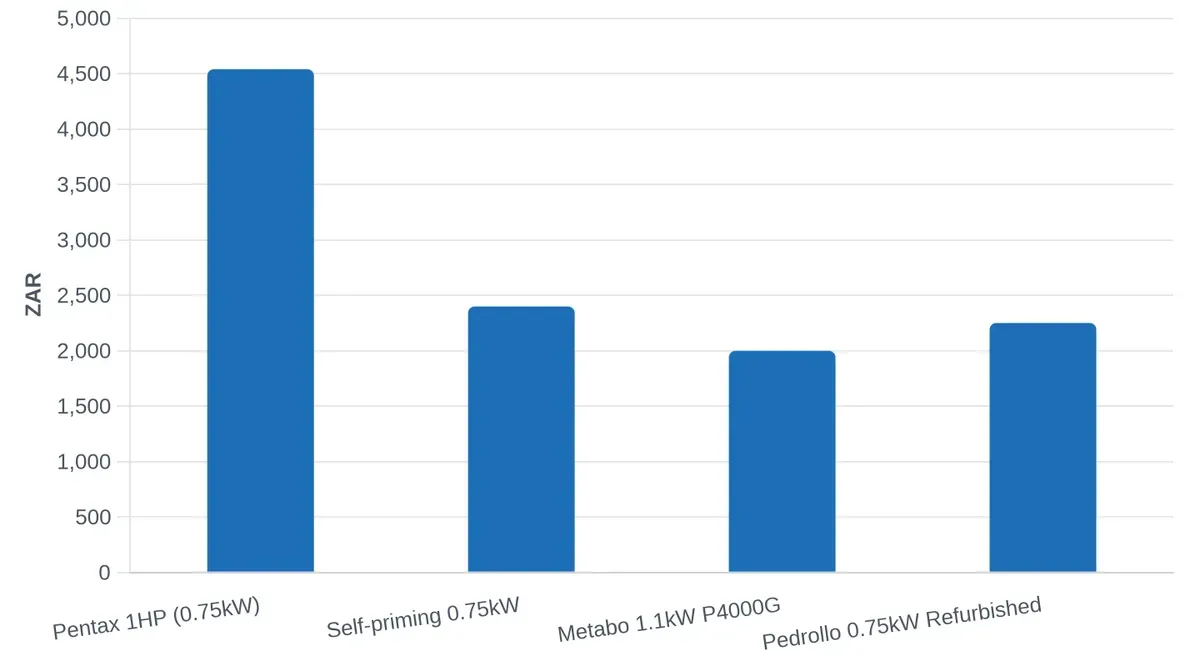
Two real, installer-documented configurations anchor this comparison.
The budget installation at R6,850 (per mjboreholes.co.za) includes a 0.75kW cast-iron surface centrifugal pump such as a Foras or Pedrollo unit, basic piping, and a manual on/off switch. Yield on a typical installation in this class runs from 0.3 to 0.5 litres per second, or roughly 1,080 to 1,800 litres per hour, according to aquify.co.za. That is enough to water a garden and fill a JoJo tank over several hours, but it is not pressure-matched to a household’s live demand.
The premium installation at R12,000 (per pedropumps.com) uses a 1.1kW to 1.5kW pump, either a stainless-steel unit like the Pedrollo JCR or a variable-speed drive (VSD) such as a SEAKOO unit. Yield in this class climbs to 2,500 to 4,000 litres per hour at 4 to 5 bar pressure, according to switchedforlife.co.za. That means live irrigation, toilet flushing, and pool top-up can run simultaneously without pressure drop.
Both figures are starting points, not all-in costs. The table below documents what the real build-out looks like.
Full cost breakdown: budget versus premium
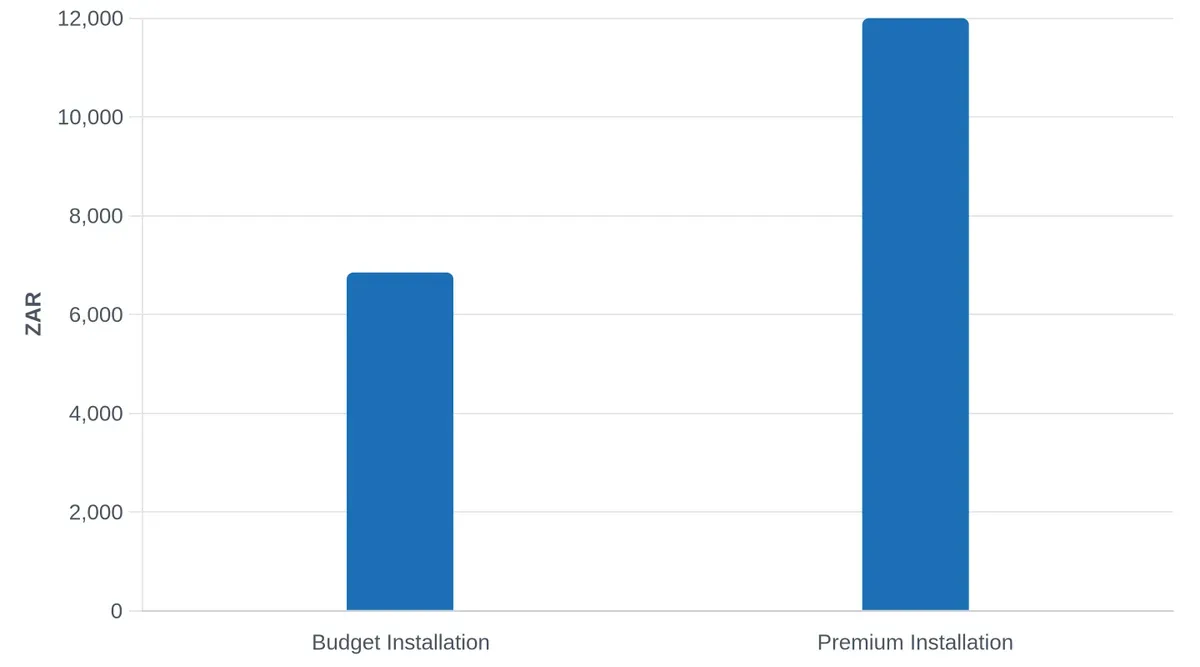
| Cost component | Budget build | Premium build | Source |
|---|---|---|---|
| Base installation (pump + pipe + labour) | R6,850 | R12,000 | mjboreholes.co.za / pedropumps.com |
| Automatic pump controller (strongly recommended) | R800 to R1,500 (add-on) | Included in VSD models | MyBroadband community |
| Blue HDPE pressure piping (replacing black irrigation pipe) | R500 to R1,200 | Often included | MyBroadband forum users |
| Joburg drilling registration fee | R1,185 to R1,240 | R1,185 to R1,240 | joburg.org.za |
| SANS 241 water quality test (basic chemistry + micro) | R1,650 to R2,300 | R1,650 to R2,300 | h2oguru.co.za |
| Comprehensive SANS 241 forensic audit (if required) | R3,714 | R3,714 | h2oguru.co.za |
| Remediation filtration system (if water fails) | R15,000 to R30,000+ | R15,000 to R30,000+ | boreholehub.co.za |
| Filter cartridge replacement (per service, every 6-9 months) | R2,500 | R2,500 | Reddit r/capetown user OutsideHour802 |
| Pump replacement (0.75kW, if budget pump fails at year 2-3) | R1,349 to R2,799 | Lower likelihood | brights.co.za |
| Piping repair (if black irrigation pipe was used) | Up to R20,000 | Negligible (blue pipe) | MyBroadband |
| Installer workmanship warranty | 12 months (ground2tap.co.za) or 1 year (dewetsboreholes.co.za) | Up to 5 years (capewellpoints.co.za) | Multiple installers |
The hidden variable: piping quality
The single most common reason a cheap wellpoint installation becomes expensive is the pipe material used between the wellpoint and the pump, and from the pump to the house. Installers and hardware stores often specify black irrigation pipe because it is cheap and easy to work with. Experienced owners are unanimous that this is a mistake.
“My suggestion, use the blue pipes, it can be pvc welded, which is a lot better than the black irrigation pipes (which leaks all the time). Plumbing from blue pipes to copper is easy, just use the correct fittings.”
MyBroadband user rh1, on piping failures
“When I first started my process, the hardware guys told me to buy black irrigation pipe. Don’t. It is prone to leaking, clamps rusting etc. Rather buy the blue pipes and pvc weld all pipes and fittings. Get a pump controller. Any pump bigger than 0.75kW should [have one].”
MyBroadband forum user Lupus, on DIY installation mistakes
A MyBroadband-documented repair bill for improper piping reached R20,000. That is enough to erase any saving made by choosing a R6,850 installation over a R12,000 one. Specifying blue HDPE pressure pipe upfront, with PVC-welded joints rather than clamp fittings, costs an additional R500 to R1,200 and removes this risk almost entirely. Make it a condition of any quote you accept.
Pump protection: the cost of skipping a controller
The budget R6,850 installation comes with a manual on/off switch. In practice, that means you must remember to switch the pump off when the wellpoint runs low, or when you have drawn enough water. Forgetting costs you a pump. Dry-running is the most common cause of premature pump failure in shallow-aquifer systems.
“Running dry [is] the single event most likely to cause immediate or premature pump failure. Never allow the pump to run when the well has run low.”
The Well Guide, on high-volume drawdown without protection
“The only thing that is missing is booster pump protection when the jojo tank runs empty for any reason and it has done this twice and have lost one booster pump.”
Power Forum user, on dry-running and pump failure
A pump controller monitors pressure and cuts the pump the moment flow drops below a set threshold. At R800 to R1,500 for a quality unit, it is the cheapest insurance available. Installers advise that any pump above 0.75kW should carry one as standard.
“I’d strongly recommend getting a pump with an automatic control unit which controls the automatic switching on/off of the pump by monitoring pressure release, and these units also have safety protections against ‘run dry / no water.'”
MyBroadband user, advising against basic setups
The Bluescape Water Solutions team in Cape Town frames it plainly: “dry run protection helps prevent damage by shutting off the pump when no water is detected.” A replacement 0.75kW pump from brights.co.za costs between R1,349 and R2,799. A controller that prevents the failure costs less than one replacement pump.
Water quality: the cost that surprises most owners
Groundwater in South Africa is not drinking water by default. It is raw water that may contain dissolved iron, manganese, calcium, magnesium, nitrates, and in contaminated urban areas, bacteria including E. coli. The water you draw is a product of your specific geology and what is happening on and under the land around you.
“We drank the borehole water for months before we thought to test it. Turns out the E. coli levels were through the roof. The water looked perfectly clear, tasted fine. Rainwater carrying bacteria and garden fertiliser was seeping directly into their water supply.”
A Fairland (Joburg) family, documented by local plumbers
“After two weeks or so I noticed the kettle starts scaling. Had it analysed and calcium and magnesium are both high.”
MyBroadband user, on severe scaling and appliance damage from hard borehole water
A basic SANS 241 chemistry and microbiology test costs between R1,650 and R2,300 (h2oguru.co.za). A comprehensive forensic compliance audit is R3,714. If the results require remediation, a custom SANS 241 filtration system from boreholehub.co.za starts at R15,000 and runs past R30,000 for complex contamination profiles. One Reddit r/capetown user (OutsideHour802) reported ongoing filter cartridge costs of R2,500 per service, every 6 to 9 months. Over five years, that is R15,000 to R25,000 in consumables alone, before electricity costs.
AfriForum’s testing of boreholes in Parys, Free State, after municipal water failures found widespread contamination. One community member captured the broader reality:
“How sad is it that residents currently have no clean water source? The municipality let them down, and now it appears that the groundwater is also polluted.”
AfriForum borehole testing documentation, Parys, Free State
Test first. The R1,650 to R2,300 you spend on a SANS 241 test before committing to a full installation can save you R15,000 to R30,000 in retrospective remediation costs.
Municipal compliance: what it costs to do this legally
A wellpoint is a groundwater abstraction structure. In South Africa it falls under the National Water Act (Act 36 of 1998) and municipal by-laws. The two cities where wellpoints are most common have specific requirements.
In the City of Cape Town, you must give 14 days written notice before sinking a borehole or wellpoint (capetown.gov.za). In the City of Johannesburg, a drilling application fee of R1,185 to R1,240 applies (joburg.org.za). These are not optional. The Borehole Water Association of Southern Africa (BWA) is direct about what happens when owners skip the process:
“If you do not follow the registration process, you risk losing your equipment and facing hefty fines imposed by municipal authorities.”
Borehole Water Association of Southern Africa (BWA)
The risk is not theoretical. Moneyweb reported that unregulated private drilling in Johannesburg caused soil and water to leak into a Gautrain tunnel, which is a real example of what happens when extraction happens without proper siting and registration. A commenter on that article (Jonnoxx) acknowledged the frustration many owners feel: “The solution is not to break the law that forces us to pay municipal fees. The solution is to change the law or to move to a DA municipality.” The frustration is real. The legal requirement is also real. Budget for compliance costs from the start.
The yield question: driller’s numbers versus real-world output
Yield claims are where installer marketing and operational reality diverge most sharply. A budget wellpoint at R6,850 is documented to yield 1,080 to 1,800 litres per hour in suitable sandy conditions. A premium setup reaches 2,500 to 4,000 litres per hour at proper operating pressure. One owner described running their wellpoint for 8 hours continuously:
“I’ve ran it once for 8 hours straight to fill up my pool and the pump cannot pump out the water faster than it fills in. Pump can run at 60 litres per minute.”
MyBroadband user Kloofvreter, on wellpoint output limits
60 litres per minute is 3,600 litres per hour, which is toward the top of the premium range and only achievable in favourable geology. Many wellpoints in denser soils deliver considerably less. The critical question is always: what does the formation actually hold?
Be sceptical of any yield figure quoted before drilling. The technical guidance from multiple sources distinguishes between a formal pump test and the informal “airlift yield” (also called a driller’s yield) that some contractors use in their marketing: “the airlift yield is the measured rate that water comes out the top while a large compressor blows air into the bottom.” This number is almost always higher than your pump will achieve under sustained normal use.
Cost-of-ownership comparison: three-year horizon
The table below models realistic three-year ownership costs for the two documented configurations, assuming a Cape Town property that tests positive for elevated mineral hardness (requiring basic filtration), no illegal installation issues, and one pump replacement on the budget build due to a dry-run event.
| Cost item | Budget build (3 years) | Premium build (3 years) |
|---|---|---|
| Base installation | R6,850 | R12,000 |
| Upgrade to blue HDPE pipe | R1,000 | Included |
| Pump controller (add-on) | R1,200 | Included |
| Compliance registration (Joburg example) | R1,200 | R1,200 |
| SANS 241 water test (initial) | R1,650 | R1,650 |
| Basic filtration system (mineral hardness) | R15,000 | R15,000 |
| Filter cartridge replacements (5 services over 3 years at R2,500) | R12,500 | R12,500 |
| Pump replacement (1 event, budget build) | R2,000 | R0 |
| Realistic 3-year total | R41,400 | R42,350 |
The takeaway from this model is not that both builds cost the same. It is that filtration and compliance dominate the lifetime cost on either path. A homeowner whose water tests clean and who builds on blue pipe with a controller from day one will spend materially less than one who cuts corners and then repairs them. The local distributor Just Pump Water puts it plainly: “budget brands save money upfront but fail more quickly in demanding conditions.”
The municipal tariff offset: what your wellpoint actually saves
The financial case for a wellpoint rests on how much municipal water it displaces. Cape Town’s Step 3 tariff (for households using between 10.5kl and 35kl per month) is R61.37 per kilolitre (capetown.gov.za). Step 1 (0 to 6kl) is R25.85 per kilolitre.
A wellpoint producing 2,500 litres per hour for 4 hours per day displaces 10,000 litres, or 10 kilolitres, of municipal water daily. At Step 3 rates, that is R613.70 per day, or roughly R18,400 per month. Even a conservative 1,500 litres per hour for 2 hours per day (3kl) saves R184 per day at Step 3. Annualised, that is approximately R67,000 in displaced Step 3 water per year at the higher output estimate.
These numbers are compelling, but they are ceiling figures. They assume your water table sustains daily extraction, your yield does not drop seasonally, your filtration system remains operational, and you are actually drawing from Step 3 volumes. For most domestic garden-and-toilet-flush use cases, the realistic annual saving is in the range of R5,000 to R15,000 per year at Cape Town Step 3 rates. Against a three-year total cost of R40,000 to R42,000 in the model above, payback is real but typically takes three to five years on a properly built system.
Inverter compatibility: a frequently overlooked constraint
Many households pair a wellpoint with solar and battery backup to maintain water supply during loadshedding. This pairing works, but pump wattage must match inverter capacity precisely. One SA Power Forum user (phalaborwa) learned this directly:
“I had previously installed a 2500 litre jojo tank with a 750 Watt booster-pump. Now this 750 Watt booster-pump was too big to handle by my 800 Watt inverter and would not run it.”
SA Power Forum user phalaborwa, on inverter overloads
A 0.75kW pump draws between 900W and 1,100W at startup due to motor inrush current. Plan for at least 1,500W of inverter capacity to run a 0.75kW pump reliably. A 1.1kW to 1.5kW premium pump requires 2,000W to 3,000W of inverter headroom. This is a real cost to budget if your backup power system is not already oversized.
Warranty realities: what your cover actually means
Installer warranties vary substantially. capewellpoints.co.za offers a documented 5-year workmanship warranty. ground2tap.co.za provides 12 months on workmanship. dewetsboreholes.co.za covers pump hardware for 1 year on manufacturer terms and conditions. The phrase “manufacturer terms and conditions” carries real weight.
“I purchased a booster pump from Takealot that failed after two weeks of normal operation. The request for a replacement of the pump was denied by Takealot, citing ‘damage arising from sea air corrosion.'”
MyBroadband user HendrikvN, on voided warranties
Coastal installations, heavy-use commercial applications, and any situation where the pump ran dry even briefly will give a manufacturer a defensible reason to void cover. A 5-year workmanship warranty from the installer is meaningfully better than a 1-year manufacturer warranty on the pump alone. Ask specifically which warranty covers which component, and get it in writing before installation.
Seasonal maintenance: the winter problem
Wellpoints in the winter-rainfall Western Cape are often switched off during the dry summer months (when water is most needed) or, less commonly, during the rainy winter when municipal supply is adequate. Dewets Boreholes documents a specific risk when pumps are left idle:
“Failure to switch the pump on, even during the winter months, can result in start-up problems in spring. Airlocks, scale build-up and seized bearings are only some of the problems that can be experienced.”
De Wet’s Boreholes, on winter neglect
The fix is straightforward: run the pump for 15 to 30 minutes every two to four weeks, even when you are not actively using it. A timer or smart switch makes this automatic and costs R150 to R400. Not doing this can result in a seized pump at the start of the summer season when demand is highest, with replacement costs of R1,349 to R2,799 for a 0.75kW unit.
What to demand from any installer quote
A quote that simply states “wellpoint installation: R7,500” is not useful. A quote you can evaluate should specify:
- Pump brand, model number, power rating in kW, and maximum head in metres
- Pipe material (blue HDPE or black irrigation), diameter, and joining method (PVC-welded or clamped)
- Whether a pump controller is included or an add-on, and which specific unit
- Wellpoint pipe diameter and screen slot size
- Depth to be jetted to and basis for that estimate
- Workmanship warranty duration and what it covers versus the pump manufacturer warranty
- Whether water quality testing is included or your responsibility
- Whether municipal registration and notification is handled by the installer
A MyBroadband community member who invested in quality components put the long-run logic plainly: “I also used quality parts (e.g. Franklin motor). I could have used cheaper components and saved R30K in the short term. I went with a higher pressure, lower delivery pump so that a smaller motor could be used.” The same logic applies at the R6,850 to R12,000 wellpoint scale: the cheapest quote is rarely the cheapest system over three to five years.
Before you request any quotes at all, the most useful first step is confirming whether your specific address and geology actually supports a wellpoint. Depth to water table, aquifer type, and local contamination risk vary enormously within the same suburb. Knowing that before you speak to an installer saves you the cost of a geological survey after the fact.
Use our address checker to see what is known about groundwater conditions at your property: Check my address.
Get started
Get an accurate wellpoint quote for your property
Vetted local installers · honest advice first
Photo: masudar rahman / Pexels