Key points
- A basic 1,000L tank-and-pump backup system starts around R6,850 in hardware alone, while a basic wellpoint installation starts around R7,000, creating a deceptive price parity that masks completely different long-term outcomes.
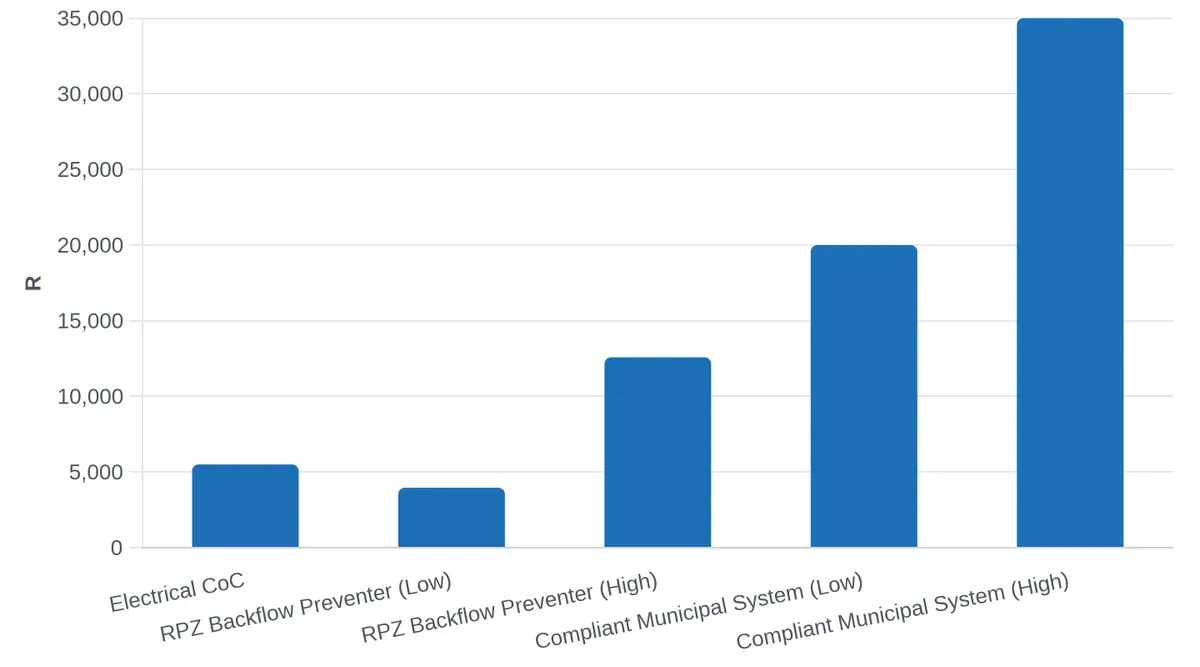
- A genuinely compliant municipal backup system, including RPZ valve, plumber, electrical CoC and correct plumbing, costs R20,000 to R35,000 fully installed (waterpointsa.co.za).
- Borehole drilling on the Atlantic Seaboard and City Bowl averages R81,680 total, with hard-rock premiums of 15% to 30% added on top (boreholeinstallers.co.za).
- The western coastal aquifer (Table Bay District) has a very low median yield of up to 0.1 litres per second (dws.gov.za), making wellpoints a realistic option only in specific sub-areas.
- During Cape Town’s Day Zero drought, groundwater levels stayed within natural ranges and aquifers essentially remained full (Daily Maverick), but that fact applies unequally across the peninsula.
- Electronic pump controllers are the most frequent point of failure in backup systems (mybroadband.co.za). Budget for a quality digital unit from day one.
- Marine-grade fittings are non-negotiable on the Atlantic Seaboard; standard fittings corrode rapidly in salt air (thermoelec.co.za).
- Connecting a pump directly to the water mains is illegal under most municipal bylaws (maskamwater.com). A manual bypass is mandatory.
Why the R150 price gap is a red herring
Walk into any hardware store in Cape Town today and you can spend roughly the same amount on either a modest tank-and-pump kit or the quoted price for a basic wellpoint installation. The numbers sit so close together that many homeowners treat the choice as a coin flip. It is not. The entry prices are where the similarity ends, and everything that follows, running costs, compliance obligations, corrosion risk, yield reliability and resale value, diverges sharply depending on which side of the De Waal Drive ridge you live on.
Cape Town’s water supply picture adds urgency to the decision. Dam levels failed to reach the 80% safety threshold by the end of the rainy season, and the City has urged households to cut consumption by at least 10% to avoid summer restrictions. Meanwhile, Cape Town’s water and rates bills changed from 1 July following a High Court ruling on tariff structures, shifting fixed charges back to connection size rather than property value, a direct impact on high-value Atlantic Seaboard and City Bowl households. The question of which backup system to choose has never been more pressing.
This article works through both systems component by component, using verified current pricing and real owner experience from Cape Town residents, so you can make a decision grounded in your specific address rather than a generalised comparison.
What you actually get for R6,850 on the tank side
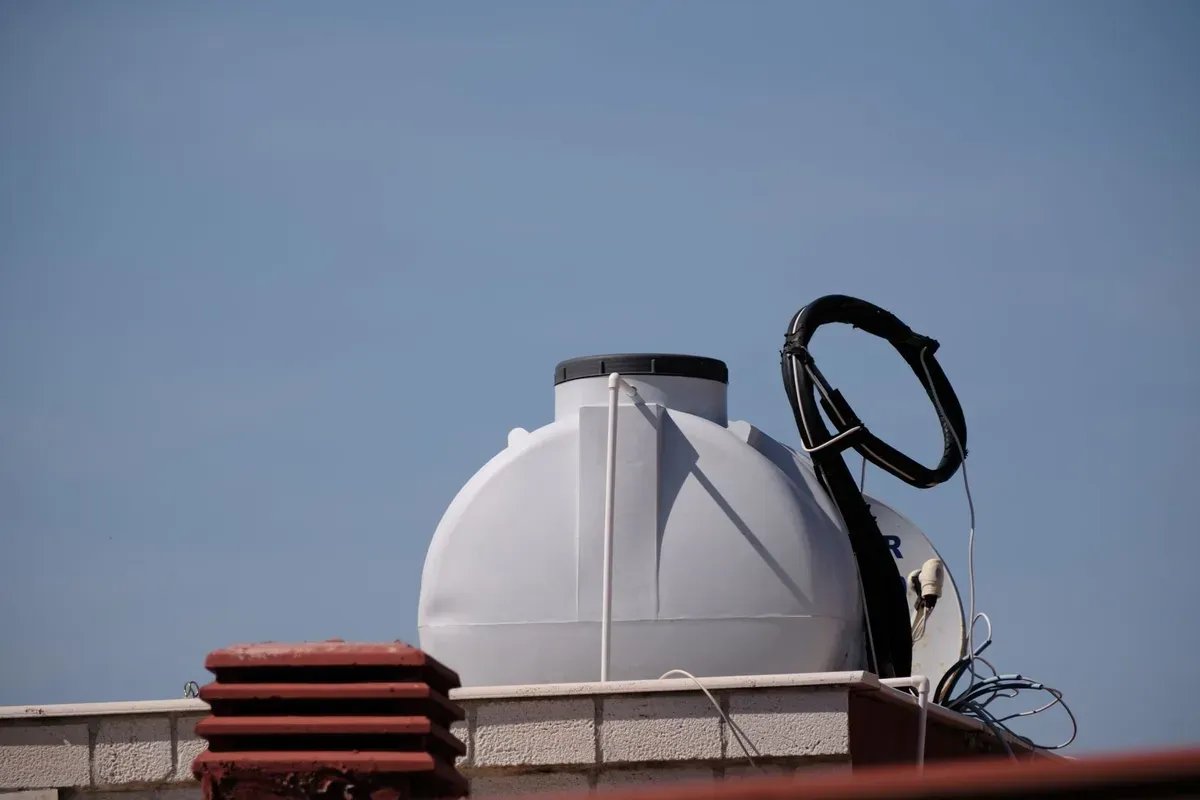
A stripped-back municipal backup system built around a 1,000L slimline tank looks like this on paper:
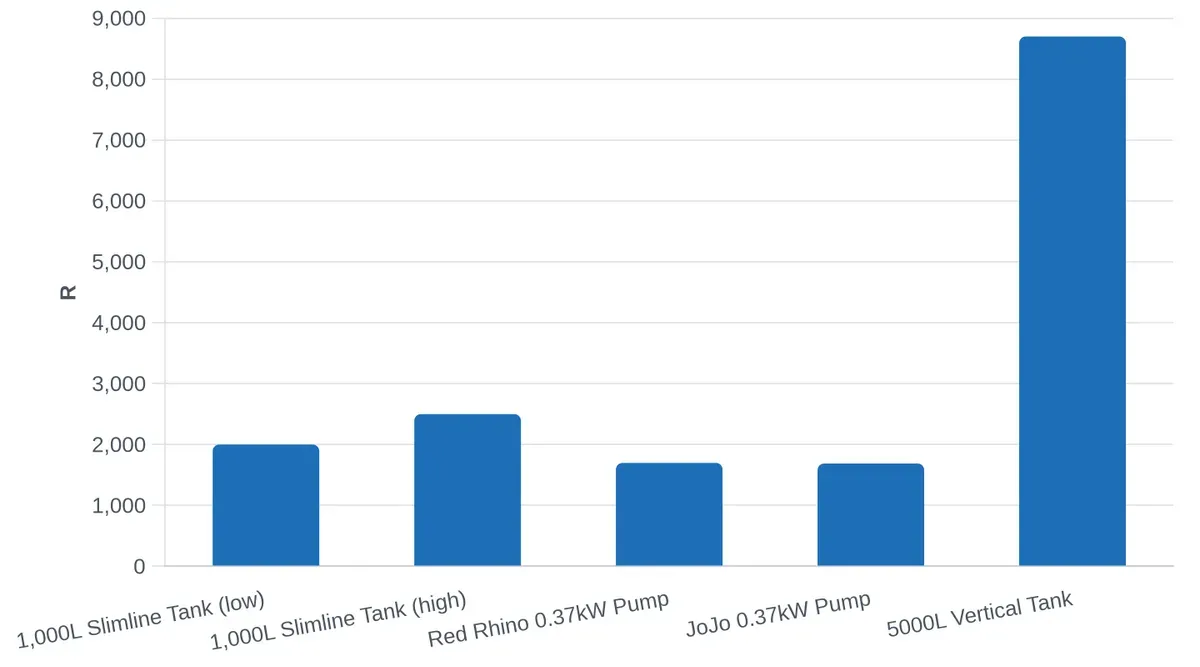
- 1,000L food-grade slimline tank: R2,000 to R2,500 (builders.co.za)
- 0.37kW booster pump (Red Rhino or JoJo equivalent): R1,689 to R1,699 (brights.co.za / jojo.co.za)
- Basic plumbing, fittings and labour: variable, often quoted at R2,500 to R3,000 by small operators
Add those up and you land somewhere near R6,850 at the low end. The problem is what that figure excludes.
“Annie said it was only a quote and it excluded the pump. Oke wanted another R4500 for pump… She was just shocked by the quote.”
Fanie’s experience is more common than installers would like to admit. The R7,000 headline price almost always strips out the pump, the backflow preventer, the electrical certificate of compliance (CoC), and the plumber’s sign-off. A genuinely compliant system, one you can legally connect to your home’s internal plumbing, costs between R20,000 and R35,000 fully installed (waterpointsa.co.za). That is the honest number to plan around.
The legal compliance layer alone adds meaningful cost. The City of Cape Town requires an RPZ (Reduced Pressure Zone) backflow preventer valve to stop any backup water from contaminating the municipal supply. These valves range from R3,963 to R12,586 depending on specification.
“Started to explore Reduced Pressure Zone (RPZ) Backflow Preventer Valves. Found one online: Protection to category 4 contamination risks R 3,963.84 Not cheap…”
“Something that was emphasized at the CTICC today was the importance of installing a backflow prevention device… The only device that the City will accept is the RPZ valve. Firstly, I am unable to find these valves on the shelf of any supply store…”
An electrical CoC for the pump installation adds approximately R5,500. Then there is the question of what happens when the municipal supply drops in pressure and cannot refill your roof tank naturally.
“Each vertical stack of flats… has a roof water tank… The tanks can only be refilled if the town mains pressure is enough to reach that particular tank.”
For mid-rise buildings on the Atlantic Seaboard and in Fresnaye or De Waterkant, this is not a theoretical concern. If municipal pressure drops during a planned maintenance outage or an emergency shutoff, a tank that relies on gravity refill from the mains may never top up when you need it most.
What you actually get for R7,000 on the wellpoint side
A wellpoint is a shallow suction well, typically between 3 and 10 metres deep, that taps the unconfined water table sitting just below the surface. In the right sub-area of Cape Town, specifically the Cape Flats, parts of the Southern Suburbs and the False Bay coastline, a wellpoint can yield meaningful volumes of water at very low ongoing cost.
A basic wellpoint kit including a 1.1kW pump, screen casing and basic fitting runs around R7,000 to R10,000 installed by a competent operator. The critical word there is “competent,” because the Atlantic Seaboard and City Bowl present a specific geological challenge. As WaterQuotes explains in their Cape Town borehole compliance guide, registration and compliance requirements exist precisely because groundwater abstraction here is not straightforward.
“Soil is very compact with a clay layer. It’s going slow now as there are a lot of rocks that we have to get out… Typically water is found once you hit rocks and clay layer, which traps water. When they drill for a ‘borehole’… they drill until they hit the bedrock layer where water gets trapped.”
The DWS data for the Table Bay District is sobering: the western coastal aquifer has a very low median yield of up to 0.1 litres per second (dws.gov.za). At 0.1 litres per second, you are drawing a maximum of 360 litres per hour under ideal conditions. For irrigation of a garden or topping a pool that is adequate, but it will not sustain a household’s full daily needs without careful management.
Contrast that with experience from better-yielding pockets of Cape Town:
“I haven’t yet run the well dry. I’ve ran it once for 8 hours straight to fill up my pool and the pump cannot pump out the water faster than it fills in. That is about 30kl in 8 hours. Pump can run at 60l per minute.”
That kind of yield is not realistic everywhere. Before you commission a wellpoint in Camps Bay, Sea Point or the City Bowl, you need a hydro-geological assessment, not just a driller’s optimistic estimate.
The Atlantic Seaboard corrosion problem: both systems are affected
Salt air accelerates material degradation on both sides of this comparison, but the failure modes are different and the mitigations are specific.
For backup tank systems, marine-grade fittings are required on the Atlantic Seaboard due to salt-air corrosion (thermoelec.co.za). Standard brass compression fittings and exposed mild-steel pump housings will fail within two to four seasons. Budget the marine-grade upgrade into your initial cost.
The DAB Divertron is one pump that largely sidesteps the salt-air problem by sitting submerged inside the tank itself (dabpumps.co.za). A pump that lives underwater cannot be reached by airborne salt. For properties within 500 metres of the Atlantic shoreline, a submersible pump mounted inside the tank is worth the price premium over a surface-mounted unit.
For wellpoints, the corrosion risk shifts to the rising main and the above-ground pump housing. The MyBroadband community has documented this failure mode repeatedly:
“Different pumps have different pressure and litres per minute flow specs. Currently, my wellpoint pump is 1.1kw metabo… I just had a black pipe and galvanise bend sticking out of the ground. There was a rusty pump in the garage.”
A rusted pump is not a cosmetic issue. It is a contamination risk and a mechanical failure waiting to happen. Stainless steel or HDPE risers, enclosed pump housings and annual inspection are the minimum standard for coastal wellpoints.
Compliance requirements: the legal layer neither system escapes
Both systems carry legal obligations in Cape Town that are frequently glossed over by installers focused on making the sale. Here is what the regulations actually require.
For municipal backup tank systems:
- An RPZ backflow preventer valve is mandatory before any connection to the internal plumbing (capetown.gov.za bylaws).
- Connecting a pump directly to the water mains is illegal under most municipal bylaws (maskamwater.com).
- A manual plumbing bypass must be installed to ensure water supply during load-shedding or pump failure (maskamwater.com).
- An electrical CoC is required for the pump installation, at approximately R5,500.
“A lot of municipalities, like the City of Cape Town… you’ll need a non-return valve to prevent any of your backup water from contaminating the municipal supply, and you can get into trouble if caught.”
For wellpoints and boreholes:
- A pre-drilling notice must be submitted to the City of Cape Town at least 14 days before installation (City of Cape Town).
- The borehole must be registered within 30 days of completion (City of Cape Town).
- Domestic abstraction under the National Water Act Schedule 1 is permitted without a licence up to 10,000 litres per day (National Water Act / DWS).
- Irrigation with private groundwater is still prohibited between 09:00 and 18:00 (City of Cape Town By-laws).
- Annual permit cost to register a wellpoint with the City of Cape Town: R0 (capetown.gov.za). The registration is free. The compliance steps have a cost in time and professional fees, but the permit itself carries no annual charge.
Pipe quality: the hidden installation failure
Whether you are plumbing a backup tank or connecting a wellpoint to your garden irrigation, the pipe specification matters more than most installers will tell you upfront.
“Use the blue PVC pipes and not the irrigation black pipes. The black irrigation pipes was what they sold me when I bought my tanks, and those connections with clamps are leaky.”
This is a cost that often appears only after installation, when a leaking connection wastes the stored water you paid to protect. Specify blue pressure-rated UPVC pipe in your quote request and confirm it in writing before work begins.
Pump controller reliability: budget for quality from day one
Electronic pump controllers are the most frequent point of failure in backup systems (mybroadband.co.za). The Cape Town owner community has learnt this the hard way.
“I have a 1K L and 2.5K L tank as muni backup. Best thing ever. Just check the pump controller that comes with the pump. I have been through 2 Ingcos, they are all the same kak with different branding. I have changed to one of the digital ones now.”
Budget at least R800 to R1,200 for a quality digital pressure controller rather than accepting the cheapest bundled unit. Over a five-year ownership period, this single upgrade is likely to save more in call-out fees and emergency repairs than any other specification decision.
Cost-of-ownership comparison table
| Cost item | 1,000L backup tank system | Wellpoint (City Bowl / Atlantic Seaboard) |
|---|---|---|
| Hardware: tank or casing | R2,000 to R2,500 (builders.co.za) | Included in drilling quote |
| Pump | R1,689 to R1,699 (jojo.co.za / brights.co.za) | R2,500 to R4,000 (1.1kW surface pump) |
| RPZ backflow preventer | R3,963 to R12,586 | Not applicable |
| Electrical CoC | Approx. R5,500 | Approx. R5,500 (if pump requires electrical supply) |
| Marine-grade fittings and plumbing | R1,500 to R3,000 (thermoelec.co.za guidance) | R1,000 to R2,500 |
| Drilling and installation | Not applicable | R81,680 average; hard-rock premium 15% to 30% added (boreholeinstallers.co.za) |
| Full installed cost (compliant) | R20,000 to R35,000 (waterpointsa.co.za) | R90,000 to R120,000+ in hard-rock coastal areas |
| Annual permit / registration | R0 | R0 (capetown.gov.za) |
| Annual filter replacements (3-stage) | R895 to R1,200 (thewaterfilterfactory.co.za) | R895 to R1,200 if filtration fitted |
| Annual electricity (0.37kW pump, 2 hours daily, R4.14/kWh, City of Cape Town 2026/2027 domestic tariff) | Approx. R1,100 per year | Approx. R2,700 to R3,300 per year (1.1kW, 2 hours daily) |
| Water source cost per kilolitre | City tariff (metered refill) | R0 per kilolitre from aquifer |
Note: Electricity costs calculated using the City of Cape Town 2026/2027 domestic tariff of R4.14 per kWh for the first 600 kWh. Tank system assumes municipal water fill at prevailing tariff. Wellpoint costs assume Atlantic Seaboard or City Bowl drilling geology with the 15% to 30% hard-rock premium applied.
The 5,000L option: a different conversation
The 1,000L entry-level tank is the comparison point for the headline price, but many Cape Town households, particularly those with gardens or a household of four or more, quickly discover that 1,000L covers roughly two to three days of careful use at best. A premium 5,000L vertical tank currently costs R8,700 in Cape Town (waterpointsa.co.za). That is more than three times the tank cost, but it changes what the system can actually do for you.
“5000L tank with a 0.75kW pump. So enough to sort out the odd glass of water. We never drink out of the taps in the bathrooms.”
Douw’s setup is honest about what a single 5,000L tank delivers: non-potable household use and peace of mind for short outages, not whole-house independence from the grid. If your expectation is full household independence, you need multiple tanks or a consistently yielding wellpoint in the right sub-area.
Ready to see which system is viable at your specific Cape Town address? Check my address and get an assessment based on your street, your water table and your local geology before committing to either option.
When a wellpoint genuinely makes sense in Cape Town
The Day Zero aquifer data from Daily Maverick is often cited as evidence that Cape Town’s groundwater is robust. It is, but that resilience is not evenly distributed. The western coastal aquifer’s median yield of up to 0.1 litres per second (dws.gov.za) means that for many Atlantic Seaboard and City Bowl properties, a wellpoint will yield enough for garden irrigation and car washing, but not enough to replace municipal supply for cooking and bathing.
Where wellpoints have consistently proven their value in Cape Town is in the commercial context and in better-yielding residential pockets, particularly properties with large gardens in areas where the water table is higher and more sustained. Cape Town remains the most resilient metro in South Africa with only an 8% outage rate, which means that for most Atlantic Seaboard homeowners, a well-specified backup tank will handle the realistic risk without the cost and complexity of groundwater extraction.
“Our water we use in the slides is all well point water. It’s off the municipal grid; it’s been off for the last eight, nine years.”
Eight to nine years of continuous commercial operation is compelling evidence for wellpoint viability, but Water World’s site geology and water table depth are not representative of a fourth-floor Sea Point apartment or a City Bowl townhouse on hard rock.
The rainwater harvesting caveat
Some homeowners consider rainwater harvesting as a third option or a complement to either system. In Cape Town, this approach has a specific and well-documented limitation.
“Rainwater harvesting in Cape Town is a waste of time and money, due to the seasonal mismatch between rainfall and demand. Our Body Corporate bought tanks during the Day Zero crisis, but never actually used them…”
Cape Town’s rainfall peaks in winter (June to August) when garden demand is lowest. Summer, the high-demand season for irrigation, is precisely when the city’s Mediterranean climate delivers the least rain. Rainwater harvesting can contribute to non-potable use in winter, but it is not a reliable standalone backup for the Atlantic Seaboard or City Bowl summer.
Structural safety: the plinth question
One compliance and safety issue that rarely appears in installer quotes is the structural requirement for large tank installations. A 5,000L tank holds five tonnes of water. The plinth and supporting ground must be engineered to carry that load.
“I have seen some ‘dodgy’ installations where people don’t take the weight of 5 tons of water in a 5000 liter tank into account, if my neighbour installed his tank against a boundary wall without compacting and building a plinth and that leans on the wall, that wall could collapse and you could have somebody killed.”
Confirm before signing any quote that the installer will provide a compacted concrete plinth sized to the tank capacity. In the Atlantic Seaboard and City Bowl, where properties frequently abut neighbours along shared or close-set boundary walls, this is not optional.
Maintenance realities: what the first two years look like
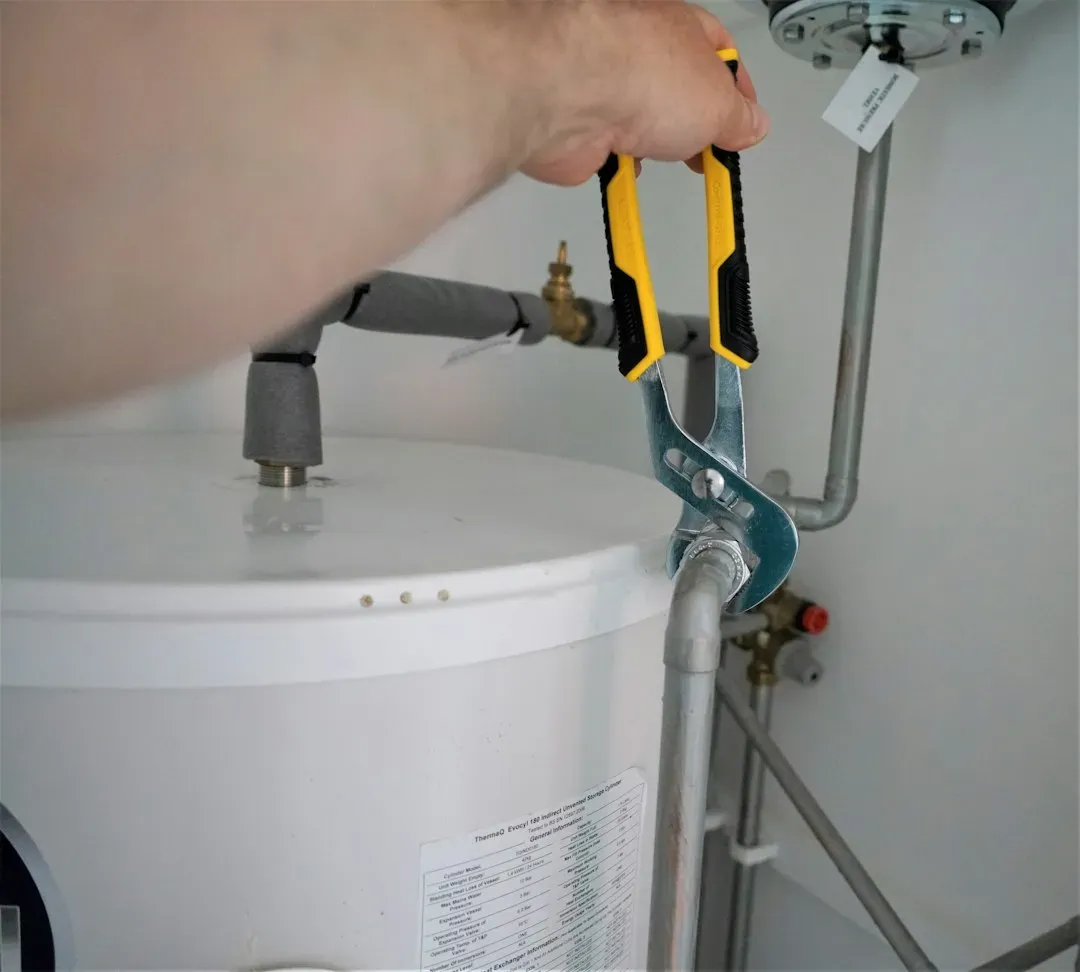
Both systems require active maintenance. The difference is in the character of the maintenance tasks.
For backup tank systems, the primary ongoing tasks are: filter cartridge replacement every six to twelve months at R895 to R1,200 for a 3-stage Big Blue set (thewaterfilterfactory.co.za); pump controller inspection and replacement as needed; and checking for debris ingress after any municipal work in the street.
“Check all your filter screens… When they work on the pipes, all the sand and metal filings… ends up in your screens and it looks like low water pressure but it’s actually low flow.”
For wellpoints, the first-year maintenance task that catches most owners off guard is iron management. Shallow Cape Town aquifers frequently carry dissolved iron that discolours water and stains surfaces.
“We fill our spare wheelie bin with wellpoint water and add a cup of chlorine, let it stand overnight until all the iron and kak settles… the water that comes out is crystal clear.”
Angela’s method works for garden-use water, but if you intend to use wellpoint water inside the home for anything beyond toilet flushing, a dedicated iron-removal filter is required. Factor that into your cost comparison.
The honest verdict by property type
Atlantic Seaboard apartments and smaller freehold properties: A compliant 2,500L to 5,000L municipal backup tank system is almost always the more practical and cost-effective choice. The geology makes wellpoints high-risk and expensive. The R20,000 to R35,000 fully installed cost (waterpointsa.co.za) is the realistic budget, not the R6,850 headline. Specify a DAB Divertron or equivalent submersible pump, marine-grade fittings, a quality RPZ valve and a digital pump controller. Do not accept a quote that excludes the RPZ, CoC or plumber’s sign-off.
City Bowl freehold properties with gardens: Similar logic applies, though properties on the lower slopes with access to the Cape Flats aquifer fringe occasionally yield a viable wellpoint. Require a test bore or hydro-geological report before committing to any drilling. The drilling cost alone averages R81,680 (boreholeinstallers.co.za) before the hard-rock premium of 15% to 30% is added.
Properties on the Cape Flats, Southern Suburbs and False Bay coastline: Wellpoints become genuinely competitive once the aquifer yield supports a sustained draw. The near-zero water cost per kilolitre can justify the higher upfront drilling investment over a five to ten year horizon. Get a yield estimate from a certified hydro-geologist, not just a drilling contractor’s quote, before deciding.
Get accurate pricing for your tank or wellpoint in Cape Town
The one number that changes everything
If you take one figure from this article, make it the fully installed cost, not the hardware price. For a compliant Atlantic Seaboard backup tank system, the honest installed budget is R20,000 to R35,000 (waterpointsa.co.za), covering the RPZ valve, electrical CoC, marine-grade fittings and plumber’s sign-off. For a wellpoint in hard coastal rock, drilling alone averages R81,680 before the 15% to 30% hard-rock premium, pushing the total installed cost to R90,000 to R120,000 or more. The R150 gap at the starting line is irrelevant once those full numbers are on the table.
Ready to see which system is viable at your specific Cape Town address? Check my address and get an assessment based on your street, your water table and your local geology before committing to either option.
Get started
Get accurate pricing for your tank or wellpoint in Cape Town
Vetted local installers · honest advice first
Illustration: waterpointsa.co.za